Apollo 17 Astronauts Saw a Distant Light Flash Twice Per Rotation
First, bright particles drifted past the spacecraft. Then Apollo 17 commander Gene Cernan spotted a distant light, and his crewmate thought he knew what it was.
During Apollo 17, the astronauts saw bright particles near their spacecraft, followed by a distant light that flashed once brightly and once dimly. Schmitt thought the light might have come from a rocket section that had separated, but the transcript does not identify it with certainty.
Excerpts from the Apollo 17 Technical Air-to-Ground Voice Transcription (December 1972) covering three time windows in which the crew described unidentified visual phenomena. Day 0 captures CMP Ron Evans and LMP Jack Schmitt watching swarms of bright tumbling fragments around the spacecraft after S-IVB maneuver; on Day 2, CDR Gene Cernan and Schmitt describe light-flash perceptions during sleep and rotating, rhythmically flashing distant objects (later interpreted by some as the S-IVB and SLA panels) while running an ALFMED experiment; on Day 3, Schmitt reports a bright flash on the lunar surface near the crater Grimaldi and asks Houston to check the seismometers. CAPCOMs include Bob Parker and 'Gordy' (Gordon Fullerton). The document is a verbatim air-to-ground tape transcript and contains no analytic conclusions.
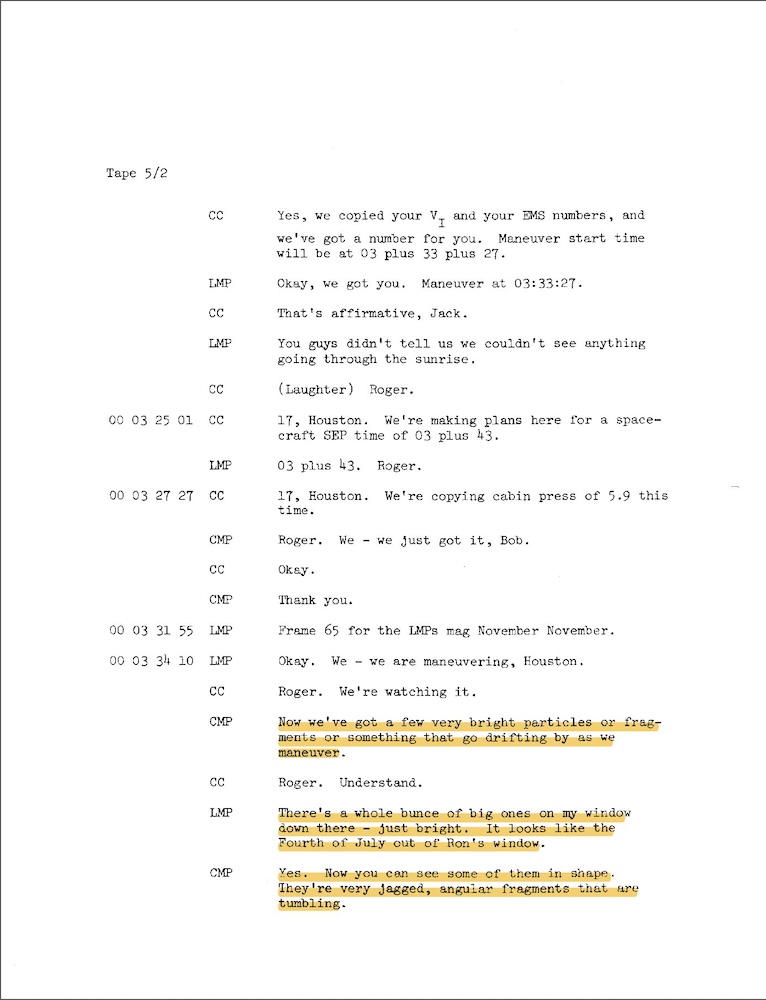
After a maneuver, CMP Evans and LMP Schmitt observe a field of very bright tumbling particles/fragments outside the windows. Schmitt likens it to 'the Fourth of July'. Evans describes them as flat, jagged, angular fragments, some up to 6 inches across, mostly drifting away with very slow tumble; an occasional fragment crosses at considerably higher relative velocity.
During an ALFMED light-flash session, CDR Cernan reports having seen flashes during a prior sleep period: peripheral horizon-type flashes, streaks, and one very bright flash 'right between my eyes like a very bright headlight - like a train coming at you, only with a flash.' He notes he had never seen them before that day.
CMP Evans and CDR Cernan report a distant bright object that is rotating rhythmically and flashing — bright flash followed by dull flash. Cernan emphasizes it is 'definitely not - not one of these particles that tends to look like a star out there. It's something physical in the distance.' Houston requests NOUN 20 attitude data and a window-axis hack to triangulate the object.
CDR Cernan reports two flashing objects out the window, similar in intensity, with regular bright/dim flashes, widely separated. One near the position of the earlier sighting; the other far to the left near the center window.
LMP Schmitt exclaims 'Hey, I just saw a flash on the lunar surface!' just north of Grimaldi. He describes it as 'a bright little flash right out there near that crater' and a 'thin streak of light' near a sharp crater further north. Schmitt suggests CAPCOM check the seismometers in case it was a small impact.
"Now we've got a few very bright particles or fragments or something that go drifting by as we maneuver."
Speaker: CMP (Ron Evans)
Why it matters: First on-tape report of the Day 0 fragment field around the spacecraft.
Page 1
"There's a whole bunce of big ones on my window down there - just bright. It looks like the Fourth of July out of Ron's window."
Speaker: LMP (Jack Schmitt)
Why it matters: Iconic crew description of the Day 0 fragment swarm.
Page 1
"They're very jagged, angular fragments that are tumbling."
Speaker: CMP (Ron Evans)
Why it matters: Direct shape/motion description of unidentified fragments.
Page 1
"My impression is that they are - flat, flakelike particles. Some may be 6 inches across. And, although there's no relative motion between the two, most of them seem to be twinkling. And I think, for the most part, they're all moving away from us."
Speaker: CDR (Gene Cernan)
Why it matters: Most detailed crew characterization of the fragment field.
Page 3
"If you had some kind of a - I got the impression maybe they were curved a little bit, as if they might be - off the side of the S-IVB. And that's a wild guess"
Speaker: CMP (Ron Evans)
Why it matters: Crew's tentative attribution to S-IVB debris, explicitly labeled a 'wild guess'.
Page 2
"the one most imposing thing I remember is - and the last one I remember before falling asleep - was the fact that there was a very bright spot that flashed right between my eyes like a very bright headlight - like a train coming at you, only with a flash."
Speaker: CDR (Gene Cernan)
Why it matters: Vivid description of an ALFMED-context light flash between the eyes during sleep.
Eugene A. Cernan
Commander (CDR) · NASA Apollo 17 · Page 5
Ronald Evans
Command Module Pilot (CMP) · NASA Apollo 17 · Page 1
Harrison 'Jack' Schmitt
Lunar Module Pilot (LMP) · NASA Apollo 17 · Page 1
Bob Parker
CAPCOM · NASA MSC Houston · Page 1
Gordon 'Gordy' Fullerton
CAPCOM · NASA MSC Houston · Page 15
Stu
CAPCOM (referenced) · NASA MSC Houston · Page 5
Moon
Page 14
Grimaldi (crater), Moon
Page 15
Oceanus Procellarum, Moon
Page 14
Mare Marginis, Moon
Page 15
Mare Crisium, Moon
Page 15
Tsiolkovsky (crater), Moon
Page 14
Orientale (basin), Moon
Page 16
Hawaiian Islands, United States
Page 12
Solomon Islands
Page 11
Hickam, United States
Page 13
Verbatim NASA air-to-ground voice transcript covering five distinct UAP-relevant exchanges across three mission days. Speakers identified throughout as CDR (Cernan), CMP (Evans), LMP (Schmitt), and CC/CAPCOM (Bob Parker on Days 0-2; 'Gordy'/Gordon Fullerton on Day 3, with one reference to 'Stu'). All timestamps are Ground Elapsed Time (GET) in DD HH MM SS form. The transcript is a NASA technical document — analytical conclusions about the phenomena are not drawn within the document itself; crew themselves offer multiple candidate identifications (S-IVB debris, ice/paint, SLA panels, ALFMED cosmic-ray-induced retinal flashes, possible lunar impact). Useful pair with the Apollo 17 crew debriefings (slugs 142, 143) and the companion Apollo 12 transcript (slug 138).
The astronauts suggested they might be pieces of ice or paint that had flaked off a rocket section. They did not identify them with certainty.
Schmitt thought it might have been a rocket section that had separated from the spacecraft. The transcript records his suggestion but does not establish what they saw.
Page 5
"I will say one thing, though; no question in my mind but that they're there."
Speaker: CDR (Gene Cernan)
Why it matters: Cernan's emphatic affirmation of the reality of the light-flash phenomena.
Page 6
"It is a - it is a bright object, and it's obviously rotating because it's flashing. It's way out in the distance, as I say, because there are particles that are close by and it's obviously not one of those."
Speaker: CDR (Gene Cernan)
Why it matters: Crew distinguishes the rhythmic-flashing distant object from nearby particles.
Page 7
"I just want to emphasize that it's definitely not - not one of these particles that tends to look like a star out there. It's something physical in the distance."
Speaker: CDR (Gene Cernan)
Why it matters: Cernan explicitly differentiates the object from optical illusion / particles.
Page 8
"One unique thing about it, Bob, is that it's got two flashes. As it comes around in - in rhythmic fashion, you get a very bright flash; and then you get a dull flash. And then it'll come around with a bright flash, and then a dull flash."
Speaker: CDR (Gene Cernan)
Why it matters: Specific signature of distant rhythmic dual-flash object.
Page 9
"That's the side and - of the S-IVB - and then the engine bell, Gene."
Speaker: LMP (Jack Schmitt)
Why it matters: Schmitt's identification of the rotating object as the S-IVB; not accepted by Cernan.
Page 9
"Hey, Bob. We got two of those flashers out there. They could be SLA panels. I don't know. They're alike in intensity and pretty regular in the - in the intensity, bright and dim flashes they come out with, and they're widely separated."
Speaker: CDR (Gene Cernan)
Why it matters: Second sighting of paired distant flashing objects, tentative SLA-panel attribution.
Page 11
"Hey, I just saw a flash on the lunar surface!"
Speaker: LMP (Jack Schmitt)
Why it matters: Schmitt's real-time exclamation of the lunar-surface flash near Grimaldi.
Page 15
"It was just out there north of Grimaldi. Just north of Grimaldi. You might see if you got anything on your seismometers, although a small impact probably would give a fair amount of visible light."
Speaker: LMP (Jack Schmitt)
Why it matters: Schmitt suggests cross-check with deployed lunar seismometers — possible meteoroid impact.
Page 15
"It was a bright little flash right out there near that crater. See the crater right at the edge of Grimaldi. Then there is another one north of it. Fairly sharp one north of it is where there was just a thin streak of light."
Speaker: LMP (Jack Schmitt)
Why it matters: Detailed location description of the lunar-surface flash and a secondary 'thin streak of light'.
Page 15
Apollo 17 Command/Service Module
spacecraft · Page 1
S-IVB (Saturn V third stage)
spacecraft · Page 2
ALFMED (Apollo Light Flash Moving Emulsion Detector)
sensor · Page 6
Lunar surface seismometers
sensor · Page 15
SLA panels (Spacecraft/LM Adapter)
spacecraft · Page 11
As Apollo 17 changed direction on its way to the Moon, Ronald Evans saw bright particles pass by the window. Jack Schmitt said they looked like fireworks.
Later in the mission, Gene Cernan spotted a distant light that flashed repeatedly. Cernan thought it was a physical object in space, and Schmitt offered a possible explanation: It might have been a large section of the rocket that had separated from the spacecraft. But exactly what the astronauts saw remains unclear.
Evans described bright particles floating near the spacecraft as it changed direction. Some were angular, tumbled slowly, and looked like pieces of something. Cernan described flat particles and said most seemed to be moving away from the spacecraft.
The crew speculated that the particles might be pieces of ice or paint that had flaked off a rocket section. Evans stressed that this was only a guess. He also occasionally noticed a particle passing the window faster than the others.
On another day of the mission, Cernan said he had seen a bright light flash in front of his eyes, like a train headlight. He also described other flashing lights. One of them, he said, seemed too distant to be particles floating near the spacecraft.
Cernan described the distant light as a rotating object, its flashes returning at a steady pace. With each rotation came a bright flash followed by a dim one. Schmitt saw a similar light and thought it might be a section of the rocket that had separated. He said its brightness changed as he watched it.
Schmitt suggested that the distant light came from a rocket stage that had separated from the spacecraft. Cernan also described two other distant lights and thought they might be panels that had detached from the rocket. The conversation transcript records these suggestions but does not identify the lights or particles with certainty.
The crew saw a bright flash, then a dim one. In the darkness of space, the lights flashed again and again.