Official · Document · NASA
Apollo 12 Astronaut Wondered If Particles Were Escaping the Moon
Alan Bean saw flashes and particles streaking through space. Hours later, fragments floated near the spacecraft—and the light that illuminated them went out.
Alan Bean saw flashes and particles streaking through space. Hours later, fragments floated near the spacecraft—and the light that illuminated them went out.
Alan Bean saw flashes and particles in space near the Moon and wondered whether they were escaping from it. Hours later, the crew spotted floating fragments, and the light illuminating them went out.
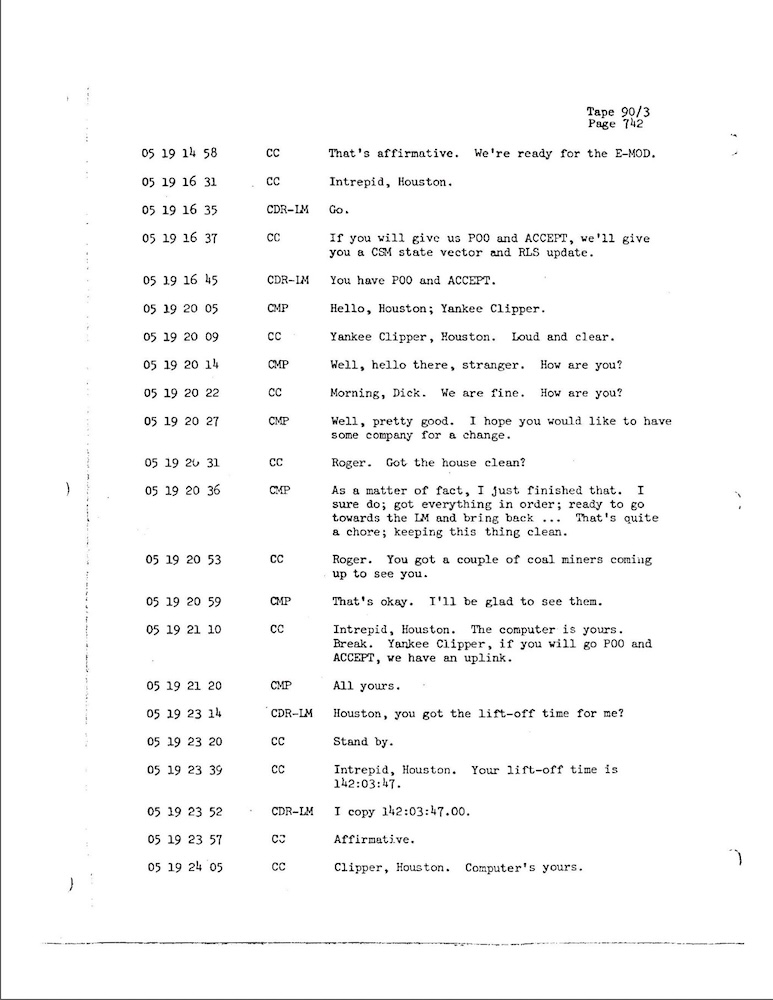
Excerpt from the Apollo 12 Technical Air-to-Ground Voice Transcription (November 1969) covering two periods of crew observations of unexplained visual phenomena while in lunar orbit. In the first segment (GET 05:19:27:25), LMP Alan Bean reports through the Alignment Optical Telescope (AOT) seeing flashes/particles of light that appear to be 'escaping the Moon' and pressing off toward the stars. In the second segment (GET 06:00:21:51 onward), CDR Pete Conrad reports the LM tracking light appears burned out because debris/'bits and pieces' floating along with the spacecraft are no longer being illuminated, though Houston's electrical telemetry indicates the tracking light is still drawing current. The document is a verbatim air-to-ground voice transcript between Intrepid (LM), Yankee Clipper (CSM), and Houston (CapCom).
LMP Alan Bean reports that while looking through the Alignment Optical Telescope (AOT) into the dark quadrant (quadrant 1, left), he sees particles or flashes of light coming from behind him on the left and 'sailing off in space.' He initially considers that they may be droplets from his water boiler but says some of them appear to be 'escaping the Moon' and 'press off at the stars.' Houston acknowledges with a 'Roger' but offers no explanation in the excerpt.
CMP Dick Gordon reports he cannot see Intrepid's blinking tracking light in his sextant. CDR Pete Conrad responds that on the first nightside pass they had 'little bits and pieces floating along with us' and could see the tracking light flashing on them; he says they still have bits and pieces floating along but nothing is flashing on them, so he believes the tracking light has burned out. Houston's electrical watchers then report that current telemetry indicates the tracking light is still on, even though Conrad reports they have just turned it off. Gordon says he still cannot see it.
"When you look out the AOT in the dark quadrant? You can see these lights - particles of light. flash~s of light just seem to come from - in this case, I'm looking in quadrant 1 which is the left one. It's coming :from behind me, the left, and they're just sailing off in space. I was thinking they're dropping from my water boiler. but it looks like some of those things are escaping the Moon. They really haul out of here and just press off at the stars."
Speaker: LMP-LM (Alan Bean), GET 05 19 27 25
Why it matters: Primary first-person crew description of unidentified luminous particles observed via the AOT; crew explicitly entertains and partially rejects the water-boiler explanation.
Page 2
"Hey, Houston. It looks like our tracking llght's burned out. Dick hasn't been able to find us in this sextant. And on the first nightside pass we had little bits and pieces floating along vith us and we could tell that the tracking light va.; flashing on them. And we still have, I've presumed to think, bits and pieces floating along and nothing's flashing on them, so I'm pretty sure it burned out."
Speaker: CDR-LM (Pete Conrad), GET 06 00 21 51
Why it matters: Establishes that 'bits and pieces' were observed floating with the LM and that the tracking light was previously seen flashing off them.
Page 4
"Roger, Pete. Our electrical watchers say that the current indicates that your tracking light is on."
Speaker: CC (CapCom Houston), GET 06 00 23 11
Why it matters: Telemetry-vs-observation discrepancy: ground says tracking light is drawing current while the crew says it appears burned out and has just turned it off.
Page 4
"Okay. Now ve just turned it off. How does the current show that?"
Speaker: CDR-LM (Pete Conrad), GET 06 00 23 19
Why it matters: Crew direct challenge to the telemetry reading.
Page 4
"You're - they're - You're flying thr0ugh the air b~ckward3, then, Pete, because I don't see it."
Charles "Pete" Conrad
Commander (CDR), Lunar Module Intrepid · NASA Apollo 12
Richard "Dick" Gordon
Command Module Pilot (CMP), Yankee Clipper · NASA Apollo 12
Alan L. Bean
Lunar Module Pilot (LMP), Intrepid · NASA Apollo 12
Jerry
Mentioned by CMP (likely CapCom/MOCR) · NASA Houston · Page 2
Fredo
Engineer present in MOCR during DEDA discussion · NASA / contractor · Page 3
Moon (lunar orbit)
Page 2
Intrepid (Apollo 12 Lunar Module)
spacecraft · Page 1
Yankee Clipper (Apollo 12 Command and Service Module)
spacecraft · Page 1
Alignment Optical Telescope (AOT)
sensor · Page 2
LM tracking light
sensor · Page 4
CSM sextant
sensor · Page 4
Abort Guidance System (AGS) / DEDA
sensor · Page 3
Document is a NASA-released excerpt of the Apollo 12 Technical Air-to-Ground Voice Transcription, Tape 90 and Tape 93, pages 742-743, 748, 778. Speakers are tagged in the source as CC (CapCom), CDR-LM (Conrad), LMP-LM (Bean), CMP (Gordon). GET timestamps are in the form DD HH MM SS at left margin. Two distinct unidentified-phenomenon discussions: (1) AOT light-particles by Bean at GET 05:19:27:25, (2) tracking-light/debris/telemetry mismatch by Conrad/Gordon/Houston at GET 06:00:21:42-06:00:23:33. A third anomaly (DEDA all-8s pulsing) is in the excerpt but Houston attributes it to EMI; included under anomalies because the document preserves it as part of the UAP-related selection. Pair with 139-nasa-uap-d2-apollo-17-transcript-1972 in any NASA Apollo cluster report.
He saw flashes of light and particles moving through space. He wondered whether they were falling from a water device aboard the spacecraft, but did not identify them.
Bean suggested that the particles might have come from the spacecraft’s water device. The transcript does not confirm this or offer an explanation for the floating fragments.
Speaker: CMP (Dick Gordon), GET 06 00 23 26
Why it matters: CMP confirms he still cannot visually acquire the LM tracking light from the CSM.
Page 4
"Fredo is here. He and I have both seen that phenomena on your DEDA during t estin:', of most a.11 the spacecrafts up at Bethpage, and it's probably an EMI."
Speaker: CC (CapCom Houston), GET 05 20 11 56
Why it matters: Houston attributes a separate anomaly (pulsing all-8s on the AGS DEDA display) to electromagnetic interference seen during ground testing at Bethpage; included as it shows the ground's pattern of explaining unusual onboard observations.
Page 3
Alan Bean peered through a small telescope aboard Apollo 12. On the Moon’s dark side, he saw flashes of light and particles drifting through space.
The particles seemed to emerge from behind the spacecraft and fly toward the stars. Bean wondered whether they were falling from a water device aboard the spacecraft, but said some appeared to be escaping from the Moon. Hours later, the crew saw fragments floating near the spacecraft, and the light illuminating them became a mystery of its own.
Bean described what he saw in a radio conversation with Mission Control. Looking through the telescope at the Moon’s dark side, he saw points of light and particles moving through space. They came from behind him, he said, and continued at speed toward the stars.
Bean suggested the particles might be falling from the spacecraft’s water device. But some looked as if they were leaving the Moon. He did not say they were a large object or a spacecraft, and he could not explain what he had seen.
Several hours later, mission commander Charles Conrad reported small fragments floating outside the spacecraft. During an earlier pass, the spacecraft’s tracking light had flashed on them. The light was meant to help identify the spacecraft.
On the next pass, Conrad could no longer see the fragments lit up. He thought the tracking light had burned out. But Mission Control said an electrical check showed it was still working.
Conrad replied that he had just turned the light off. Mission Control checked again, and this time the test showed the light was off. That ended the conversation about the light; the fragments remained outside the spacecraft.
The transcript does not identify the particles, flashes, or floating fragments. The water device is the only ordinary explanation mentioned, but Bean did not say it was the source of the particles. The source material offers no later explanation for the sightings.
Bean saw points of light disappear toward the stars. No one in the conversation could say where they came from.