Pilots and Radar Saw Things the Air Force Couldn’t Explain
In 1952, an American general said pilot and radar reports had left the phenomenon a mystery.
In 1952, General Sanford said radar reports and pilot sightings made it impossible to dismiss every report as a malfunction. To him, the phenomenon remained a mystery.
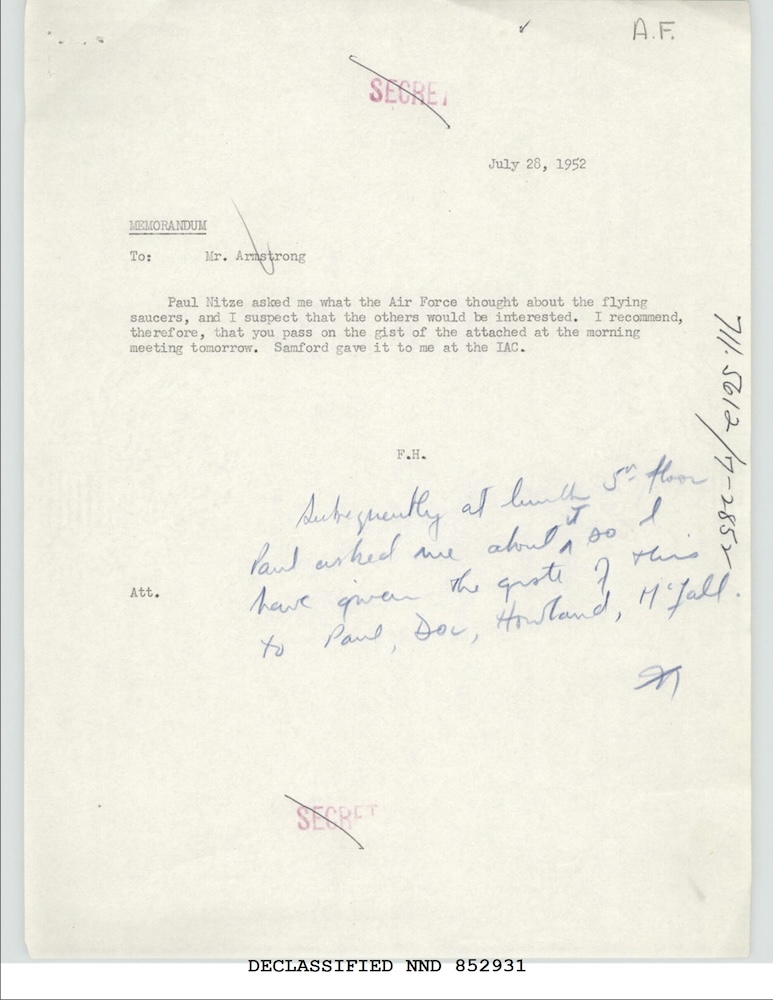
A two-page Department of State internal memorandum dated July 28, 1952, conveying U.S. Air Force views on flying saucers. The cover note records that Paul Nitze asked what the Air Force thought, and that General Samford provided the substance at the Intelligence Advisory Committee (IAC), to be passed along at a morning meeting. The attached memo reports Samford's assessment that flying saucers remain a complete enigma, that similar phenomena have reportedly been observed for over 100 years, and that the increase in sightings is mainly attributable to improved observation and reporting methods plus publicity.
"Paul Nitze asked me what the Air Force thought about the flying saucers, and I suspect that the others would be interested."
Why it matters: Documents the origin of the inquiry and senior State Department interest in the Air Force position.
Page 1
"there is very little that can be said to clarify the flying saucer business: It is still a complete enigma."
Speaker: General Samford
Why it matters: Official Air Force characterization of flying saucers as unexplained as of July 1952.
Page 2
"phenomena falling within the general description of flying saucers have actually been known to exist and have been reported one way or another for over 100 years."
Speaker: General Samford
Why it matters: Asserts a century-long history of such reports.
Page 2
"There is no question, according to Samford, that "credible observers are reporting the incredible.""
Speaker: General Samford
Why it matters: Frequently cited official acknowledgment that reliable witnesses were reporting inexplicable phenomena.
Page 2
"The radar observation may have elements of "electronic fluke," but is sufficiently tied in with pilot observation so that it cannot be attributed entirely to this."
Speaker: General Samford
Why it matters: Notes corroboration between radar and pilot observations, ruling out radar error as a full explanation.
Page 2
"The Air Force views the flying saucers as a threat only because they are not understood and they are sufficiently frequent as a phenomena to mean that they will give great attention to them until they understand them."
Speaker: General Samford
Why it matters: States the Air Force's rationale for treating the phenomena as a threat.
Page 2
Paul Nitze
asked what the Air Force thought about flying saucers · Department of State · Page 1
Armstrong
addressee of the cover memorandum ("Mr. Armstrong") · Page 1
General Samford
provided the Air Force assessment of flying saucers; gave it at the IAC · U.S. Air Force · Page 1
radar
radar · Page 2
Dated July 28, 1952, coinciding with the Washington National Airport radar-visual sightings and Gen. John A. Samford's press conference of that period. Cover note initialed; attached substantive memo initialed "F.H." Declassified NND 852931. OCR is moderately garbled (e.g., 'Jir. A~rong' for Mr. Armstrong, 'r.a..' / 'tfM\.' for initials); names inferred from context.
General Sanford of the US Air Force.
A system that detects objects using radio waves.
No. He said the phenomenon remained a mystery.
A State Department official asked the Air Force what it thought about flying saucers. A general named Sanford replied, and his response was presented at a meeting the next day.
Sanford offered no explanation. He said flying saucers remained a complete mystery. What made it difficult for the Air Force to dismiss the reports as mistakes was the combination of radar reports and pilot sightings.
Sanford said phenomena described as flying saucers had been reported for more than a century. He thought the increase in reports was due, in part, to improvements in how people observed and reported them.
One way people detected these phenomena was with radar, a system that uses radio waves to identify objects. Civilian and military pilots alike could report what they saw. Greater publicity surrounding the subject also contributed to the rise in reports.
Sanford acknowledged that some radar sightings might have been caused by malfunctions. But he said they were also consistent with pilot reports. He did not specify whether the pilots had seen the same objects that appeared on radar or different phenomena. In his view, the connection between the two kinds of reports made it impossible to attribute them all to malfunctions.
He described the people making the reports as reliable witnesses who recounted things that were hard to believe. As he put it: “Reliable observers report the unbelievable.” The Air Force saw the phenomenon as a cause for concern because it did not understand it. Sanford said the service would therefore continue to monitor and investigate the reports until it understood them.
The document does not explain what caused the sightings or specify what the pilots saw. It suggests that better ways of observing and reporting, along with greater publicity, contributed to the rise in reports.
The general could not say what was behind the reports. But he knew what to do: keep investigating.