479 records the US government has released on unidentified anomalous phenomena: Project Blue Book files, AARO reports, FBI investigations, infrared footage and audio. Every record gets an article: what's in it, what's weird about it, and what's still unsolved.
The frame that sent the FBI knocking on AARO's door
What we're looking at
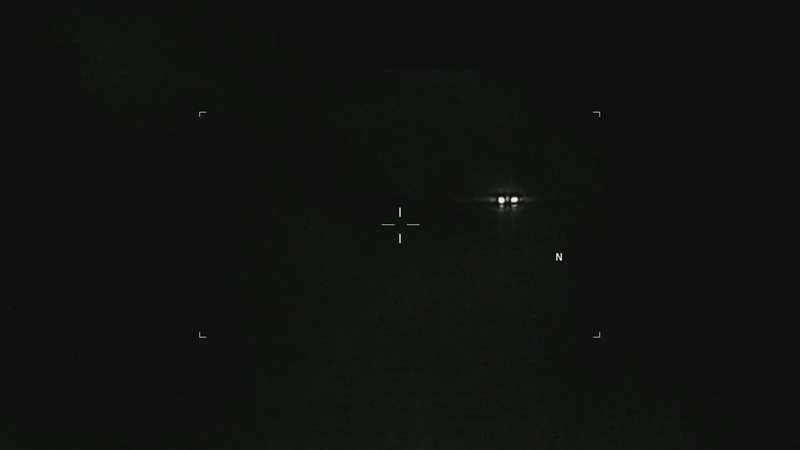
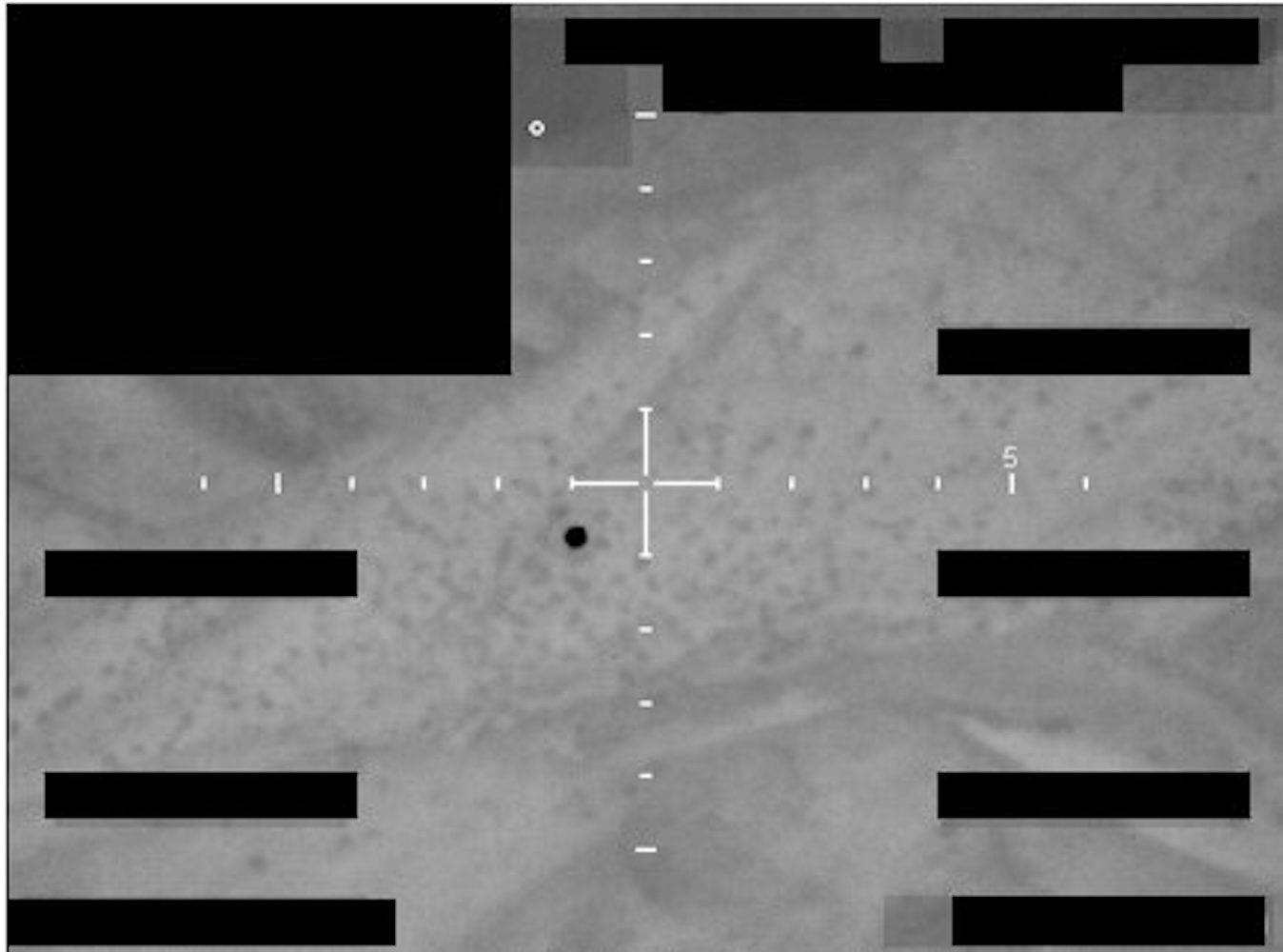
The first of eight frames the FBI handed to AARO in 2025. Dead center in the crosshairs: a small, dark, irregular shape. The professional operator who captured it, someone trained to tell aircraft, drones, birds and balloons apart, couldn't classify it. That's exactly why the image was passed up the chain instead of gathering dust in an internal archive. When a civilian investigative agency concludes it can't close a case on its own, that is a UAP in the fullest sense of the word.
The open question
The FBI doesn't call in outside help for nothing. What was it about this shape that made someone inside a serious institution decide it needed an investigation beyond their own walls?
Top-down view: a shape that matches nothing in the sky
What we're looking at
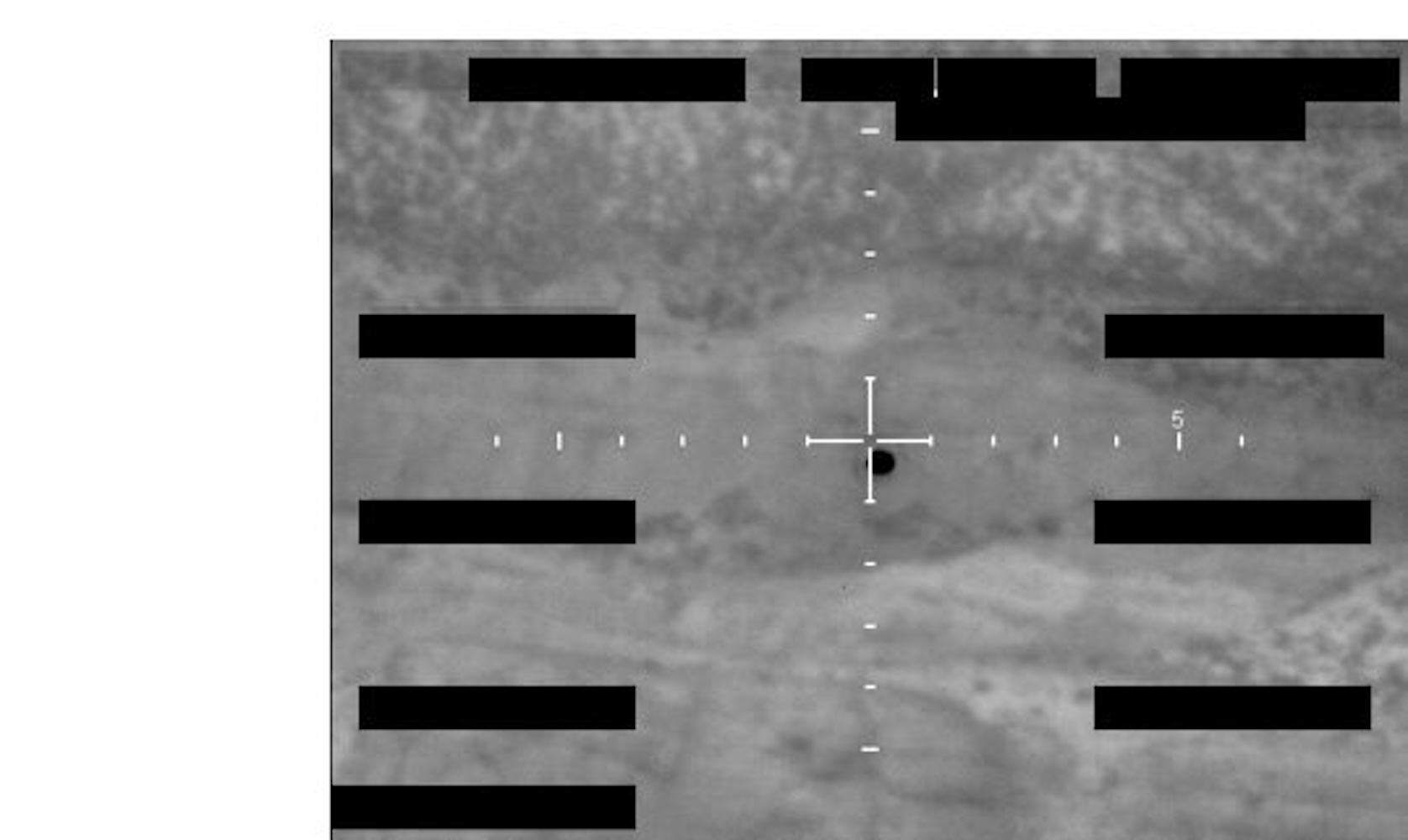
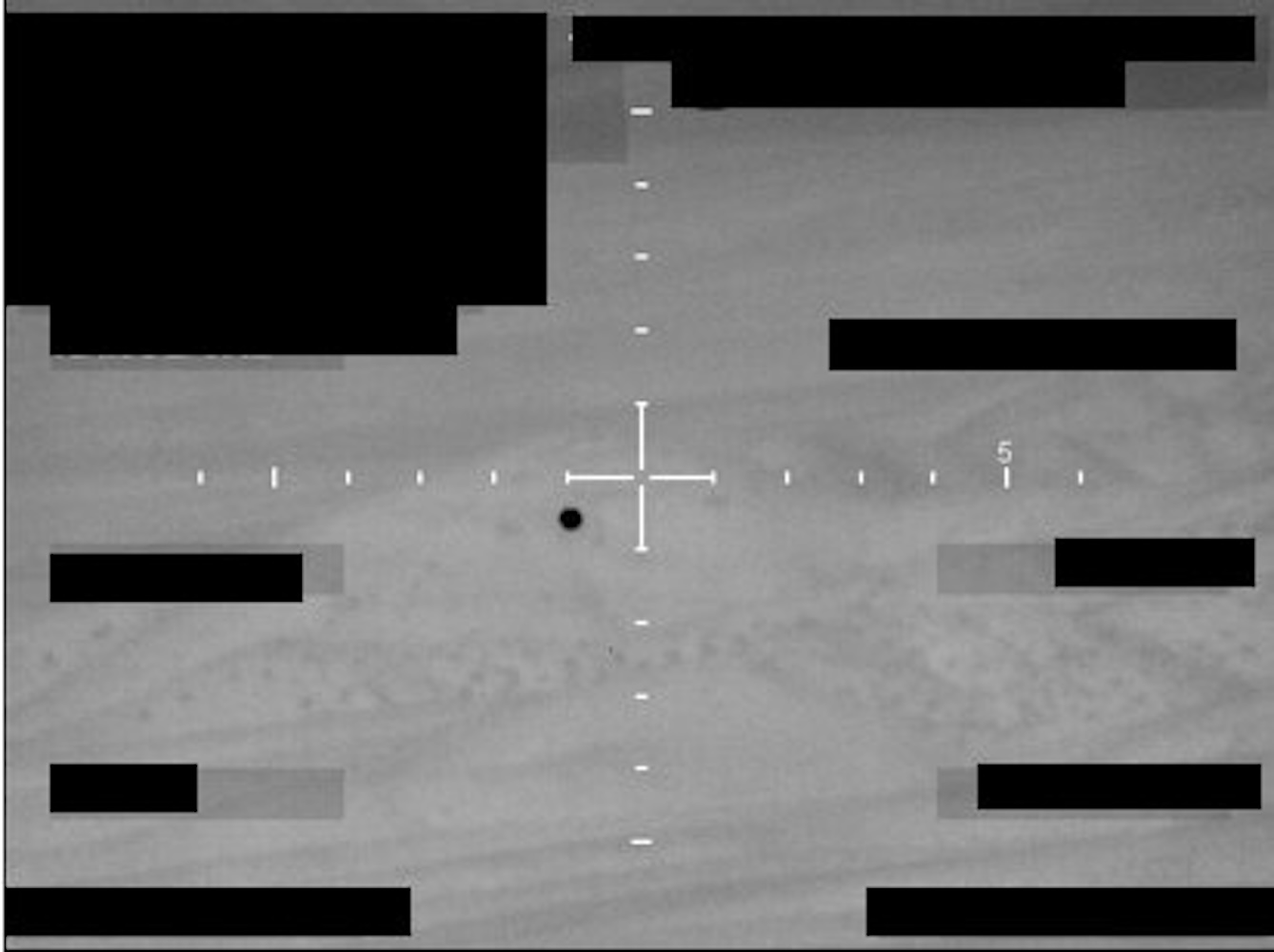
Same setup, second frame. A top-down view of terrain with a vegetation pattern. The horizontal scale reads '5', a hint that this is frame 5 of an internal sequence longer than what was released. The blunt shape stays locked in the crosshairs. Anything passing over terrain like this should be identified within seconds by speed, altitude and signature. Not here. And the frames before and after suggest it stayed put long enough for the operator to track it.
The open question
If the shape matches no known airborne profile (not a plane, not a drone, not a balloon, not a bird, not a missile), how are we supposed to classify it? What category is missing from our dictionary?
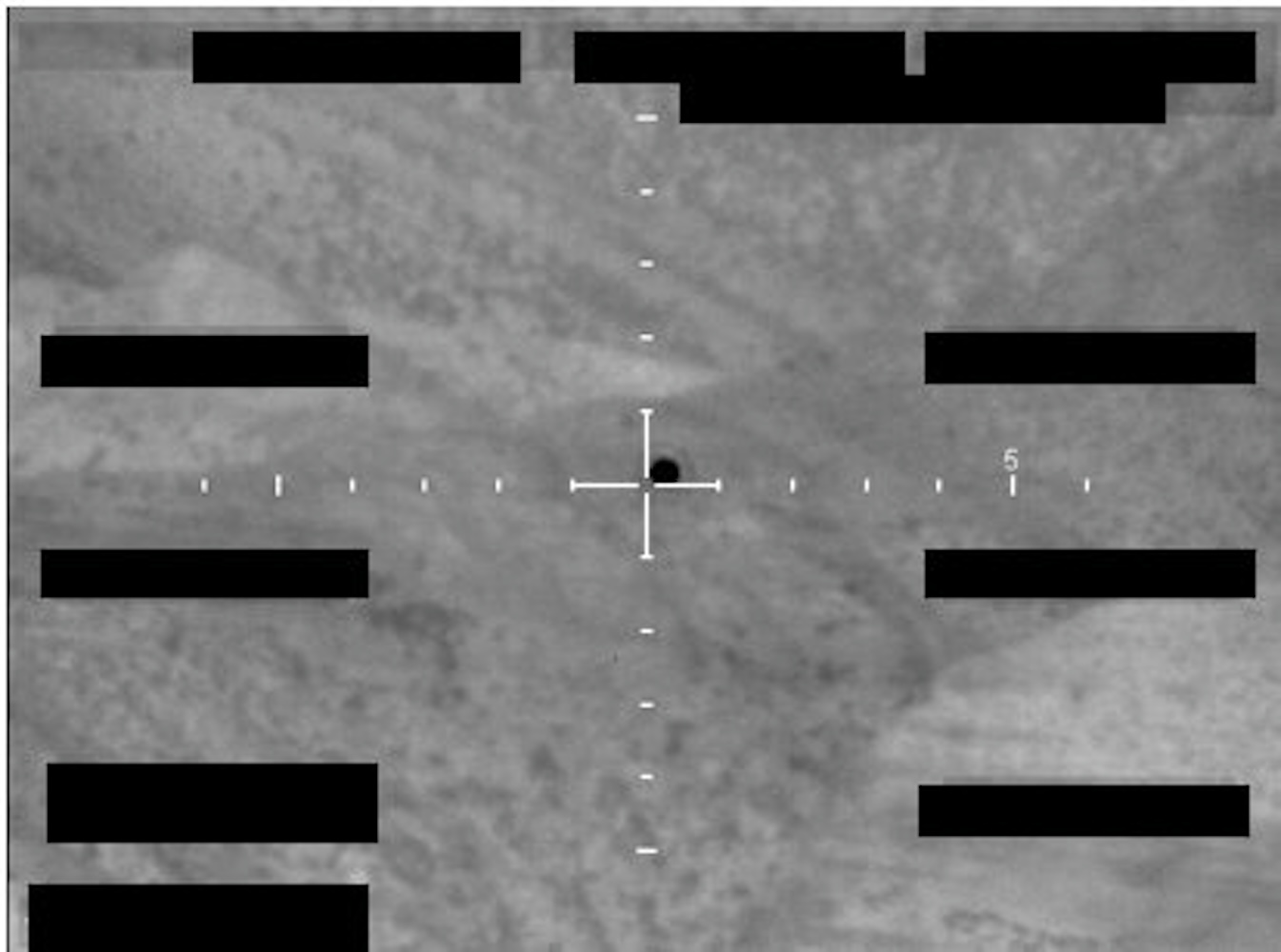
Frame three. The dark shape sits precisely on the crosshair's intersection, a sign the operator managed to track it long enough to aim right at it. Something you can follow across multiple frames isn't sensor noise, a passing reflection or a bug splat on the lens. It's a stable presence in space. Planes, drones and missiles do that too, but they all come with known radar signatures and altitudes. Here, there's no such ID.
The open question
A military tracking system could follow it but couldn't identify it. An object consistent enough to hold a track, yet unfamiliar enough to fit no category: what is it?
White redaction: hiding the context, not the object
What we're looking at
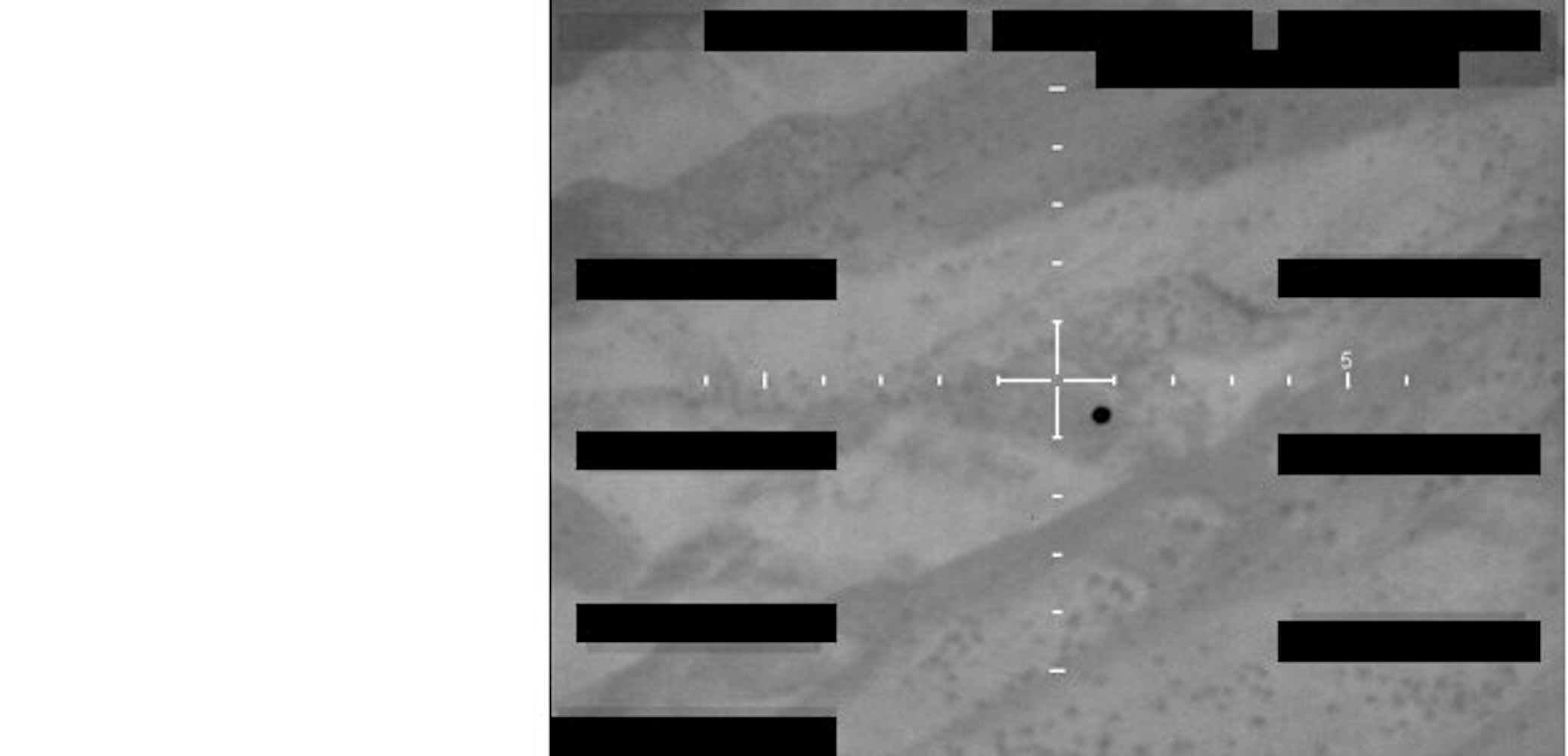
Same dark shape, same angle. But this time the entire left half of the screen is covered by a single, solid white mask rather than the rows of redaction boxes seen in the rest of the series. Most likely it hides details of the military system, the sensor or the location. Choosing to cover the context while leaving the object fully visible is a statement: the FBI and AARO want the public to see what they couldn't identify, not the platform that filmed it.
The open question
When a government hides the sensor but leaves the object in plain view, it's asking us to investigate one specific thing. What does that say about what it thinks we saw?
A 'target under track' marker: the system caught something odd
What we're looking at
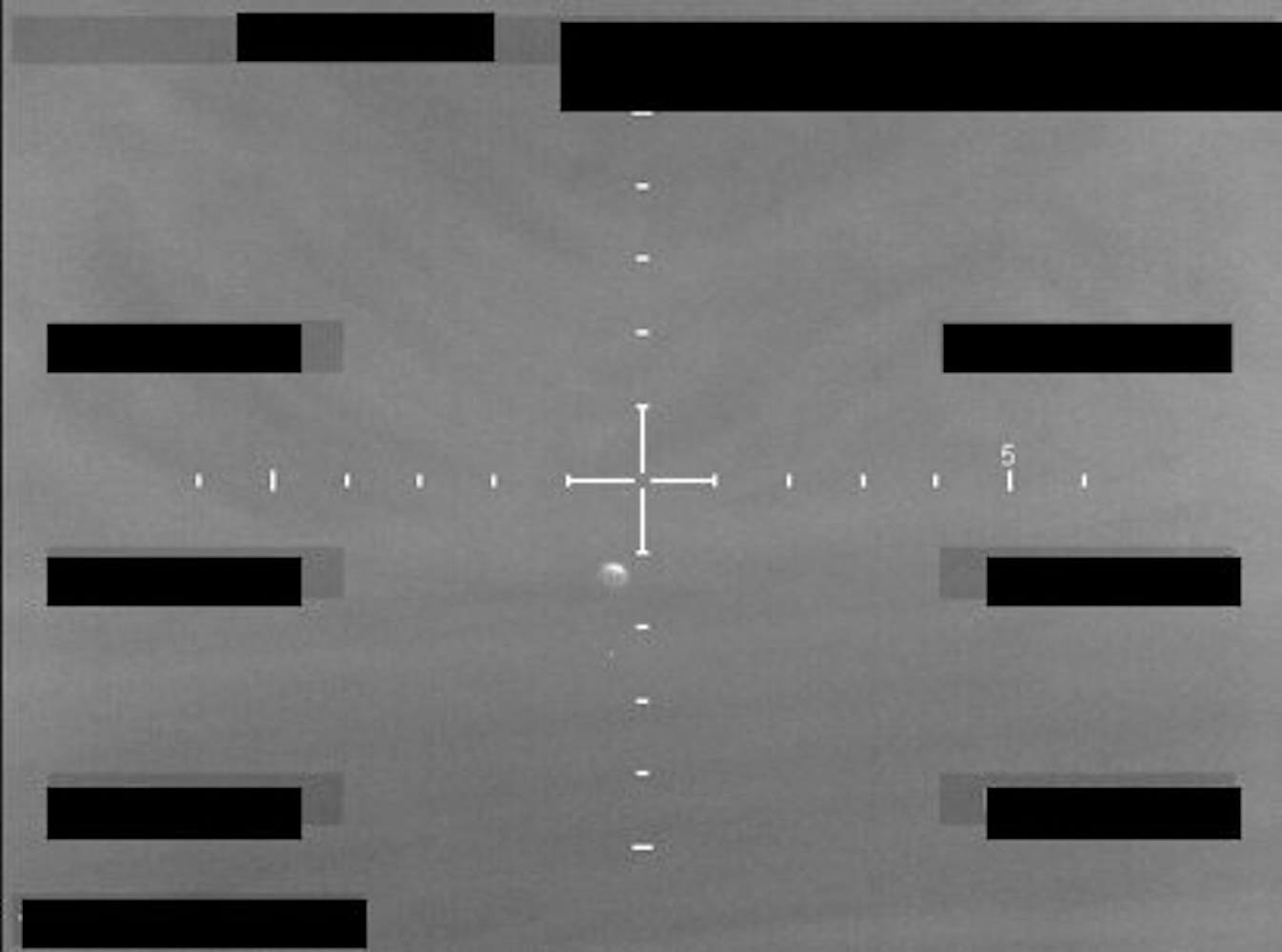
A top-down view of grainy terrain. This time, alongside the dark shape, there's a round white dot above the crosshairs. On modern military sensors, a white dot like that is often an automatic 'target under track' marker, meaning the algorithm flagged the shape as worth the system's attention. So it wasn't just the human operator who thought something was off; the machine did too. In modern UAP classification, a combined 'human + sensor' experience where neither can make an ID is the standard.
The open question
When both the operator and the automated system agree something doesn't fit, but nobody can say what it is, what's missing from our database?
On the horizon: civilian altitude, still unidentified
What we're looking at
The only frame in the series with a clear horizon. Ground below, sky above, and the dark shape sitting right on the horizon line. That puts it in the air somewhere between the ground and civilian-commercial altitude, exactly the zone where planes, drones and weather balloons should be identified within seconds. It's the most closely watched slice of US airspace. If something is up there without being identified, either the detection systems missed it or it doesn't fit any category in the database.
The open question
Something flying at our standard altitudes should be the easiest thing to identify. What lets an object at 'home altitude' stay unidentified even to the FBI's experienced machinery?
An object that suddenly flares: not something our skies usually do
What we're looking at
Same angle, same sensor, same series, but the object that has been dark until now shows up bright, with a glint (a specular highlight). In other words, its surface was reflecting light at that exact moment. A sharp jump in brightness on an object that isn't changing angle needs explaining: either its surface changed shape, it suddenly rotated, or something on it 'switched on'. Airliners, birds and balloons don't 'blink' like that. Large drones can reflect light, but they get identified right away.
The open question
In the skies over American soil in 2025, who can produce a sudden glint off a small object without showing up in the identification database? That missing answer is exactly what makes this photo a UAP.
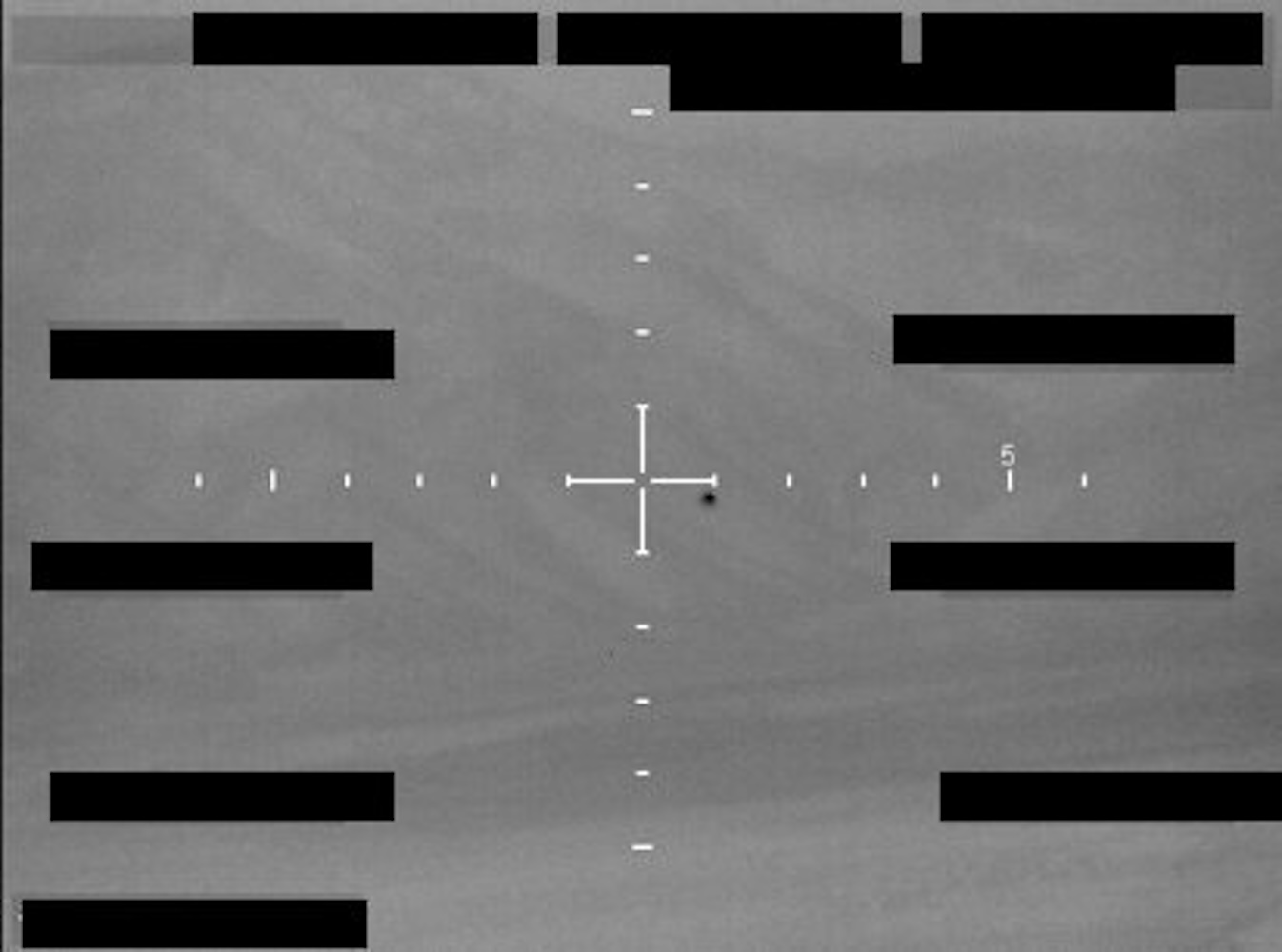
The last frame in the released series. A flat, hazy background: no ground, no sky, no horizon. Just the crosshairs, the small shape, and the rest of the screen blacked out by redaction. Here the FBI wrapped up its eight frames and sent the whole lot out for external investigation. No incident report attached, no capture date, no location. The FBI couldn't close the case itself, so it passed it to AARO, the agency set up specifically to collect cases no official body has been able to explain.
The open question
When the agency responsible for domestic threats can't close a case alone and sends it to an agency that exists only because of cases like this, we're watching an open admission: there are things in our skies that nobody understands yet.
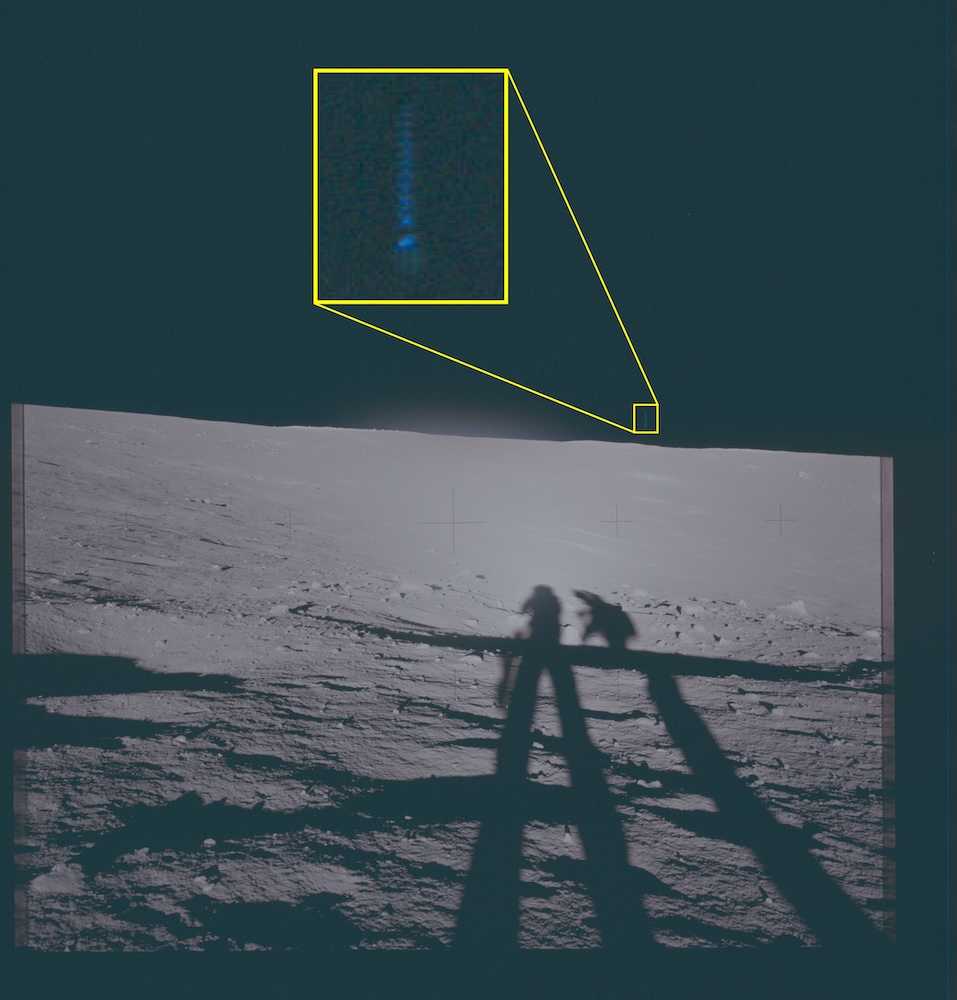
Apollo 12: a cluster of light above a Moon with no atmosphere
What we're looking at
A NASA photo from Apollo 12, November 1969. The lander's legs, an astronaut's shadow, lunar regolith. And in the black sky, a small cluster of bluish pixels. In 2026, NASA archive reviewers chose to highlight it with a yellow box and send the image to AARO as part of the 'PURSUE' effort to re-examine historical UAP material. The Moon has no atmosphere: no birds, planes, drones, balloons or missiles. Any physical light source in the lunar sky calls for an astronomical explanation, a geometric one, or something else entirely.
The open question
57 years after the shot was taken, NASA chose to send this image out for external review. What changed in our knowledge that lets us see something in these points of light that we didn't see in 1969?
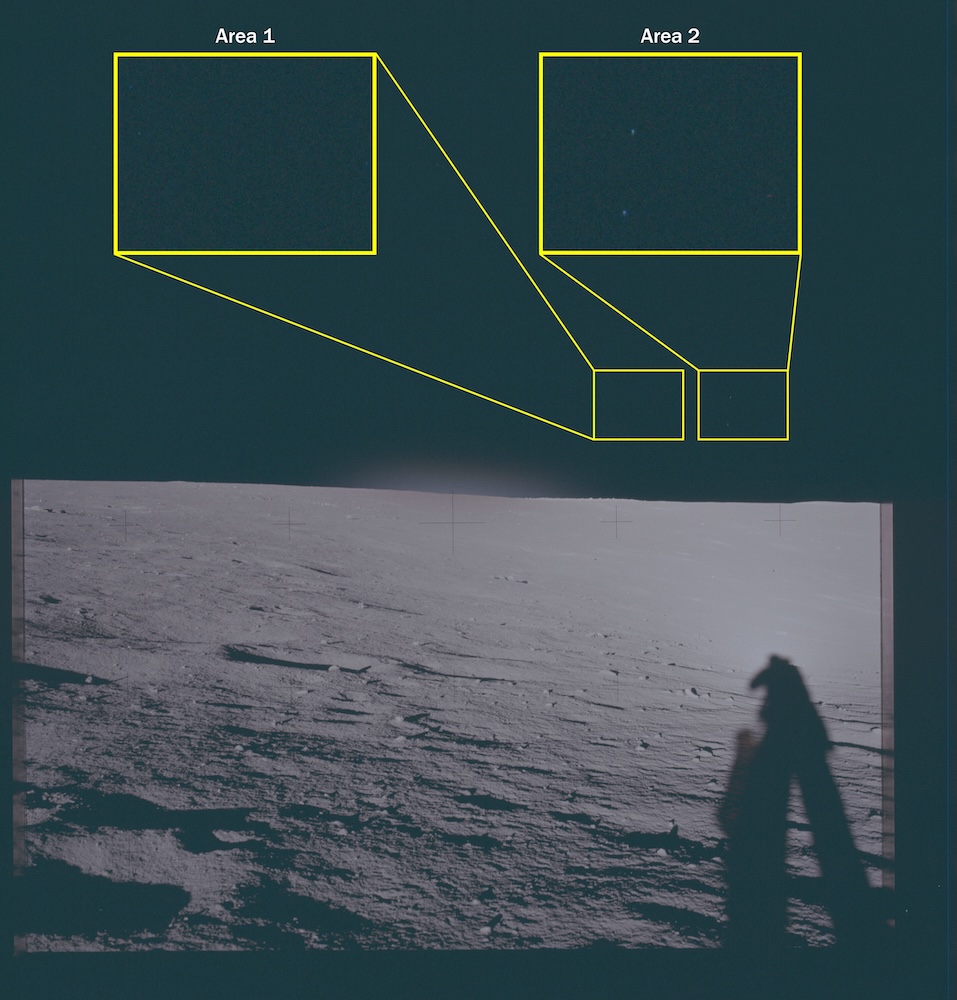
Two points at once: statistically, that's not two mistakes
What we're looking at
Another Apollo 12 photo. This time NASA marked not one box but two, 'Area 1' and 'Area 2', both in the upper half of the frame above the lunar horizon. Inside each, a tiny, faint point. When two separate objects show up in a single image of empty space, the odds that it's lens contamination or a film-processing error are very low. Two objects mean either two different physical light sources or two statistical noise events in the same frame, and the latter is considered very rare in calibrated space-mission photography.
The open question
What are the odds of two different errors in the same image? And what are the odds these were two real things, up there above the Moon, at the same moment?
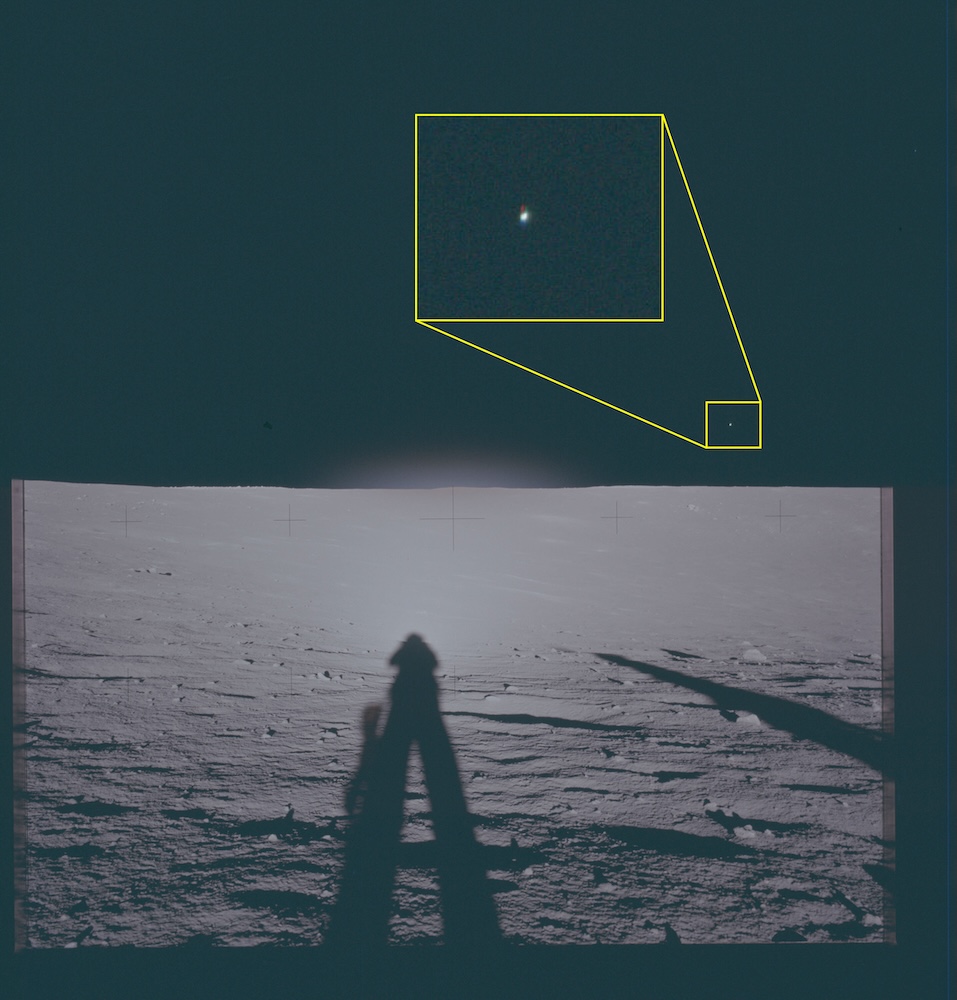
Under the sun's glare: a point someone judged to be real
What we're looking at
A third Apollo 12 frame, in color. In the upper right corner, a strong sun glare casts a bluish-white haze along the horizon. Inside that glare, right at the edge, NASA drew a yellow box around a bright point. Sun glare usually hides detail and creates fake reflections inside the optics, which is why professional reviewers are trained to ignore points in areas like this. Deciding to mark one right here says the detail survived the optical analysis.
The open question
To flag a point next to sun glare, you have to be confident it's something real and not an internal camera reflection. What about this point convinced NASA's reviewers it wasn't system noise?
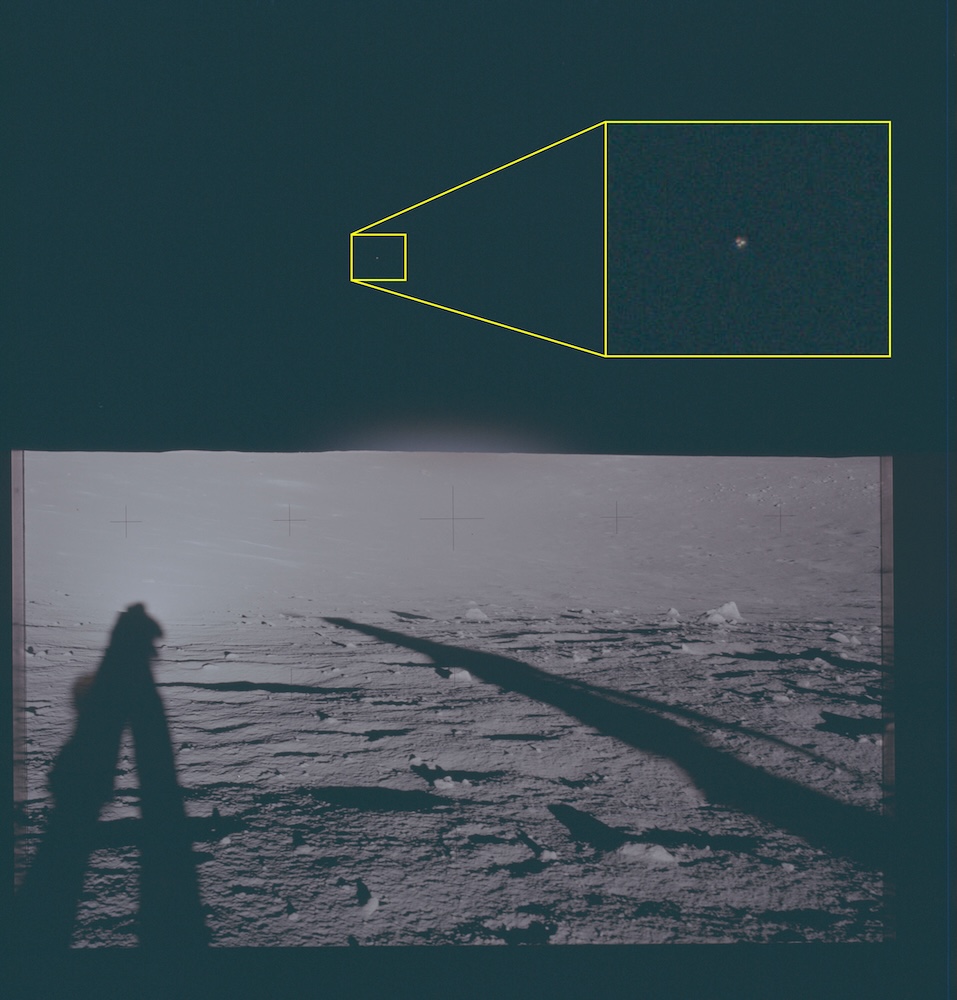
The astronauts didn't see it. Image-processing software did.
What we're looking at
An Apollo 12 photo. Two shadows on the regolith: the astronaut with his backpack, and the thin line of an antenna. Familiar ground, familiar context. But NASA's reviewers in 2026 found a point in the image that shouldn't have been there, one the astronauts themselves, standing on the lunar surface, never noticed. Modern image-processing software can pull out points of light far below the threshold of the naked eye. What went unseen then is visible today.
The open question
In 1969 the astronauts documented the Moon as they saw it. In 2026 we're seeing things in their photos they couldn't have seen. What else is hiding in NASA's archives, waiting for the next round of review?
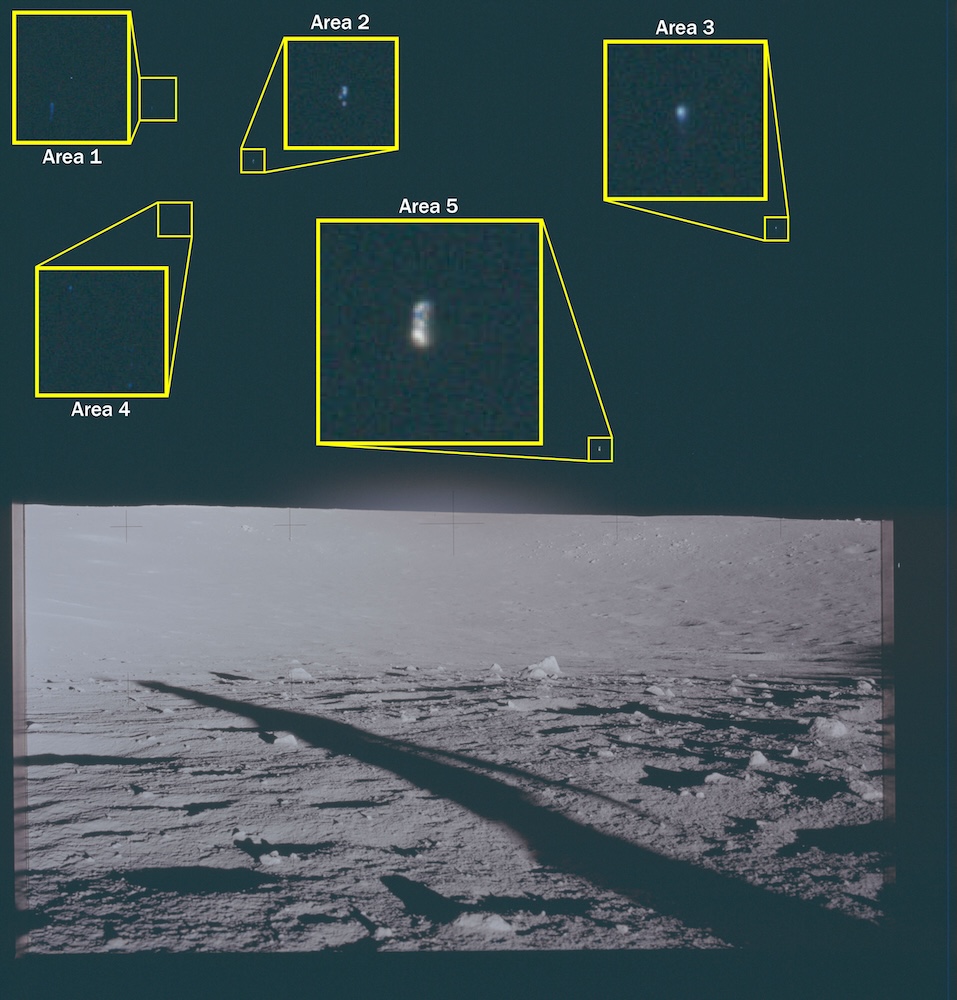
The fifth image in the series is a composite: at the bottom, a black-and-white shot of the lunar surface from the lander, and above it five zoom boxes labeled 'Area 1' through 'Area 5'. Each holds a tiny bright point. When five anomalies appear in one image and NASA goes to the trouble of producing separate zoom frames for all of them, that's an official judgment that none of the five fits the standard scientific expectation for the lunar sky, which should be black and empty except for stars that need a far longer exposure than the mission photo used.
The open question
If five points in one image are noise, why are they distributed like this? And if they're not noise, what does it mean to have five physical things at once in the same patch of space, at the same moment?
Apollo 17: three points in a vertical line. A geometric arrangement.
What we're looking at
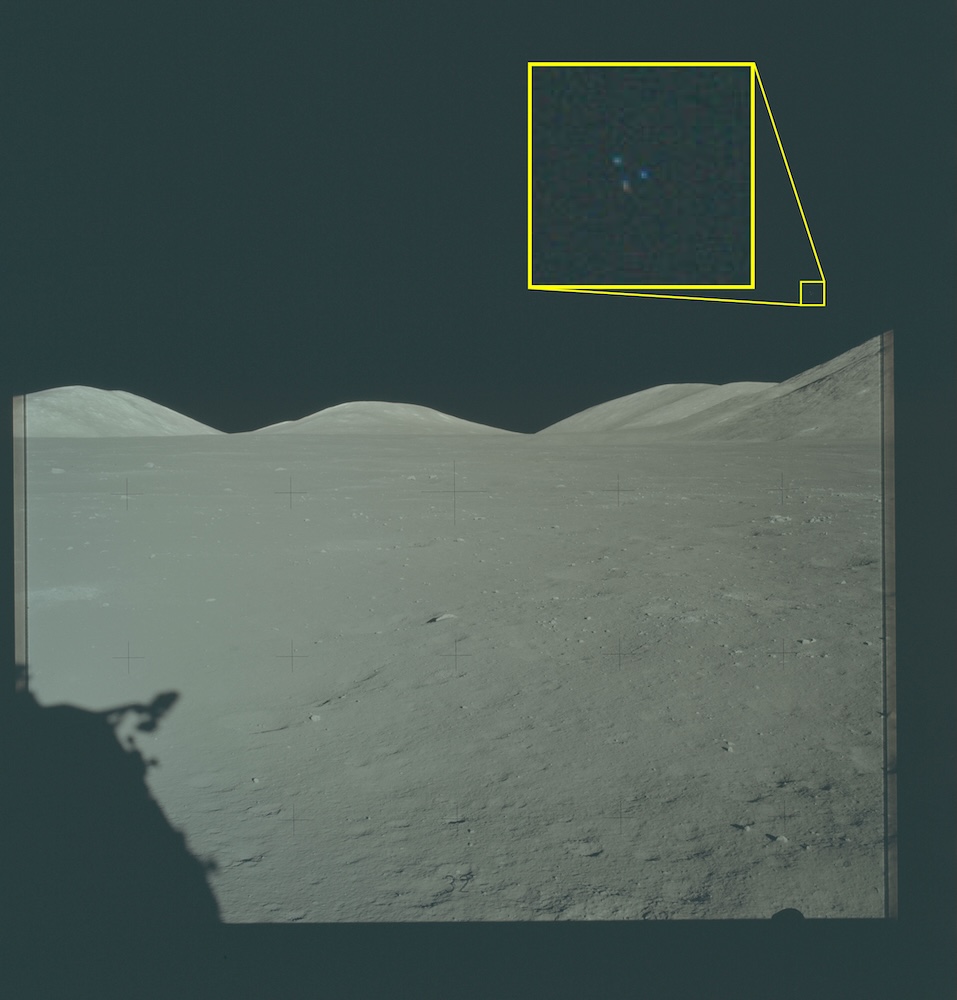
A color photo from Apollo 17 in December 1972, the last mission to the Moon. Rolling hills on the horizon, black sky. NASA drew a yellow box with a zoom showing three tiny bright points lined up vertically. A geometric arrangement like that, three points in a straight line, is exactly what makes astronomical algorithms and human reviewers slow down at the same time. Digital noise scatters randomly. Straight lines between light sources do occur in nature (stars in an angular alignment), or in objects that were designed, built or synchronized from outside.
The open question
Three points in a straight line above the Moon. If it's a natural phenomenon, which one? If it isn't, why in 2026 did they prefer to push this photo out for external review rather than write it off as a systematic film artifact?
Iraq, May 2022: a 'Russian Sukhoi' assessment that couldn't close the case
What we're looking at
10 seconds of infrared sensor footage from a US aircraft over Iraq. Two contrast areas move together in the center of the frame. AARO's official assessment: most likely an SU-27 or SU-35, Russian fighter jets. Normally an assessment like that closes the case. But the video is still classified as an unresolved UAP and was released in 2025, which suggests something in the motion, the thermal signature or the geometry doesn't match the Sukhoi's established profile. The assessment says 'most likely', not 'certainly'.
The open question
When an official assessment says 'known aircraft' but the military keeps the case open and puts it in front of the public, what's hiding in the gap between 'most likely' and 'certainly'?
#dvids#uap#iraq#ir
Video
DOW · DVIDS
16 / 2024·DOW · DVIDS
Syria, October 2024: a 'curved ball of light' that matches no known weapon
What we're looking at
5 seconds of FMV footage from a US aircraft over Syria. In the first second, an undefined colored area crosses the top edge of the screen from right to left and vanishes. Mission report D32 described it as a 'curved, non-uniform white ball of light' with a 'glowing halo' around it, unusual wording for military jargon, typically reserved for plasma or atmospheric phenomena. But the military couldn't find a single standard category (missile, engine flare, ball lightning, flashbulb) that fits the motion and geometry.
The open question
What is a 'curved white ball of light' in the air? Not a plane. Not a flare. Not lightning. When the military can't find a category, what new category do we need?
#dvids#uap#syria#fmv
Video
DOW · DVIDS
17 / 2023·DOW · DVIDS
UAE, October 2023: a trained operator couldn't make the ID
What we're looking at
A single still from a military system, shown for 43 seconds in the DVIDS archive. The original operator drew a red circle around the area of interest himself: an elongated smudge in the upper left whose intensity rises from one side to the other. Mission report D12 notes the object was moving north to northeast. A person trained to identify air threats, watching the screen in real time, spots something odd enough to circle by hand and in the end can't say what it is. That's a clear statement: 'I haven't seen anything like this in all my thousands of flight hours.'
The open question
An experienced operator saw something that 'called for a red circle'. What was it about that smudge that didn't match any case he'd seen in his entire service?
#dvids#uap#uae#still
Video
DOW · DVIDS
18 / 2024·DOW · DVIDS
Greece, January 2024: a diamond shape visible on only one band
What we're looking at
1 minute 6 seconds over Greece, the airspace of a NATO country, and the first in the series outside the Middle East. Mission report D7 described a diamond-shaped object moving at 434 knots. The decisive detail: it was visible only on the SWIR (short-wave infrared) sensor. When the operator switched to visible light, the object disappeared. Ordinary physical objects reflect light across the visible spectrum. An object that shows up only on one specific band is either a thermal signature from a very particular emission, or something we don't recognize from the existing lineup of human-made planes, drones and missiles.
The open question
Advanced American, Russian and Chinese aircraft don't vanish on a basic visible-light scan. A diamond-shaped object that disappears when you look with your eyes: what is it keeping us from seeing?
#dvids#uap#greece#swir
Video
DOW · DVIDS
19 / 2020·DOW · DVIDS
Middle East, May 2020: two minutes a targeting lock couldn't grab
What we're looking at
2 minutes 17 seconds of infrared sensor footage over the sea. A solid white object makes erratic movements above the water. 'Range Fouler' report D38 documents the lock attempt: in the first minute the sensor zooms in, at 2:10 a blue reticle appears but fails to lock, and at 2:15 the sensor loses the object completely. Military lock systems are built to predict the motion of planes, missiles and birds, based on defined physical models. An object that evades them for two full minutes is making moves that fit none of those models.
The open question
When an advanced military targeting system can't predict an object's next move for two full minutes, what kind of motion is it making? And why isn't it in our physics books?
#dvids#uap#middle-east#ir
Video
DOW · DVIDS
20 / 2013·DOW · DVIDS
Middle East, 2013: an eight-armed star, and two official versions that clash
What we're looking at
1 minute 46 seconds of infrared sensor footage from a US aircraft over the Middle East, 2013. AARO described the object in unusual terms: 'a contrast area resembling an eight-armed star, with arms of alternating lengths'. At 00:10 the sensor zooms in; between 00:11 and 00:29 the star moves across the frame trailing a visible wake; at 00:30 it exits bottom right. After an edit cut, at 00:35 it returns and stays for almost another minute before exiting the top left corner. The original reporter attached no verbal or written description. What makes this case special: two official metadata systems disagree about it. The manifest classifies the recording as an 'unresolved UAP report'; the public DVIDS title says 'resolved as aircraft'. A closer reading points to another possibility: 'an eight-armed star with alternating arm lengths' is a classic optical signature of an IR sensor imaging a point heat source through the lens aperture. A distant jet or missile would look like a star because of the camera, not because of the real shape of what was filmed.
The open question
Two official sources say two different things about the same video. If it really is an aircraft, why is the case still in the UAP database? And if it isn't, what does this optical signature mean, one that physicists can also explain?
#dvids#uap#middle-east#ir#contradiction
Video
NASA · DVIDS
21 / 1965·NASA · DVIDS
Gemini 7, December 5, 1965: an astronaut reports a 'bogey' live
What we're looking at
Six and a half minutes of audio (not video: the screen stays black during playback) from the Gemini 7 mission, December 5, 1965. The recording: air-to-ground communications and NASA's public affairs commentary feed. Astronaut Frank Borman, a former military man, reports an unidentified object to Houston and picks the word 'bogey', fighter-pilot slang for 'an unidentified aircraft that needs to be classified'. Crewmate Jim Lovell confirms the sighting and adds comments. It's one of the earliest, most public and most authoritative recordings of American astronauts reporting a UAP in real time: before there was public interest, before there was anything to gain, before the term 'UAP' even existed. In 2026 the recording appeared in the DOW archive alongside modern cases, a sign that both NASA and the Department of Defense see it as testimony that's still relevant.
The open question
In 1965, two astronauts report an 'unidentified aircraft' live over the US from low orbit. In 2026, the recording is reclassified as active UAP testimony. What does that say about a phenomenon's continuity across 60 years?
#nasa#audio#gemini 7#1965
22 / 2023·FBI · Department of War
Three red dots and an orange orb over a desert dirt road
What we're looking at
The illustration shows a desert landscape at night: a pale dirt road leads to a pass between low hills, and in the twilight sky there are three small red lights in a row next to a larger, brighter, glowing orange-red orb. It's a digital reconstruction the FBI prepared in 2026 at the request of the Department of War, based on a direct eyewitness account from a federal law enforcement agent who reported a phenomenon that recurred over two days in October 2023 near a sensitive security site in the Western US. Worth remembering: this isn't a photograph, it's an artist's interpretation of what the witness described. What made the sight unusual was the combination of one large light source with a separate cluster of red dots, as if there was more than a single object.
The open question
If the witness saw a separate cluster of lights next to the big orb, was this one object with several lights, or several objects moving together in the same field of view?
#orbs of light#western us#security site#fbi rendering
A Moon-sized orange orb on the horizon, with three red lights beside it
What we're looking at
More of the same event: a gravel road stretches toward a gap between dark hills, and low above the horizon hangs a glowing orange-red orb about the size of a small Moon, with three small red lights next to it. This too is a 2026 FBI digital reconstruction, built on a firsthand account from the same federal agent (labeled DOW-UAP-D079): not a photo from the scene but an interpretive rendering. The detail that grabs attention is that the lights are described as sitting very low, close to the ground, not high in the sky like a star or a plane.
The open question
Why was such an intense light source described as sitting so low above the horizon, right where an ordinary object would already have dropped behind the hills?
Two watchers on open ground and a single point of light low in the sky
What we're looking at
This kicks off a second sequence of illustrations, from a separate account (DOW-UAP-D080): two figures stand with their backs to us on open desert at night, looking at a single bright, yellowish point of light low in a star-filled sky. The FBI produced the rendering in 2026 at the Department of War's request. It's an artist's interpretation of what the witness described, not camera footage. What sets this point apart is that it's far brighter and more prominent than the stars around it, which is why it stood out enough to be documented on its own.
The open question
If just one point of light stood out above all the stars, what made a trained witness flag it as anomalous rather than a familiar celestial object?
The same two witnesses, and a bright yellow-white orb high above the ridge
What we're looking at
The second reconstruction in the same sequence: the two figures keep watching, and now the glowing orb appears higher and bigger, a round yellow-white light above a low ridgeline, larger and brighter than the stars around it. Again, this is a 2026 FBI digital rendering based on the same eyewitness account, not a photo of the event itself. This pair (2-1 and 2-2) essentially captures two moments of the same sighting, in which the light appeared in different positions in the sky.
The open question
If the light changed altitude and position between the previous reconstruction and this one, how fast and along what path was it moving from the two witnesses' point of view?
An orb with a burning red core, low and right of the ridgeline
What we're looking at
At this point in the same sighting, the rendering describes the light in more detail: a small, intensely bright object low on the right of the sky, a glowing orange-yellow disc with a concentrated red-orange center, clearly distinct from the pinpoint stars around it. It's still a 2026 FBI digital reconstruction based on the federal agent's description, not instrument data. The dense red core and the saturated glare are what set it apart, in the witness's eyes, from any natural light source.
The open question
What could explain a concentrated red core inside a glowing orange light, a structure that fits neither a star, a plane nor a firework?
A row of red lights and one bright orb stretched above the ridgeline
What we're looking at
Here the picture changes: instead of a single light source, the two figures are watching a horizontal row of lights, three small red dots next to one large, bright yellow-white orb, lined up low over the desert ridge. The FBI prepared the reconstruction in 2026 based on the same eyewitness account (DOW-UAP-D080), and it is an artist's interpretation only. The neat, almost linear arrangement of several light sources at the same altitude is what made the witness see it as one organized phenomenon rather than random lights.
The open question
How does a neat horizontal row of separate lights hold at the same altitude, with no visible body connecting them?
#row of lights#ordered formation#desert ridge#western us
Four red orbs and a big yellow one, spread out over the desert
What we're looking at
Now the row is longer and brighter: four glowing red orbs, evenly spaced, stretch across the starry sky above the ridge, and at the right end sits a much larger yellow-white orb, almost Moon-sized. The two figures stand in the foreground, watching. This too is a 2026 FBI digital reconstruction based on the federal agent's description, not a photo. The even spacing between the red orbs and their contrast with the dominant yellow one are the details that made this sighting anything but routine.
The open question
What do the equal gaps between the red orbs mean, and how is the big yellow orb at the end of the row connected to them?
An intense orange orb glowing low over a layered badlands cliff
What we're looking at
The third in the first witness's sequence (DOW-UAP-D079): a badlands landscape at night, a blue starry sky over eroded cliffs, and a paved road winding through the brush. Low in the sky, right above the top of a layered cliff, hangs a large and especially bright orange-red orb, far more saturated and colorful than the bluish landscape around it. It's a 2026 FBI digital reconstruction based on the witness's description, not a photograph. Its low position, right above the cliff edge, and the intensity of its glow are what made it stand out to the observer.
The open question
Why does such a bright light source look like it's resting right above the cliff edge, instead of appearing as a dim, distant point on the horizon?
From inside the car: an orb of light hovering over the dark road
What we're looking at
Here the point of view shifts completely: the rendering puts us in the back seat of a car driving at night, behind a driver with glasses and a passenger beside him, and through the windshield we see a dark two-lane desert road with a single yellow-white orb of light hovering right above it. No shape, no structure, just a glowing ball. It's a 2026 FBI digital reconstruction based on the federal agent's description: an artist's interpretation, not a photograph. The light's closeness to the road ahead of the car is what made this moment more unsettling than the other, more distant sightings.
The open question
If the orb was hovering right above the road ahead of the car, how far away from the passengers was it really, and how did it react as the car got closer?
#from the car#orb of light#desert road#close encounter
An arc of seven red lights hovering over the mountain ridge
What we're looking at
The final reconstruction in the sequence is also the most dramatic: two figures stand on a dirt road next to their car, and above a distant mountain ridge hovers an arc of about seven glowing red lights in a shallow V, with no visible body connecting them. Lower down, near the valley floor, two pairs of bright white lights appear on either side of the road. It's a 2026 FBI digital reconstruction based on the federal agent's account (DOW-UAP-D080): an interpretive rendering, not a photo. The arcing array of lights and the separate white lights lower down are what make this the standout sighting of them all.
The open question
How does a neat arc of seven red lights hold its shape above the ridge, and what's the connection between it and the pairs of white lights that appeared lower in the valley?
#arc of lights#v formation#security site#western us
This clip, whose official title describes a formation of four UFOs over water off the coast of Iran on August 26, 2022, was filmed by US forces in the CENTCOM area of responsibility. It's operational footage released by the Department of War, not an outside production. What flagged it was that the four moved together as an orderly formation rather than as random targets.
The open question
What keeps four separate objects in an orderly formation above the water, with no visible means of propulsion?
#formation#over-water#iran#centcom
Video
Department of War
33 / 2021·Department of War
UFO with instant acceleration, Syria 2021
What we're looking at
The clip's official title describes a UFO over Syria that accelerated instantly, from operational footage in the CENTCOM area of responsibility. This is sensor footage released by the US government, not material of civilian origin. What bumped it onto the list of cases was the sharp change in speed, seen without the usual gradual acceleration.
The open question
How does an object go from relative rest to high speed almost instantly, skipping the gradual acceleration phase every known aircraft goes through?
#instant-acceleration#syria#centcom
Video
Department of War
34 / 2022·Department of War
A cigar-shaped UFO or a fast orb, October 2022
What we're looking at
This clip, from October 15, 2022 in the CENTCOM area of responsibility, is labeled in its title as a UFO that looks like either an elongated cigar or a fast-moving orb. Even the official wording shows uncertainty about the shape itself, which is one reason the footage was kept. It's operational footage the Department of War made public.
The open question
Why couldn't even the people filming it decide whether it was an elongated cigar-shaped object or an orb moving too fast to capture clearly?
#cigar#spherical#speed#centcom
Video
Department of War
35 / 2022·Department of War
A spherical UFO moving erratically, Europe 2022
What we're looking at
The clip's title describes a spherical UFO moving erratically, from a mission in the EUCOM area of responsibility in 2022. It's operational sensor footage released by the Department of War. What flagged it was the jumpy movement pattern, which doesn't square with the smooth, predictable path of a plane or a drone.
The open question
What drives the spherical object's erratic movement if it has no visible control surfaces to explain the sharp changes in direction?
#spherical#erratic-motion#europe#eucom
Video
Department of War
36 / 2020·Department of War
A spherical UFO ducking in and out of clouds, Afghanistan 2020
What we're looking at
The clip from November 23, 2020 over Afghanistan, in the CENTCOM area of responsibility, documents, according to its title, a spherical UFO moving in and out of a cloud layer. It's operational footage released by the Department of War. Its repeated passes through the clouds are what made it possible to track the object over time and document it.
The open question
How does a spherical object keep a steady course and altitude while repeatedly passing through layers of cloud?
#spherical#clouds#afghanistan#centcom
Video
Department of War
37 / ·Department of War
A pulsing spherical UFO over water
What we're looking at
The clip's title describes a spherical UFO whose light pulses above the surface of the water. It's operational footage released by the Department of War, with no exact date or location in the source data. What flagged it was the regular pulsing of the light, which isn't typical of a simple sun reflection.
The open question
What's behind the regular pulsing of the object's light above the water, if there's no recognizable aircraft navigation lighting?
#spherical#pulsing#over-water
Video
Department of War
38 / ·Department of War
A UFO formation over and around water (USO)
What we're looking at
The clip is labeled in its title as a USO-type UFO formation (USO stands for unidentified submerged object), from a Department of War operational mission. The source data gives no exact date or location. What sets footage like this apart is that the objects move together as a formation close to the waterline.
The open question
What's the connection between the formation of objects above the water and the USO markings below the surface that appear in the same footage?
#formation#uso#over-water#underwater
Video
Department of War
39 / 2020·Department of War
NAG UFO, June 2020
What we're looking at
This clip, whose official title documents a NAG-type UFO on June 1, 2020 in the CENTCOM area of responsibility, is part of the sensor footage the Department of War released. The official wording sticks to a short operational code, so the main visible information is the date and the region. The very fact that the clip was kept and released shows it was classified as an event worth documenting.
The open question
What about the June 1, 2020 encounter justified keeping it as a separate UFO record, despite the bare-bones operational wording?
#nag#2020#centcom
Video
FBI
40 / 2024·FBI
Orbs of light over a pond, Northeastern US 2024
What we're looking at
In October 2024, around 18:51 local time in the northeastern United States, a witness filmed a light source hovering below the horizon line over a pond, at an estimated distance of about 2,700 feet. The FBI released the clip as part of a witness case file, not as a staged production. What flagged it was that the light source stayed hovering in place, below the horizon, above the water.
The open question
What keeps a steady light source hovering over a pond, below the horizon line, with no predictable movement up or sideways?
#orbs-of-light#over-water#northeast-us#fbi
Video
FBI
41 / 2025·FBI
An orb of light sighted in a backyard, Northeastern US 2025
What we're looking at
In July 2025, around 21:00 local time in the northeastern United States, a witness noticed an intense, glaring light in his backyard while parking his car on his way home from work. The FBI released the clip as part of documenting his testimony. What made the event worth documenting was the unusual intensity of the light at such a short distance from the witness.
The open question
Where does such an intense, glaring light in a private backyard come from, at a range that doesn't fit any known lighting source?
#orb-of-light#backyard#northeast-us#fbi
NASA · 1996
Three Space Photos Capture an Object Against Earth
In the third image, an object appears against Earth. NASA’s description says it seems to have passed between the shuttle and the planet.
Photo
FBI · October, 2023
The FBI Turned an Agent’s Account Into a Mystery Image
The image is based on a firsthand account, not a photograph of the incident.