Flying Saucer Investigators Went Silent After Visits
Gray Barker claimed three men in dark suits visited investigators. His book hinted at what they discovered but didn't reveal what the visitors said.
Gray Barker claimed that flying saucer investigators stopped publishing and speaking after visits from three men in dark suits. The text on the back of his book hints that the investigators discovered something, but doesn't specify what.
Three-page OCR of the dust jacket of Gray Barker's book 'They Knew Too Much About Flying Saucers,' published by University Books, Inc. (404 Fourth Avenue, New York 16, N.Y.), priced at $3.50, filed as Serial 403 within the FBI's 62-HQ-83894 UFO/flying-disc case file. The jacket copy promotes Barker's account of civilian saucer researchers being silenced after visits from 'Three men in dark suits,' and describes Barker as a Clarksburg, West Virginia film-booking businessman and publisher of The Saucerian. The document contains no FBI investigative narrative, agent notes, dates, or witness statements on its own; it is a piece of publicity/jacket material apparently retained in the Bureau case file.
Per the jacket copy, Barker became seriously interested in flying saucers in 1952 when 'one of the most astonishing ones allegedly landed near his home in West Virginia and he investigated the story and found the shaken and fearful eye witnesses convincing enough to go on with further investigations.' No further specifics, witnesses, or sensor data are stated on the jacket.
"One by one, the leading figures among flying saucer researchers, who have challenged the government denial that saucers come from outer space, have been silenced."
Why it matters: Core thesis of the book — alleged silencing of civilian UFO researchers.
Page 2
"Three men in dark suits have visited these saucer researchers. Nobody knows what they said, but it was enough to reduce their hearers to silence."
Why it matters: Early popularization of the 'Men in Black' motif in UFO lore.
Page 2
"They might be government agents, they might even be men from outer space, or they might have muscled into a situation fraught with many possibilities."
Why it matters: Speculation explicitly raises government agents as one possible identity of the silencers — relevant to why the Bureau may have retained this jacket.
Page 2
"one of the most astonishing ones allegedly landed near his home in West Virginia and he investigated the story and found the shaken and fearful eye witnesses convincing enough to go on with further investigations."
Speaker: jacket copy (re: Gray Barker, 1952)
Why it matters: References Barker's 1952 West Virginia landing investigation — likely the Flatwoods Monster case.
Page 2
"Finding time for his literary career between details of operating his business, he publishes The Saucerian, a flying saucer periodical, and contributes to educational journals and motion picture technical magazines."
Why it matters: Identifies Barker as publisher of The Saucerian periodical.
Page 3
Gray Barker
author, flying saucer researcher, film booking/buying agent, publisher of The Saucerian · Clarksburg News Building, Clarksburg, West Virginia · Page 2
H. G. Rhawn
publisher and owner of the daily Clarksburg News · Clarksburg News · Page 2
Gropper Associates, Inc.
jacket designer · Page 2
Clarksburg, West Virginia, USA
Page 2
Clarksburg News Building, USA
Page 2
404 Fourth Avenue, New York 16, N.Y. (University Books, Inc.), USA
Page 3
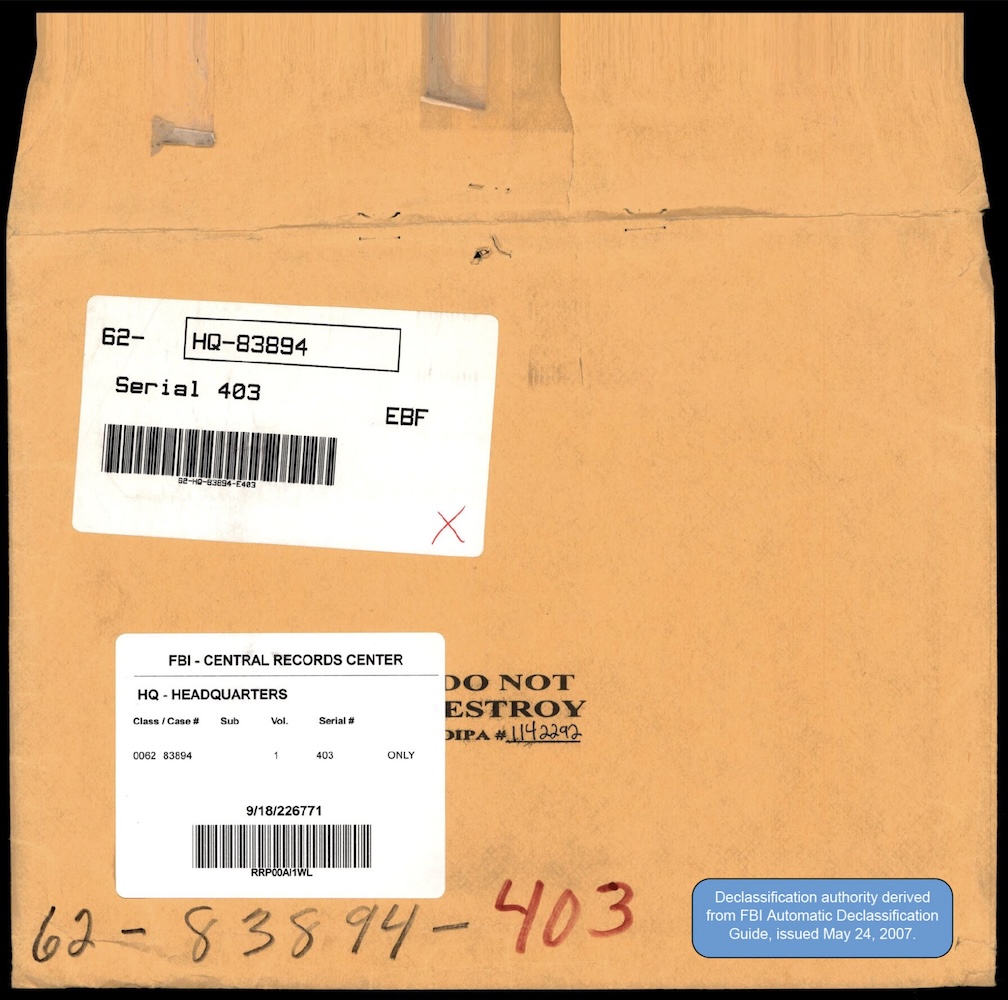
This serial is jacket/cover copy of Gray Barker's 1956 book 'They Knew Too Much About Flying Saucers' (University Books, Inc., NY), not an investigative FBI report. OCR is rough (chars=9761 over 3 OCR'd pages, ocr_ratio 1.0) but the jacket text is readable. No FBI agents, file routing slips, classification stamps, dates, or exemption codes are legible in the OCR output provided. The fragmentary text on page 1 ('sEPA #114229', '55-77 - (0 3', 'DO NOT') may be partial Bureau filing/serial markings on a cover sheet but is too garbled by OCR to transcribe with confidence — flagged here for possible re-OCR or human review. Useful for the 'civilian researchers / Men in Black' thread and as evidence that the Bureau collected published UFO literature into its case file.
The text describes them as men in dark suits but does not identify them.
The text on the back of the book hints that there was a discovery, but does not say what it was.
In 1952, Gray Barker heard about a flying saucer that reportedly landed near his home in West Virginia. He went to investigate the accounts and met eyewitnesses who were frightened and convinced by what they had seen.
Barker continued his investigation, then noticed something strange: investigators he'd met stopped publishing and talking about flying saucers. He claimed three men in dark suits visited them. What happened during these visits, and what had the investigators discovered beforehand? The text on the back of his book promised answers — but didn't reveal them.
"Flying saucers" was a common term for aerial objects people couldn't identify. Barker wasn't interested in the subject before hearing about the alleged landing. After checking the story, the eyewitnesses he met convinced him to continue investigating.
After several years of connecting with leading investigators, he claimed they fell silent, one after another. They still lived in the same places, but ceased publishing material on the subject. They also refused to discuss flying saucers or explain their silence.
According to the text, three men in dark suits approached the investigators. No one knew what was said to them. Barker described the silence that followed the visits but provided no details about a specific encounter or a particular investigator's reaction.
The text on the back of the book hints that the investigators discovered something, and that others tried to silence them because of it. It promises to share Barker's ideas about what they found. But it doesn't specify what the discovery was, nor does it explain why the visitors wanted the investigators to remain silent.
The text is an advertisement for Barker's book and does not present independent confirmation of his claims. It doesn't identify the visitors, doesn't say what they said, and doesn't reveal what the investigators discovered or what led to their silence.
Three men entered the story. The question is what remained in the room after they left.