Official · Document · Department of State
Space Advisor Proposed Setting Aside Disputes in Case of Encounter
In a 1963 memo, Maxwell Hunter outlined how the United States should respond to visitors from space.
In a 1963 memo, Maxwell Hunter outlined how the United States should respond to visitors from space.
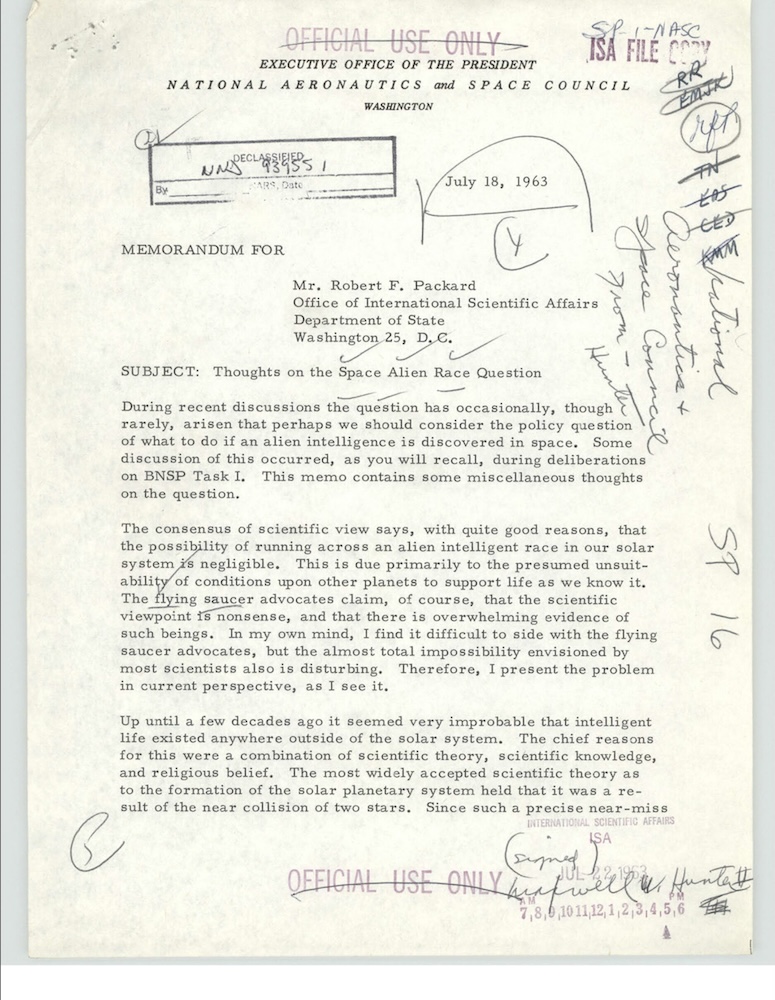
In a 1963 memo, Maxwell Hunter suggested quickly determining the capabilities of visitors from space. In the event of an encounter, he believed humans should set aside their differences.
Six-page memorandum dated July 18, 1963 from Maxwell W. Hunter, II, Member of the Professional Staff of the National Aeronautics and Space Council (Executive Office of the President), addressed to Mr. Robert F. Packard of the State Department's Office of International Scientific Affairs. Titled 'Thoughts on the Space Alien Race Question,' it offers Hunter's personal speculative analysis of policy implications should an alien intelligence be discovered, framed against then-current scientific theories of stellar/planetary formation, biological abiogenesis, Mars 'Canali,' lunar anomalies, and Einsteinian travel limits. The memo references prior internal discussion during deliberations on 'BNSP Task I' and concludes that detection of an alien race would drastically affect U.S. diplomatic policy. Document carries an 'OFFICIAL USE ONLY' marking and a partly-visible 'DECLASSIFIED' stamp.
"SUBJECT: Thoughts on the Space Alien Race Question"
Speaker: Maxwell W. Hunter, II
Why it matters: Memo subject line establishes the document's purpose: U.S. government internal policy speculation on extraterrestrial intelligence.
Page 1
"During recent discussions the question has occasionally, though rarely, arisen that perhaps we should consider the policy question of what to do if an alien intelligence is discovered in space. Some discussion of this occurred, as you will recall, during deliberations on BNSP Task I."
Speaker: Maxwell W. Hunter, II
Why it matters: Acknowledges that internal U.S. policy deliberations (BNSP Task I) had touched on extraterrestrial-contact policy.
Page 1
"The flying saucer advocates claim, of course, that the scientific viewpoint is nonsense, and that there is overwhelming evidence of such beings. In my own mind, I find it difficult to side with the flying saucer advocates, but the almost total impossibility envisioned by most scientists also is disturbing."
Speaker: Maxwell W. Hunter, II
Why it matters: Author frames his stance between flying saucer advocates and orthodox scientific dismissal.
Page 1
"One school of flying saucer advocates claims that the Martians have been mining our moon for natural resources for some time."
Speaker: Maxwell W. Hunter, II
Why it matters: Direct reference to a flying-saucer claim being analyzed (Martian lunar mining).
Page 3
"if we were not as scientifically sure of ourselves as we are, three recent events would be hailed as broad hints of intelligent life on the moon. (1) The discovery of hot gasses eminating from the crater Alphonsus when the moon was supposedly dead... (2) The infra-red scans which show hot spots... (3) The fact that no lunar or planetary probe of significance has been successful, in spite of major efforts on the part of two very successful earth orbitfaring nations."
Speaker: Maxwell W. Hunter, II
Why it matters: Author lists three contemporaneous lunar/planetary anomalies that, absent scientific confidence, could be interpreted as evidence of lunar intelligence.
Page 3
"If all the scientific speculation were to turn out wrong and we were to stumble across an alien race, we would want to know as quickly as possible which of the three types I have indicated it was, as our diplomatic policy would damned well be influenced by the results."
Speaker: Maxwell W. Hunter, II
Why it matters: Explicit linkage of extraterrestrial-contact scenario to U.S. diplomatic policy formulation.
Page 5
"In any event, a policy of the immediate burying of all Terrestrial hatchets would likely be in order."
Speaker: Maxwell W. Hunter, II
Why it matters: Argues that confirmed contact should trigger immediate global de-escalation among Earth nations.
Page 5
"There likely is nothing to be done at the moment to prepare for these possibilities (the only body of writing on the subject available in an emergency is science fiction), because no one of consequence is going to take this rubbish seriously unless it happens. At that point, our policy will be determined in the traditional manner of grand panic."
Speaker: Maxwell W. Hunter, II
Why it matters: Closing observation that no serious U.S. preparedness exists; policy by 'grand panic'.
Page 6
Maxwell W. Hunter, II
Member, Professional Staff (memo author) · National Aeronautics and Space Council, Executive Office of the President · Page 6
Robert F. Packard
Memo addressee · Office of International Scientific Affairs, Department of State · Page 1
Washington, United States
Page 1
Mars
Page 2
Moon (Earth's)
Page 3
Crater Alphonsus (Moon)
Page 3
Asteroid Belt
Page 4
Venus
Page 4
Uranus
Page 4
Lunik III
spacecraft · Page 4
Mariner II
spacecraft · Page 4
Project Ozma
ground · Page 3
Header/margin area shows partial 'DECLASSIFIED' stamp and stray markings; an 'OFFICIAL USE ONLY' caveat and a date stamp 'JUL 2[?] 1963' appear, with handwritten notations and what looks like a routing list of hours '7,8,9,10,11,12,1,2,3,4,5,6'.
Likely reason: Original handling caveats and declassification markings; not redaction of substance.
OCR shows a header 'OFFICIAL-USE-ONLY' across the page top.
Likely reason: Document handling caveat.
Document is a speculative policy memo, not an incident report; no specific UAP sighting is recorded. Manifest description is incorrect: it lists '1952' and 'two page memorandum' but the source is a six-page memo dated July 18, 1963. Author Maxwell W. Hunter, II was a noted aerospace engineer (Douglas Aircraft, then NASC). Addressee Robert F. Packard was a State Department science officer. The 'SP-16' file designation in the corpus slug refers to the State Department subject-numeric file series for outer space matters. The memo is signed but appears to be Hunter's personal/professional speculation rather than a formal NASC position. No incidents recorded (incidents array intentionally omitted).
Maxwell W. Hunter II, a professional staff member of the White House Space Council.
No. It addressed the future possibility of an encounter with intelligent life.
He believed that visitors who could travel faster than light understood nature far better than humans.
Maxwell Hunter sat down to write a memo about an encounter with intelligent life in space. Working with the White House Space Council staff, he addressed an official at the U.S. Department of State. His question was simple: What would the United States do if it discovered sentient beings beyond Earth?
The memo was written in 1963 and released to the public in 2026. Hunter didn't claim that such visitors had already arrived. He sought to imagine how U.S. decisions would change based on their capabilities — and suggested that humans set aside their disputes.
Hunter described three possibilities. Intelligent life could exist on a planet in our solar system, like Mars. Visitors could arrive from another system, orbiting a distant star. Or they might be able to travel faster than light — something the science of his time couldn't explain.
The last possibility particularly concerned him. If such beings were encountered, he wrote, the United States should expedite negotiations. The ability to travel faster than light, he explained, would indicate an understanding and mastery of nature far exceeding human knowledge.
Even without such speed, Hunter believed it was crucial to quickly ascertain the technology visitors used. Did they fly using engines powered by conventional materials, or by atomic energy? Perhaps their understanding of nature was even more advanced.
The answer, he wrote, would significantly impact U.S. policy. An encounter with visitors of limited capability would not be similar to an encounter with those who understood the laws of nature far better than humans.
Hunter also had a suggestion for all humanity: if an encounter occurred, immediately set aside their differences. Even if only limited-capability visitors were found, or remnants of an interstellar expedition, he believed the encounter would present humanity with a problem greater than those it had created for itself.
It is unknown if intelligent life exists beyond Earth, or if an encounter will ever happen. The memo states that scientists considered an encounter within the solar system unlikely, but Hunter thought it was wrong to treat the possibility as impossible.
Meanwhile, his suggestion remains on paper: if visitors arrive, perhaps it will be the first time humanity has a common adversary.