Official · Document · Department of State
Georgian Official Suggested Reports of Aircraft Might Describe UFOs
Georgia reported bombings in a mountainous region. Russia denied involvement, and a Georgian official offered a strange explanation.
Georgia reported bombings in a mountainous region. Russia denied involvement, and a Georgian official offered a strange explanation.
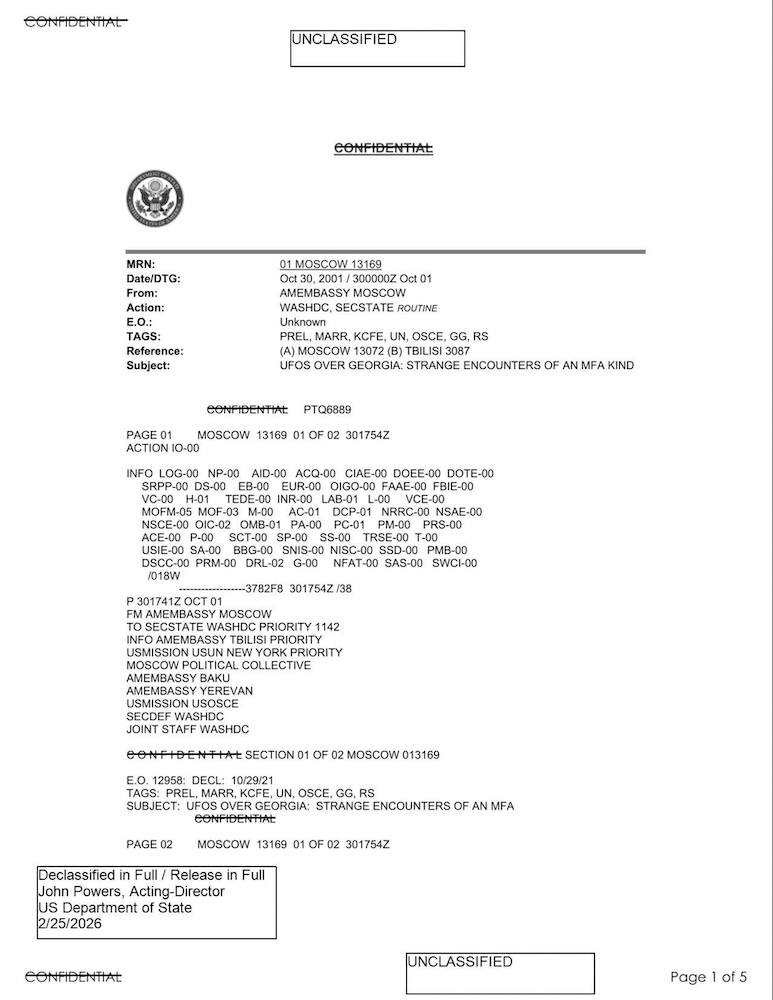
Georgia reported that Russian aircraft had bombed a mountainous region. Russia denied the reports, and a Georgian official said they might have referred to UFOs.
U.S. Department of State diplomatic cable (CONFIDENTIAL, MRN 01 MOSCOW 13169) from AmEmbassy Moscow to SecState Washington dated 30 October 2001, reporting on an October 30 meeting between Ambassador Vershbow and Russian Deputy Foreign Minister Mamedov regarding Georgian accusations that Russian planes violated Georgian airspace and bombed positions in the Kodori Gorge October 28-29, 2001. Russian MFA officials categorically denied Russian planes were involved; MFA Georgia Desk Chief Tereoken quipped that reports of planes in the area 'might as well have been about "UFOs"' since Moscow lacks the technical capability to determine whether foreign planes were in the region. The cable also covers the Russian withdrawal of military equipment from Gudauta base, the visit of Georgian Parliamentary Speaker Zvania to Moscow, and rumored visits by Defense Minister Sergey Ivanov. The post comments that the UFO claim 'would be humorous if it were not for the seriousness of the violations' and characterizes the denials as 'a traditional Russian penchant to avoid an awkward admission with a bold lie.'
Georgian Foreign Ministry alleged that Russian planes violated Georgian airspace and bombed areas of the Kodori Gorge on October 28-29, 2001. Russian MFA (Mamedov) and MFA Georgia Desk Chief Tereoken categorically denied Russian planes were involved, with Tereoken stating reports of planes might as well have been 'UFOs' because Moscow lacked the technical capability to determine whether foreign planes were in the region. Tereoken acknowledged credible reports of Abkhaz helicopters bombing areas 'where the terrorists were.'
"REPORTS OF PLANES IN THE AREA MIGHT AS WELL HAVE BEEN ABOUT "UFOS.""
Speaker: Tereoken (MFA Georgia Desk Chief, paraphrased/quoted)
Why it matters: Source of the cable's UFO subject line; Russian official's dismissive framing of unidentified aircraft as UFOs.
Page 2
"MOSCOW, HE EXPLAINED, DOES NOT HAVE THE TECHNICAL CAPABILITY TO DETERMINE WHETHER THERE WERE FOREIGN PLANES IN THE REGION."
Speaker: Tereoken
Why it matters: Russian MFA admission of detection limits over Georgian/Abkhaz airspace.
Page 2
"WAS NOT ACCUSING ANYONE,"
Speaker: Tereoken
Why it matters: Disclaimer accompanying suggestion that 'any side' could have sent planes over Kodori.
Page 2
"IT IS HARD TO ACCEPT OFFICIAL RUSSIAN DENIALS THAT RUSSIAN PLANES WERE NOT INVOLVED. TO POSIT THAT THEY COULD BE UFOS WOULD BE HUMOROUS IF IT WERE NOT FOR THE SERIOUSNESS OF THE VIOLATIONS."
Speaker: Embassy Moscow (Vershbow) — COMMENT section
Why it matters: U.S. embassy's own assessment treating the UFO framing as a deflection rather than a genuine UAP report.
Page 4
"THEIR OFFICIAL DENIALS REFLECT A TRADITIONAL RUSSIAN PENCHANT TO AVOID AN AWKWARD ADMISSION WITH A BOLD LIE."
Speaker: Embassy Moscow (Vershbow) — COMMENT section
Why it matters: Embassy explicitly characterizes the UFO claim as a cover for Russian airspace violation.
Page 4
"UFOS OVER GEORGIA: STRANGE ENCOUNTERS OF AN MFA KIND"
Speaker: Cable subject line
Why it matters: Subject line itself frames the cable; pun on 'Close Encounters' / MFA (Russian Ministry of Foreign Affairs).
Page 1
Mamedov
Deputy Foreign Minister · Russian Ministry of Foreign Affairs · Page 2
Vershbow
Ambassador (signer of cable) · U.S. Embassy Moscow · Page 2
Tereoken
MFA Georgia Desk Chief · Russian Ministry of Foreign Affairs · Page 2
George Krol
POLMINCOUNS (classifying officer) · U.S. Embassy Moscow · Page 2
Zurab Zvania
Georgian Parliamentary Speaker · Government of Georgia · Page 3
Gennadiy Seleznev
Russian Duma Speaker · State Duma of the Russian Federation · Page 3
Sergey Ivanov
Defense Minister · Russian Federation · Page 4
Shevardnadze
President of Georgia · Government of Georgia · Page 4
Putin
President · Russian Federation · Page 4
Chkheidze
Georgian POLCOUNS · Embassy of Georgia, Moscow · Page 3
John Powers
Acting Director (declassification authority) · U.S. Department of State · Page 1
Kodori Gorge, Georgia
Page 2
Abkhazia, Georgia
Page 2
Gudauta (base), Georgia/Abkhazia
Page 2
Sukhumi, Georgia/Abkhazia
Cable header: FROM AMEMBASSY MOSCOW; TO SECSTATE WASHDC PRIORITY 1142/1143; INFO AMEMBASSY TBILISI PRIORITY, USMISSION USUN NEW YORK PRIORITY, MOSCOW POLITICAL COLLECTIVE, AMEMBASSY BAKU, AMEMBASSY YEREVAN, USMISSION USOSCE, SECDEF WASHDC, JOINT STAFF WASHDC. MRN: 01 MOSCOW 13169. DTG: P 301741Z OCT 01 (transmitted 301754Z OCT 01). Subject: UFOS OVER GEORGIA: STRANGE ENCOUNTERS OF AN MFA KIND. TAGS: PREL, MARR, KCFE, UN, OSCE, GG, RS. References: (A) MOSCOW 13072 (B) TBILISI 3087. Classification: CONFIDENTIAL (sections 01 and 02 of 02), classified by POLMINCOUNS George Krol, reason 1.5 (B/D), E.O. 12958, declassification 10/29/21. Signer: VERSHBOW (Ambassador Alexander Vershbow). Post: U.S. Embassy Moscow. Declassified in Full / Release in Full by John Powers, Acting Director, U.S. Department of State, 2/25/2026. Document is a routine diplomatic cable; the 'UFO' reference is rhetorical/political, not a UAP sighting report. Substantively the cable is about Russia-Georgia tensions, the Kodori Gorge incident, Gudauta base withdrawals, and the Zvania-Seleznev exchange. This is one of three companion State Department UAP cables (this is Cable 3); 154 and 155 are siblings.
A Georgian foreign ministry official. He said reports of aircraft in the area might also have referred to unidentified flying objects.
No. The cable describes reports and denials, but offers no independent evidence that the bombings took place or identifies the aircraft.
Page 3
Tbilisi, Georgia
Page 2
Moscow, Russia
Page 1
Russian Ministry of Defense
Russian Federation · Page 2
Russian General Staff
Russian Federation Armed Forces · Page 3
Russian planes (alleged)
aircraft · Page 2
Abkhaz helicopters
aircraft · Page 2
The U.S. ambassador to Moscow raised reports of aircraft bombing a mountainous region of Georgia at a meeting. According to the reports, Russian aircraft crossed the border and attacked the Kodori area.
Russia denied its aircraft had been there. Then a Georgian official suggested the reports might actually have referred to UFOs, or unidentified flying objects. The U.S. cable said Russia’s denial was hard to accept.
On October 30, 2001, the ambassador met with Russia’s deputy foreign minister. The ambassador said that if the reports were true and the incidents continued, they could damage relations between the United States and Russia.
The deputy minister replied that the Russian Ministry of Defense strongly denied that Russian aircraft had taken part in the incidents. He also said Russian aircraft had not flown over the area where the bombings took place.
The head of the Russian affairs department at Georgia’s foreign ministry repeated the denial. He said no Russian aircraft had been near the area on those days. The U.S. ambassador recounted the conversation in his cable.
The official said there were credible reports that helicopters belonging to the authorities in Abkhazia, a region of Georgia, had bombed places where, he said, terrorists were located. As for the reports of aircraft, he said they might also have referred to UFOs.
He added that Russia had no way to determine whether another country’s aircraft had been in the area. He said either side might have sent aircraft over Kodori.
The authors of the U.S. cable wrote that Russia’s denial was hard to accept. They raised the possibility that Russia had denied the reports to conceal its actions, and wrote that the UFO explanation would have been amusing if the reports were not so serious.
The cable offers no independent evidence that the bombings took place or identifies the aircraft. Russia denied the reports, and the American suspicion that the denial was intended to conceal operations has not been proven.
One report left two possibilities in the sky: aircraft or something no one identified.