Official · Document · FBI
Air Force Wanted to Examine the Ground, Too
In 1949, procedures were established for investigating unidentified object reports — including soil samples and aircraft inspections.
Released to the public May 8, 20262 min read
In 1949, procedures were established for investigating unidentified object reports — including soil samples and aircraft inspections.
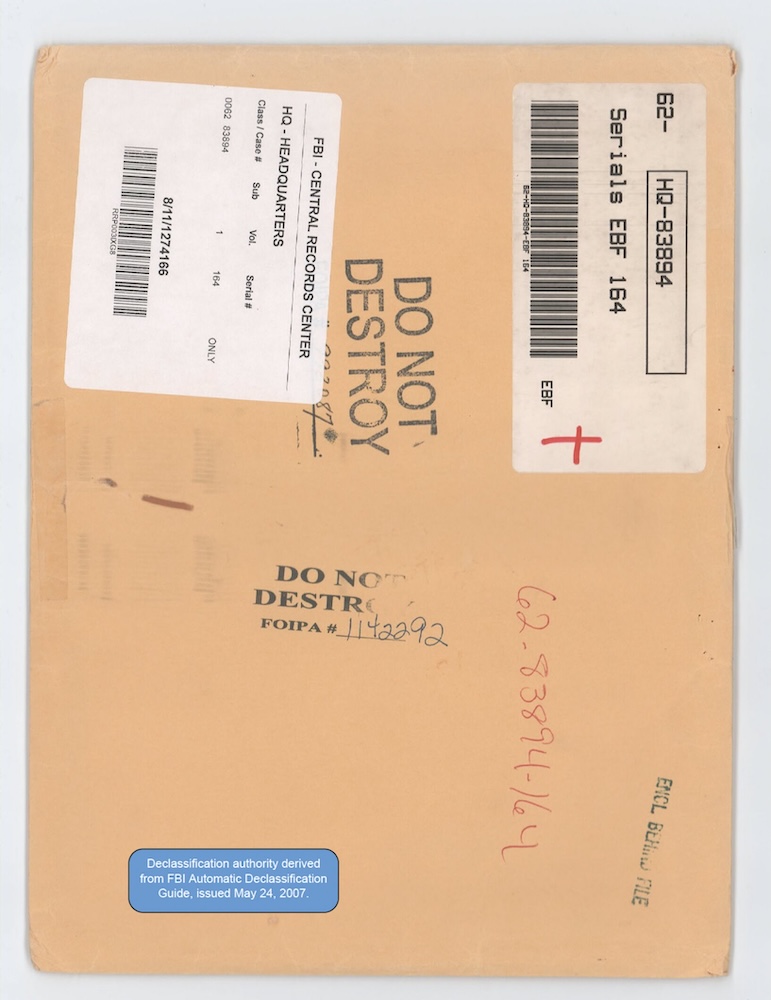
In 1949, the US Air Force set guidelines for investigating UFO reports: ascertain how they vanished, search for debris, compare soil samples, and inspect nearby aircraft.
Serial 164 of FBI file 62-HQ-83894 ('Flying Discs' case file) is a 137-page PDF whose substantive content is a single U.S. Air Force document reproduced 17 times: 'Air Intelligence Requirements Memorandum Number 4: Unconventional Aircraft,' issued 15 February 1949 by the Directorate of Intelligence, Headquarters United States Air Force, Washington 25, D.C., signed by Major General C. P. Cabell, USAF, Director of Intelligence, Office of Deputy Chief of Staff, Operations. The memorandum, classified RESTRICTED and bearing form/control number 'C9-4892, AF', enunciates continuing Air Force requirements for reporting sightings of unconventional aircraft and 'Flying Discs,' rescinds Department of the Army Collection Memorandum No. 7 (21 January 1948) and letter CSGID 425.1 (25 March 1948), and prescribes detailed reporting procedures and a 7-page questionnaire (Part II - Requirements) covering observer position, object appearance, propulsion, radar observations, and physical evidence collection (soil samples, Geiger-counter checks, photographs, fragments). Page 1 is the FBI file jacket bearing the stamp 'Declassification authority derived from FBI Automatic Declassification Guide, issued May 24, 2007.' The file contains no FBI investigative narrative, no teletypes, no witness statements, and no agent reporting; it is the Bureau's retained reference copy (in 17 duplicates) of the USAF reporting requirement that defines what was to be collected and forwarded to the Commanding General, Air Materiel Command, Wright-Patterson AFB, ATTN: MCIAXO-3.
"The purpose of this memorandum is twofold: a. To enunciate continuing Air Force requirements for information pertaining to sightings of unconventional aircraft and unidentified flying objects, including the so-called 'Flying Discs.' b. To establish procedures for reporting such information."
Speaker: Air Intelligence Requirements Memorandum Number 4 (15 February 1949)
Why it matters: States the formal purpose of the 1949 USAF reporting requirement for UFO/'Flying Disc' sightings; establishes that the term 'unidentified flying objects' was already in official Air Force usage by February 1949.
Page 2
"Department of the Army Collection Memorandum Number 7, dated 21 January 1948, and letter, CSGID 425.1, dated 25 March 1948, both subject as above, which have been transferred to Air Force agencies for action, are herewith superseded."
Speaker: Air Intelligence Requirements Memorandum Number 4
Why it matters: Documents the transfer of UFO collection responsibility from the Army (CSGID) to the newly independent Air Force; rescinds the earlier 1948 Army collection memo on 'flying discs.'
Page 2
"Cables will contain the phase, 'Pass to COMGENAMC WRIGHT-PATTERSON AFB, DAYTON, OHIO, ATTN: MCIAXO-3.'"
Speaker: Air Intelligence Requirements Memorandum Number 4
Why it matters: Names the operational routing instruction that funneled overseas Air Attache and major-command sighting cables to the Air Materiel Command at Wright-Patterson (the Project Sign / Project Grudge / forthcoming Project Blue Book pipeline).
Page 2
"5. If object contacted earth, obtain soil samples within and without depression or spot where object landed (and then presumably departed) for purpose of making comparison of soils. 6. If object came sufficiently near other aircraft or known objects check surfaces with Geiger counters for possible radioactivity."
Speaker: Air Intelligence Requirements Memorandum Number 4, GENERAL section
Why it matters: Explicit 1949 USAF instruction to collect soil samples at landing/touch-down sites and to check for radioactivity with Geiger counters; treats the possibility of physical landing trace evidence as actionable.
Page 8
"10. Was any radio antenna to be observed, i.e., (any projections or extentions that might presumably be construed as such)."
Speaker: Air Intelligence Requirements Memorandum Number 4, GENERAL section item 10
Why it matters: Field instructed to look for and describe possible radio antennas on the object.
Page 8
"DISTRIBUTION: Commanding Generals, Major Air Commands, ZI and Overseas / All United States Air Attaches / Director of Central Intelligence / Special Assistant for Research and Intelligence, Department of State / Director of Intelligence, GSUSA / Chief of Naval Intelligence / Commandant (INT), United States Coast Guard / Director, Federal Bureau of Investigation"
Speaker: Air Intelligence Requirements Memorandum Number 4
Why it matters: Distribution list confirms the FBI Director was an addressee of the 15 Feb 1949 USAF UFO reporting requirement, which is why a copy resides in FBI 62-HQ-83894; also documents inter-agency distribution to CIA, State, Army, Navy, and Coast Guard intelligence chiefs.
Page 8
"Declassification authority derived from FBI Automatic Declassification Guide, issued May 24, 2007."
Speaker: FBI declassification stamp (file jacket cover)
Why it matters: Identifies the declassification authority for this serial as the FBI's 2007 Automatic Declassification Guide rather than a case-by-case review.
Page 1
C. P. Cabell
Major General, USAF; Director of Intelligence, Office of Deputy Chief of Staff, Operations; signatory of the memorandum · Headquarters United States Air Force, Directorate of Intelligence, Washington 25, D.C. · Page 8
Washington 25, D.C., USA
Page 2
Wright-Patterson Air Force Base, Dayton, Ohio, USA
Page 2
Directorate of Intelligence, Headquarters United States Air Force
USAF · Page 2
Air Materiel Command (ATTN: MCIAXO-3)
USAF · Page 2
Office of Deputy Chief of Staff, Operations
USAF · Page 8
This serial does not contain a sighting, witness, agent, field office, or teletype to extract — it is the Bureau's retained reference set of the 15 Feb 1949 USAF Air Intelligence Requirements Memorandum No. 4 (signed by Maj. Gen. C. P. Cabell), reproduced 17 times after a single FBI declassification cover page. Despite the manifest description suggesting a rich case file with 'investigative records, eyewitness testimonies, and public reports' covering 1947-1968, this specific serial (164) is just the reference memo. Useful aggregator value: (1) confirms FBI Director was on the 1949 USAF UFO reporting distribution; (2) anchors the Army-to-Air-Force transition (CSGID 425.1 / Collection Memo No. 7 superseded); (3) names the MCIAXO-3 routing at Wright-Patterson AMC. No FBI exemption codes (b1/b6/b7C/b7D) appear in the OCR; the only redaction-like marking is the page-1 FBI Automatic Declassification stamp dated May 24, 2007. Page 1 OCR is largely garbled (file jacket art) and cannot be cleanly transcribed beyond the declassification stamp. Confidence held at 0.8 because the content is repetitive and the OCR for page 1 is degraded, but the substantive memo body is fully legible across all 17 reproductions.
No. It details what information should be collected when a report is received.
The memo does not provide results from any specific investigation.
After someone reported an unidentified object, the US Air Force wanted to get the details quickly. A memo from February 1949 outlined what needed to be investigated and how to transmit the information.
The instructions weren't limited to describing what was seen in the sky. They asked for details on how the object moved and disappeared, and even to check if it left a mark on the ground. If it approached an aircraft, that aircraft also needed to be inspected.
The report was supposed to include the object's color, shape, and size. It also needed to describe its speed, any sound it made, and its movement: whether it ascended, descended, swayed, or changed direction.
Then came the question of how the sighting ended. Did the object explode, fade and disappear from the observer's sight, or vanish behind an obstruction? In the case of an explosion, debris and other evidence needed to be sought. Each possibility required a different investigation.
If the object reached the ground, the instructions called for taking a small amount of soil from the impact area and comparing it to nearby soil. This would allow for checking if the soil at the site appeared different from its surroundings.
The object, its surroundings, and the spot where it touched the ground, if applicable, needed to be photographed. If no photos were available, drawings could be made. The instructions also requested collecting debris and physical evidence, when possible, and obtaining a written, signed statement from the eyewitness.
If the object came close enough to an aircraft or another known object, its surface needed to be checked with a radiation-measuring device. Afterward, it was to be compared to another unaffected aircraft. Radiation is invisible energy that can be measured.
The memo also requested checking if other aircraft or experiments in the area could explain the report. In other words, alongside searching for unusual signs, the instructions also included examining what was happening in the vicinity.
The memo establishes how the Air Force wanted to investigate reports but does not describe any specific sighting. It also doesn't say whether any investigation found radiation, debris, or changes in the soil, or what explained any particular report.
The instructions extend to the very handful of soil beneath where an object might have touched the ground.