The Pentagon Released a Warp-Drive Study. It Wasn’t About Aliens
Written on April 2, 2010, for the Defense Intelligence Agency, the study examined whether distant stars might someday be reached in a reasonable amount of time.
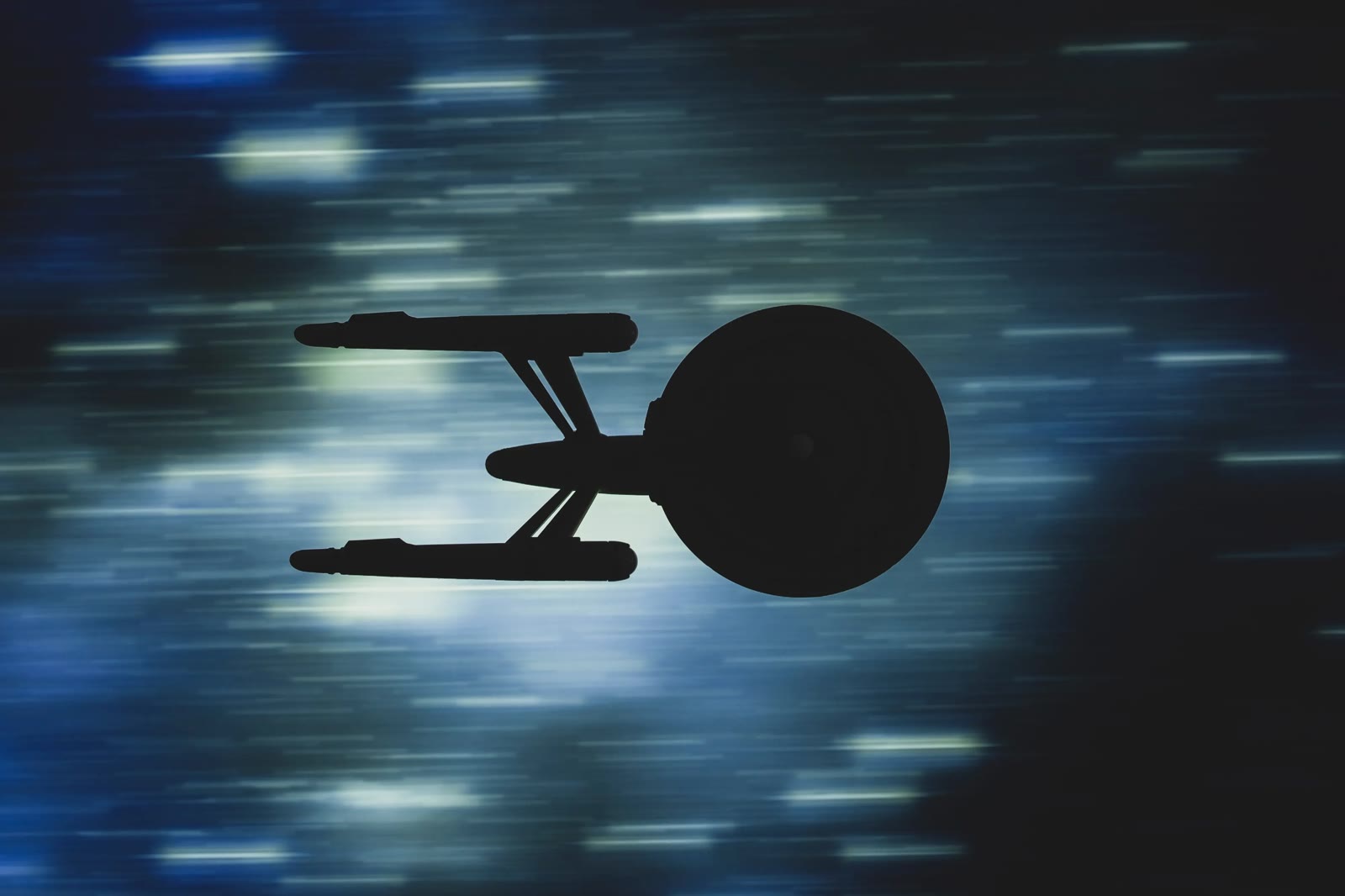
A 2010 Defense Intelligence Agency study examines a warp drive, which could theoretically propel a spacecraft by contracting and expanding space. The study describes no encounters with aliens, and the researchers themselves acknowledge that the idea is many years from becoming reality.
The U.S. Defense Intelligence Agency commissioned a study of a warp drive, a way to propel a spacecraft by altering the space around it rather than accelerating the craft itself. The document was written on April 2, 2010. The Pentagon included it in a file released in September 2026 as part of its UFO files, though a version had been publicly available for years.
Headlines accompanying the release promised a hunt for aliens. The document describes no such encounter, and it lays out no plan to search for extraterrestrial life. Instead, it examines whether it might someday be possible to reach distant star systems in a reasonable amount of time.
The Idea: Move Space, Not the Spacecraft
The idea is based on a mathematical model presented by Mexican physicist Miguel Alcubierre in 1994. Under the model, the spacecraft is surrounded by a bubble that contracts space in front of it and expands space behind it. The spacecraft remains in place inside the bubble while the space around it moves. In theory, the bubble’s motion could let a spacecraft travel vast distances without accelerating to the speed of light, which, according to Einstein’s theory of relativity, an object with mass cannot reach. “The basic idea is to create an asymmetric bubble of space,” the report states.
The problem is energy. According to the report, such a bubble would require far more energy than humanity can produce today. Early models assume the use of “negative energy,” a theoretical concept that no one knows how to produce in the quantities needed. One calculation in the report concludes that such a drive would propel a spacecraft at a speed the researchers themselves describe as ridiculous. “Snails can crawl faster than that,” they wrote. The report does not say how long such a journey would take under that calculation.
An Unproven Hypothesis
The researchers link the idea to dark energy, which they attribute to the universe’s accelerated expansion. They speculate that dark energy is connected to additional dimensions beyond the three dimensions of space, and that controlling them might affect the universe’s expansion. There is currently no evidence for these dimensions, and no known way to control dark energy.
Physicist Katie Clough of Queen Mary University of London, who studies warp drives, said that despite its mathematical basis, the idea remains a long way from practical application.
The report’s authors wrote that a practical warp drive could be many years away, but they did not rule out future progress. “Scientists may someday find a way to achieve what seems like magic to us today,” they wrote.
Questions & answers
Is the Pentagon planning to build a spacecraft that can travel faster than light?
The document examines the possibility on a theoretical basis only. It contains no construction plan, and the researchers themselves say it could be many years before the idea is realized.
Why is the idea linked to dark energy?
The researchers speculate that dark energy is connected to additional dimensions, and that controlling them might make it possible to affect the expansion of space. This hypothesis has not been proven.