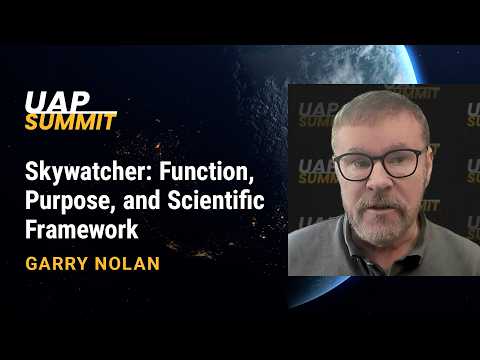
Garry Nolan at PEAR Club: UAP materials and intelligence
P
Pear Club
Interviews
39K views · a week ago · 1:21:52
Researcher Garry Nolan speaks at the PEAR Club, exploring the possibility that UFOs are not alien spacecraft. He presents a theory about technology created by advanced intelligence.
0 comments
No comments yet. What did you see? Drop a timestamp (like 12:34) and everyone can jump straight to it.
Garry Nolan, a Stanford pathology professor and researcher, joins PEAR Club at Princeton University for a wide-ranging conversation about UFOs and unidentified anomalous phenomena. He describes laboratory analyses of materials reportedly connected to UAP encounters, including tests of chemical composition, isotopic ratios and material structure. Nolan cautions that unusual or industrially produced material does not, by itself, establish an extraterrestrial origin.
The discussion also covers brain scans of people reporting unusual experiences, military and pilot accounts, and an effort to conduct observations using active radar. Nolan distinguishes reports he has heard from what he has personally witnessed, saying he has not seen a UFO himself. The conversation considers possible forms of non-human intelligence, including biological and artificial possibilities, and asks how researchers can investigate extraordinary claims scientifically without treating speculation as confirmation.
Key points
Nolan describes laboratory analyses of samples reportedly associated with UAP encounters, including their composition and isotopic ratios.
He says unusual or industrially produced material does not by itself prove an extraterrestrial origin.
The conversation covers brain research involving people who report unusual experiences.
Nolan recounts an observation effort involving active radar and discusses military reports.
He says he has not personally seen a UFO and distinguishes reports from confirmed findings.
0:00Gary, thank you for um for coming and I think I'll just start with a little intro, a little background for Gary, then we'll get right into it. So, tonight we're joined by Dr. Gary Nolan, a professor of pathology at Stanford University School of Medicine and a leading researcher in genetics, immunology, and cancer biology. Dr. Nolan has published over 350 scientific papers, holds 50 US patents, and has been recognized as one of Stanford's top 25 inventors. His research has helped develop technologies used around the world to better understand the immune system and diseases like cancer. Beyond his biomedical research, Dr. Nolan has become one of the most prominent scientists investigating unidentified anomalous phenomena, also known as UAPs and UFOs. He's analyzed materials reportedly
0:47associated with UFO encounters, examined brain scans of individuals reporting possible UAP encounters, and he also is a member of the newly established UAP Science Advisory Council, which was which provides scientific advice to the federal government as a part of the White House's UAP Transparency Initiative. He's also a co-founder of the Soul Foundation, which brings together scientists and scholars to investigate these extraordinary questions in a rigorous and open-minded way. That mission really resonates also with what we're trying to do here at Pair, which is create a space where extraordinary questions can be explored in a serious and open way without assuming the answers in advance. So, Dr. Nolan, we're really excited to have you tonight.
1:33>> Yeah, well, thank you very much guys and gals. I very much appreciate it. It's nice to see. You should get together with I think there is a common group also up at Yale who are working who have a similar group of like-minded individuals. I spoke with them a while back. >> Yeah, I did not know that. So, I'll definitely get in touch. Appreciate that. >> Yeah, I think Peter knows >> Okay. >> just skyfish. >> Oh, awesome. Okay. Well, I guess kind of just get started, I'd love to kind of if you could go over what initially drew you to the UAP topic and how did you become involved in researching this phenomena? >> So, um I guess I'll just actually start with this first slide here. Uh let me see if
2:20
I can get this going. Uh share blah blah blah. Where is it? Why is it not showing? Ah, there we go. Okay. So, that's basically your question right there. Um so, well look, I mean I've been interested in uh science fiction, frankly, for quite a while. I mean my since I was a very young boy, probably most of what I read was uh science fiction rather than the uh let's say the standard liberal arts work um or papers and uh books. Uh but
3:05I was also interested in the science. So, you know I'd you know my parents got me, let's say my first chemistry set when I was about five or six. Uh today it would have been outlawed. It probably would have killed it would have killed you. It had so many poisons in it. It was sort of funny. That was back in the early '60s. Um but uh you know it it it really I got interested in it because at one level back in the let's say the early '2000s when YouTube started to become a thing, you know I was poking around on the internet and you start going down these various rabbit holes. And one of the rabbit holes that I just got drawn towards was the whole UFO phenomenon. Uh and I found a lot of schlock on there, but I also found a lot of stuff that said to me, hmm that looks interesting. I mean this was well before the time of of AI hoaxes.
3:51I think uh you know you you might have thought that you could make something with uh Photoshop etc., but an animation, but some of them just looked a little too real. Um and and actually the first thing that got me brought into it was uh a small skeleton that people were claiming was an alien uh tiny alien. It was called the Atacama skeleton uh that somebody had found and you know if you looked at it it looked like an alien and I thought to myself okay well I can figure out what that is you know maybe if it's if it's human or if it has genetics and so I reached out to the individual who claimed to have access to it uh and after a number of months managed to get a small piece of bone uh from one of the ribs of it but meanwhile I had
4:37had them do uh x-rays of the of the skeleton. I'd brought it to literally who the person who was the world leader in pediatric bone disorders at Stanford um who had literally written a book on the subject matter and he'd said well you know I haven't seen this collection of disorders in a human baby before and the uh the bones all look old enough and [snorts] you know long story short we did the genetics of it. It turned out to be fully human. It came from the Atacama region of uh Chile because we also happen to have the expert on uh South American indigenous uh genetics uh at this on the Stanford faculty at the time and you know we published the paper
5:22uh to what I thought was going to be little acclaim just to say hey it's it's human but literally the next day all over the internet front page of every newspaper was basically the headline Stanford scientist sequences DNA of alien baby. And so that was my introduction to fame and fortune and notoriety uh at the time and so um it wasn't long after that actually that uh at my door came two men uh who knocked on my door at my office and uh said hey we're from we're from the CIA and an aerospace company and uh we have some people who've had
6:09some problems. About 100 of them that had been collected that we wanted we asked around for who has the most advanced blood analysis system. It turns out that it was you who is the person who everybody pointed us at because of something we co-developed called Cytoff which led us to deep data analysis. And what we found was that well first of all what they showed me was that or told me was that they had a number of individuals who had started hearing things and suffering all kinds of audio and dysmorphia in their body or seeing
6:55things and they didn't know what was happening but what was fascinating was these were all people who were in either the diplomatic corps or the intelligence corps of the US Armed Services or our Security Services. And you know so how did these cases come to be collected in one place? Well the way that the government works is that case records move up various chains and eventually they move over to a place where people start to analyze them and this was a group of individuals who had been put in what had been called the weird bucket. We don't know what to do with these people and or what to do with these medical cases. But then one individual
7:41an analyst, CIA analyst had looked at enough of them and said hey there's something common about all of these that we're starting to notice. And so this was literally one of the first things that they that they showed me was that this is what the cross section of an individual's brain is supposed to look like normally and then here's a cross section of one of the individuals who had both a systemic sclerosis, basically skin damage and internal damage but also damage to their brain. This what these white areas here are damaged dead areas of the brain. And if you have a family member or a friend who has for instance multiple sclerosis, you'll see very similar kinds of patterns in the in the brain. And so this what what this really did was this was around 2012 and we studied
8:27these individuals for about four years. I flew out to meet a lot of them to take their verbal records and was around 2016 that the front page of the New York Times hit a set of stories called Havana Syndrome. A group of individuals who in Havana in our diplomatic corps who were suffering almost the identical symptoms that we were seeing. We had at the time started already call what we were seeing interference syndrome because these individuals were being interfered with. But this was science and but the reason and where UAP came into this was that although 90 of the individuals didn't say anything about UAP, 10 of the individuals actually had well five of the 10 had started to say huh well actually it wasn't
9:13I didn't have voices in my ears or anything like that. I actually actually was close to an object that was emitting some sort of radiation that was to me I would have called it a UFO. And I got skin damage. Now what was fascinating about those individuals is that they didn't have this kind of damage. They actually had damage across their body or whatever portion of their body was facing the object that they claimed that they saw. And I also spoke to to them as them as well. So you know once we got into that what was fascinating was that we noticed something else in in one of these in some of these individuals. And you see this area that I've circled here and
9:58this is sort of a one of the side benefits of looking deeply into into the biology or whatever it is you're looking at and looking for anomalies. This dentate pattern that see here is actually not supposed to be there. Um in the standard medical texts. This is the area of the basal ganglia and this is the head of the caudate and the putamen. This is the head of the caudate and this is the putamen here. Um and these wirings across the uh across this gap here are different between individuals. And as it turned out, and this is a long study that I did with a group at Harvard, Maria Modi, uh who studies autism and brain development um at Harvard Medical School. So we did and
10:44we published now four papers showing that what we had noticed here was that this was related to uh intuition and intelligence. So the more of these connections you have between here, the better you were at, it seems, recognizing anomaly or something which was out of place and intuiting what it actually really means. So that's kind of problem solving. And it is now well known that even though at the time it wasn't, it is now well known that this area of the brain is involved in intuition. And we've related it to to this area here. So why would individuals like this show up again and again in studies in our diplomatic core or in people who got close to these objects? Well, one idea might be that they pay
11:29attention. Well, first that they're intelligent and uh uh people who are, let's say uh intelligence analyst, have to use intuition. So they're going to have a function like this or they're going to have a brain structure that correlates with a functionality that relates to intelligence or they're willing to notice something out of place and you know move towards it or walk towards it. And so here's one of the interesting things that we found uh and I'll stop on this part here for a moment um after this is that if we looked at 200 individuals and the amount of cross connectivity across such individuals, the control range of most individuals is a density of this. But we had found amongst that cohort and
12:16a group of other couple of couple of hundred others of high intelligence individuals connectivity patterns that related all the way up to super high connectivity and this correlated very closely with IQ and functionality. And what was even more important is that even though this is only found in about one in 200 individuals, we found a number of husband-wife pairs where both the husband and the wife would have it as well as the children. So it's a whatever this feature is, intelligence, you would might not be surprised is heritable. But also that intelligent people like to marry other intelligent people. So you might have and this is kind of a kind of a warning sign here. You might
13:01be seeing the first signs of something that I would call speciation. So I'll stop on on that. That's what got me started on it. And then depending on what else you ask, I'll move on to some other sections. But that got me interested. But what I found was almost immediately was an incredible amount of pushback from my colleagues. And I was basically cornered at one point at a medical conference actually was a cancer conference by one of the the the the deputy heads of the National Cancer Institute at a bar and he said, Gary, you know,
13:46you're going to ruin your career with this. You know, why are you doing this? And you know, I just looked at him and I said, well, why why shouldn't I? I'm just asking questions. It's just data. I why are you why are you being this way? He says, well, it's just it's just the wrong kind of questions to ask. And I just I got really mad at that and I said, you know what? You sound more like a priest than a scientist. Maybe you should give up your PhD. You know, maybe you should go join the clergy because that's doctrine. That's dogma. that's not how science is done. And so, you know, if I had slapped him in the face, that would have been a that would have been a worse react that would have been a lesser reaction than what I had said when I said you should give up your PhD
14:31because you're breaking your oath. So anyway, that's what got me started. It was that inner like how dare you tell me I can't ask a question cuz that's supposed to be the very basis of what science is, asking questions. >> Love to hear that and that's it that you're right, you know, it is about asking the questions and I've even heard you say it's science it's looking at you know the data off the curve and trying to understand like what are those like if something seems anomalous like let's look into that rather than just dismiss it. And I guess kind of the next thing that you know we definitely really be curious to hear about is you know you've like you've you've been saying you've been personally investigating brain scans but also you've been looking into you know actually materials from these crafts and
15:16you've also had a lot of you know experiences where you've even spoken to people firsthand who have had these encounters and if you can maybe just go over some of the um most compelling evidence that you have seen that something is generally anomalous and potentially involving non-human intelligence. >> Right. Okay, well I've got got the slides ready to go for you on on some of this. So um I'll share again. >> Great to hear. >> Um here we go. Share. So um this was actually one of the first ones and I I don't know how many of you know Jacques Vallée. Um Jacques Vallée has written um a number of books. He
16:01worked with uh Hynek. Uh if any of you have ever seen um Close Encounters of the Third Time, the French scientist is actually based on Jacques Vallée. Uh and um so uh Jacques is a very close personal friend of mine and I've met with him and actually I consider him my mentor, uh who've pointed me in many of the right ways and probably the most annoying answer he ever gave me uh and when I first met him and frankly made me fall in love with him was uh when I said I asked him I said well is it is it one thing that we're seeing or is it many things? And his answer was well or is it one thing pretending to be many things? Cuz you have to start thinking when
16:46we're when we talk about this in the long run is are we seeing one species that's here? Are we seeing one phenomenon that's here? Are we seeing a collection of phenomenon? Uh and as you dive deeper and deeper into the into the matter it gets weirder and weirder. Um but this was the the first case that Jacques and I um investigated. So he over the decades had collected uh materials with great chains of evidence from individuals. So let me give you a bit of history of Jacques. When he was a young boy uh during World War II um his father was a judge. So he was a in a well-off family. His mother and he looking over the valley saw a UFO off in the distance
17:31and a friend of his saw the same thing. And that in some manner or another set a path in his life towards going on and becoming an astronomer, getting a PhD in astronomy and eventually moving to the US and working in astronomy as well as he was actually one of the first uh developers of something called ARPANET which was the precursor to the internet and then he became a venture capitalist etc. So uh a very accomplished individual. But along the way he was still working on uh UFOs and looking at data off the curve. And so this was some material that he had obtained uh from an account that had happened in Brazil uh in the Ubatuba area of Brazil. And so an object is seen uh above the water by some fishermen
18:18uh uh it it actually didn't explode itself. It dropped something which then exploded. Right? Like it dropped something that looked like it was flaming uh and white hot and then that exploded all over the water and onto the beach. And he picked up some of the material and then sent it off to a a reporter uh in Rio de Janeiro. And then some of it made its way to the United States and some of it made its way down to Venezuela. Uh and here's what got kind of interesting. The stuff that came to the United States was shown to be nearly pure magnesium. Um and so uh but the stuff that went to Venezuela turned out to be uh something else. So uh it wasn't just a uniform object, but both of the
19:05analyses of each of those chains of evidence ended up being interesting. Um and this is just the chain of evidence of who had it and where it came from uh and then what came to me. Um and actually some of it went to this guy Peter Sturrock who who was an astrophysicist at uh Stanford who was who's just recently died at the age of a hundred. Um but he was also interested in UFOs and I met him uh about 10 years ago. Uh wonderful wonderful old British classical British academic. So I told you that around 1957 this was supposed to have happened. Um so the analyses of the material that came to the US showed ultra high purity magnesium.
19:50That's interesting. One of the other interesting things about magnesium, if you know it, is that once you set magnesium on fire, you probably heard of something called a magnesium flare. It's very hard to put it out. So, you know, if this thing exploded, it would not have gone out in water. It would have still burned. So I think the explosion uh if it did uh have anything to do with the magnesium, didn't set the magnesium on fire itself. So he received it, later tested it. But I got a hold of some of the material here, two different versions of it, moisture A and moisture B. So if any of you know Spanish, that that's um not uh so this is not Brazilian, that's Spanish. It means sample A and sample B. Um but if you know anything about your early chemistry, that to me didn't that
20:36didn't look like magnesium uh because magnesium should have an oxidized surface on it. Uh so it was shiny. So I thought, oh that's interesting. Um so we started doing some analyses and we did two kinds of analyses. Um one analysis was something using an instrument called an atomic probe tomographer. And what APT does is you can literally take apart uh a piece of material atom by atom and get its relative position uh and you use something called a time of flight mass spectrometer uh and what you get is a a column of information of what the atoms are and what their masses are. Uh and as it turns out that this piece by itself
21:22was something like 99.999% silicon and not um actually um magnesium, which was weird cuz the other people said that what they had in America was magnesium. So let's just stop there for a second. Who was making in 1957 99.999% magnesium? Now I had dinner literally two nights ago with one of the one of the heads of TSMC, the Taiwanese semiconductor um corporation. They're like the they make 95% or sorry 70 something percent of all uh silicon related uh objects uh and
22:08technology in the world. Uh and he runs us he runs all of the startups here in Silicon Valley and around the country, a Taiwanese gentleman. And he was at dinner with with me and a bunch of other VCs. Um and so you know they actually have several of these instruments that do kind of analysis because they are interested in knowing what the interfaces are for many of their semiconductors. Okay, so so that was the silicon. So okay, who was making it and why were they making it? This level of purity was not available or not easy to make and and if it even was, why would you do it and blow it up over a uh beach in uh Ubatuba, Brazil and drop it from a cylindrical or a saucer-shaped object
22:54that fishermen saw. So you you you you can't explain any of this stuff away by just explaining one feature. You can say that maybe people people could have made this level of purity, but then you have to explain why it was in Brazil and why it got blown up and dropped off of um a saucer-shaped object, right? So a lot of the debunkers that are out there will pick off any one of the individual pieces and say, well, it can be explained by this. And Mike Shermer is probably one of the worst and unfortunately he he sits on the UAP uh um council with me and he and I get into vociferous arguments all the time. You know, well-meaning, but you know, uh I I don't think he's uh a a good faith arguer uh and that's publicly known. So that's fine if
23:39anybody wants to go tattletale on me. Um but what caught my interest was that well, it's supposed to be magnesium that the other people had said. So we went to a different kind of mass spectrometer called a secondary ion mass spec and this was a um this is something uh called a magnetic sector mass spectrometer uh which whereas here you can see every individual atom uh and you can get its relative position. This is so accurate that you can tell the difference between chromium 54 and iron 54 which you can only see at a mass resolution of like the third or fourth decimal point. Um and so we went looking in this piece of what was otherwise pure magnesium,
24:24sorry, otherwise pure uh silicon for well, what's going on with magnesium. Um, and what was fascinating was that moisture A and moisture B differed. Um, moisture A looked like the kind of magnesium or it had it had impurities down at the 1 in 1,000th level uh of something of magnesium 24 25 and 26 and this other instrument that I used is so sensitive you can see down to the parts per trillion. Um, and uh the ratios of shard one and shard two two different shards from the sample A uh in the same instrument at the same time on adjoining
25:09uh positions on the rack that is that moves around that looks just like terrestrial levels of these magnesium isotopes. And the the levels of the isotopes of the various um elements that have multiple stable isotopes pretty much anywhere on Earth and even if you go to Mars will be uh what happens or what shows up naturally according to stellar formation. Um, but what was fascinating was that the the other sample moisture B had both shards different from this and different from natural. So again this is just data. It's not proof of anything but the question you have to ask is who would change the ratios of the
25:54magnesium isotopes that went into a highly pure silicon and for what reason would you do it and how would you do it? Now it was possible to change ratios of isotopes. I mean at the time uh the Cold War was well you know into uh its full-on process. People were isolating isotopes of uranium and uh plutonium for making bombs. Uh, [snorts] but what they weren't going about making isotopes of magnesium for any good reason because we frankly don't know what we would do with those different isotopes in the first place. So why would you separate them and make them different? So what are we left with? We're left with something which is clearly industrially produced, right? There's no doubt about it. You don't you you you can't go onto a beach
26:39anywhere and find a chunk of silicon the size of your hand uh that is as pure as this. And we are left with this oddity uh where part of it has natural ratios of magnesium and the other part of it has unnatural ratios. Okay, so that's one example of one thing that gets dropped off of an object that somebody sees. There are multiple things like this. I've got probably half a dozen of them of things that are dropped off of objects uh molten metals that are dropped and people go and collect them. I've got I've got pieces like this from Australia, a piece from uh central California. Uh and this one is from uh Council Bluffs, Iowa circa
27:241977. So, I was about 16 years old at that time. And uh it was observed by multiple individuals from multiple places. Um and they saw an object about 500 ft off the ground. And I've spoken to one of the um one of the uh witnesses and he drew this kind of hexagonal shaped object uh that looked like a probably 50 ft high and 20 ft across that was glowing. And it dropped this molten metal. And this is from the This is one of the original uh and I actually have the Polaroid sitting right behind me uh in my drawer uh of the police that came and took a picture of this. It's about
28:09um 5 ft across in each direction of molten metal. Okay, so what is it? Uh so I went in uh and did again these kinds of analyses. Uh and this was the first ever published peer reviewed paper on a UAP uh um material that nobody had nobody had ever published anything like this before. And how do we get it published? Because we didn't claim anything. We just said, here's the story, this is what it is. We're putting the data out. We'll let you guys decide what you think that it is. But it's an interesting story and uh and here's the background to it. Um and so here's just the the the TLDR on it.
28:54Naturally occurring elements, no isotopic ratios, but what was interesting is that it had like titanium, iron, a couple of other elements in it, chromium and stuff. And yet, depending on where you looked in the material, it had a slightly different flavor. It's kind of like imagine if you took chocolate, strawberry and vanilla ice cream, let them melt, swirled them just a little bit. Depending on where you looked, it would have different ratios of chocolate, vanilla or strawberry. So whatever it was was not something that somebody had fully mixed in a blender. And then but every possible explanation from thermite to
29:39aircraft meteorite, every industrial explanation was completely impossible for this material to get where it was. Um and uh we we had replicated work that had been done at that time and then we did additional work uh showing this differential variation of the material across the object. So again, what are we left with? Something which is clearly industrial, correlated with an unusual sighting, dropped off an object. And if you can go into the do an AI search of the literature these days and you'll uh and newspaper reportings and you'll find at least a dozen of these things where people find these objects, stuff that's dropped off. So you're sort of left with a okay, are they throwing away are they throwing away their garbage?
30:25Is this like a reason to like eject the warp core cuz something has gone wrong? Um is this refuse of some kind? Uh the only common the most common thing I found of the few that I have is that they all seem to contain except for the silicon one, aluminum. So that's the that's the last of that one. Um but the most fascinating one, and this is one that I'm working with a couple of um uh there's a a Stanford grad student here in material science and a and a grad student who just finished his PhD up at Berkeley and working over at the um uh at the uh Berkeley Labs in material science. And this one is an old story of something called the Arts Parts story.
31:10Um again um something claimed to be from a UFO. It has a a less connected history to something actually observed, but um this is basically how it looks. It's layered magnesium oxide crystals with interlaced layers of bismuth and zinc. Um and so we've done some pretty deep analysis of these colors here are the crystalloid magnesium oxide layers and the colors represent the angle of reflection of uh that you can use with incoming electromagnetic radiation. So the these are columns of magnesium which have slightly different orientations and the orientations can be represented here by
31:56these hexagons showing that they have slightly different angles and the colors represent the angles. Um and the shape of this is due to the fact that according to the material scientists, this underwent high stress, uh high heat um and uh was clearly related to some sort of crash. And the story that it came from was a crash. Now again, go into the literature, try to find anything related to aeronautics or you what have you that would say that this is why a person would make something like this. Why would a person make something like this? There's no known reason for making it and certainly no known reason for putting bismuth at the interface with interlaced um zinc
32:42crystals. Uh and you know, even if you talk to a material scientist, they say we don't know how anybody would make this. Um we're we're basically left with you know, the methods that you would use would be sputtering, molten salt electroforming or grind yard deposition. And the standard ways that we might make something like this just it is not evident that it was made by that cuz it doesn't have the necessary um structure or contaminants that the approaches that are known to uh work from a potentially making something like that would have left behind such such residue. So again, we're left with this is this is the most clearly made object
33:27uh that is of industrial design, but we have no known purpose. Now that doesn't mean that there's not some super secret black super secret black project somewhere that would have needed to make something like this and that just sort of snuck out the back door and somebody mistook it for a piece of UFO. Um uh but uh still there's we're we're writing up this paper actually right now. Um we're going to publish it with this in the same manner. Just here's what people have claimed. Here's what it is. You tell me why anybody would have made it. Right? And because I would love to I would love to have somebody come and tell me, hey, this is actually this so you can stop worrying about it. So that's kind of the general approach that we that we make um and how we
34:13approach it. So I'll stop there on on on that one. >> Awesome. Well, that is really appreciate like that in-depth breakdown. I think you know, a lot of us here haven't you know, been exposed to the um like exactly what what makes these anomalous and you know, you were breaking that down really specifically and that is a big part of your research and even like you've been saying, you're looking at you know, you're just calling this evidence. You're not trying to jump to a conclusion to anything, and I think that's I think that's a really big part in like actually pushing this forward. And I guess >> but I'll I'll also say to the to the group as well cuz you're going to get push back whenever you bring this
34:58subject matter up. Um they're going to say, well, there's no evidence. Well, there's lots of evidence. Uh evidence is just data contextualized around a hypothesis. You know, the same set of numbers that could be somebody's golf score could also be your heart rate, right? Depending upon how you ask the question. So there's lots of evidence for UFOs, but proof really only only happens in uh math where you can border the guard rails of the question in such a way that you can prove what it is that you've got. So when people say there's no evidence, laugh at them. >> Will do. Well, I guess kind of that kind of leads into I guess my next question and that is you know, you've spoken like you were
35:44kind of just going over the analysis you've done on the materials, but I I've heard you speak about, you know, personal experiences you've had and you've also, you know, had a lot of encounters with people who have also had, you know, firsthand experiences with you know, UAP or, you know, even potentially aliens. So could you are there any cases that you could speak to openly and share? >> you've you've set me up perfectly for literally the next slide. >> Wow, let's let's go. >> Um so I was part of um let's call it a a military aligned but um publicly funded uh study where you know, how I got here involves
36:30phone calls in the middle of the night from shadowy figures who I had to call a friend of mine and give him the telephone number and say, I just got this phone call from this guy who said xyz. He called up his friend in the IC who traced the number, called them, got the their voiceprint and figured out what area the country they were ever from, and then the guy who had originally called me called me back and said, how did you do that? I said, well, I have my contacts, too. And so I tracked the guy down. He agreed to meet me in Houston cuz I was going I was doing my sabbatical down in the laboratory of this guy Jim Allison who won the Nobel Prize for immunotherapy is a good friend. And so we met at a hotel bar late one night
37:15to set up what became this was the the Sky Watcher effort. So he claimed and had showed me in that bar that he had a signal that he could use that would cause UAP to occasionally show up within a few hours after the signal being set off. How did he find the signal? He wasn't looking for it. He was one of those people who just noticed something odd. He's a military and worked with the military in radar systems and noticed that when certain radar signals that they were using for other totally other purposes, totally banal or military purposes, he started getting these objects showing up on his
38:01on their radar. And this was before the before drones were a big thing, let's just say. And so you know, he noticed the data off the curve. And he kind of put it together. And then he snuck out the back door with this information and collected some of his own radar equipment and did some early tests himself and said, huh, this seems to be this seems to be working. Stuff is showing up. So we got this project funded to the tune of about $10 million. It was called the Sky Watcher project. And we went out we had about probably or about probably 15 people. About half of of were military aligned and had been involved in,
38:47let's just call it um uh collection services um in the in the past not necessarily UFO collections but just they were experts at collecting downed objects mostly former Russian or Soviet or Chinese materials. So um we went out literally into the middle of the desert in three different locations. One was in Southern California near China Lake um where we could another was near El Paso where we could cordon off about 10 miles on either side of us fully from any overhead air traffic. This was all arranged with the FAA.
39:33We got permission to use active radar um and here's sort of the idea that we were looking to make a call and see if anything showed up. Um so here's the site uh and this is me in the helicopter basically arriving at the site um where we did the did the work. And this is our lovely accommodations just looks like the looks like the four seasons doesn't it? Um it's a military training ground. Um and so you know um we had this was the one in El Paso. We had also done one at the China Lake facility
40:18and we'd gotten some really weird stuff to show up and got some interesting um video of that and and drawings and that was extremely controversial what was going on but it was it was interesting. And uh and by the way just one of the things that I I forced everybody to sign before we did any of this is that if we get something to show up there will be no attempts to shoot it down. I I don't want to be involved in any takedowns of any objects that might have anybody on board. I mean, for I would lose my tenure. I mean, I have a great endowed chair. I mean, I you know, why would I even you know, ethically I just couldn't even imagine doing something like that. Uh but at least people signed it whether
41:05they would ever have followed through we'll we'll see. So we did it. We ship on we we got something to show up. And um and we call this the jellyfish. Uh and there's many uh uh basically images of this kind of object, whatever it is. Uh so we didn't just take a picture of it. We actually sent a helicopter up. Um and this is a military grade helicopter. Now here's what was fascinating. Um the helicopter was only able to get within about 100 ft of the object. Now listen to how I just said that.
41:52It tried to get closer but it couldn't. It was being stopped. The electronics stopped working. This is a military helicopter which has a backup uh manual system. So they turned off the electronic version and they went to manual and the manual wouldn't work either. It would only let them move backwards. You know, um I interviewed the pilots when they came down uh and said, what did you see? Have you ever anything like this ever happened to you before? Short answer was no and I'm never and then the the second answer was, I'm never going up into do anything like that again. I'm leaving now. So um Eric Berlinson, one of our
42:39representatives because we had reported this, said that the intelligence community was aware but we let them know what of what we were doing and they have repeated what we did elsewhere out at White Sands in New Mexico and have seen something show up. So why do objects show up when the angry monkeys send signals on a repeated basis? I don't know. But um that's you know basically. And so I told you earlier I was involved with the X Prize. We put so two of the three Avi Loeb has the third uh of what will we hope to be one of the X Prize challenges. We haven't got it funded yet. Technology beyond human capability.
43:24Reproducible signal and response. And with Avi's uh is movement uh as measured by multiple by multiple criteria uh in a non-human manner and prove it in any one of these three ways and you get $10 million. So anyway that's the uh that is not formally done yet but that's what we're trying to we're trying to get funded right now. >> That was really interesting seeing those videos and that was pretty insane as well even seeing how the helicopter was working like that. And Yeah no I I never seen that before but I'm I'm curious so like you've spoken to a
44:10lot of these different you know I guess intelligence officers and you know this is something that you actually went to first hand and got to experience but are there like what what do what do people report like are there patterns that you have been seeing and even I saw on the Sky Watcher um website you guys have like I think nine different classifications of UAPs that you guys have I guess research so >> Right or seeing yeah. >> what are like the patterns of like are people saying that they're seeing um beings and yeah. >> Well the the beings I have a harder time with the beings um you know uh I mean there's I'm having arguments with people on Twitter all the time about what why they look to be why they look to be humanoid. And I just have a hard time with them
44:56genetic from as a geneticist, that's where my PhD in, uh when I was a grad student here at Stanford, um was uh I I have a hard time with them having the two arms, two legs, forward-looking eyes. I can imagine a thousand different variations of you know biology that could uh work equally as well without being an you know for like an arthropod or whatever or humanoid um tetrapod. And uh so um the craft sizes and object movements have been classified. Uh but there's that's just what Sky Watcher has observed, right? As opposed to what the field overall has observed over
The transcript is shortened here. Keep watching from this moment in the player.