Official · Document · Department of War
Reports of Evading Objects Troubled the Air Force
US Air Force commanders believed the reports described something real. They still didn't know what was seen.
US Air Force commanders believed the reports described something real. They still didn't know what was seen.
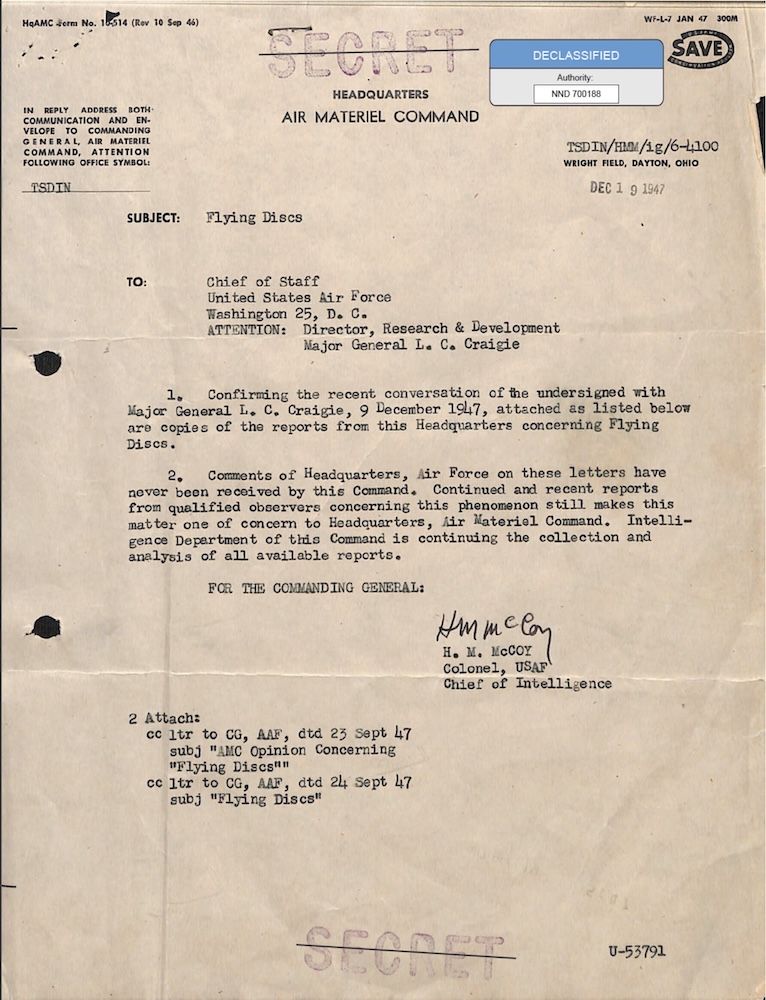
In 1947, the US Air Force determined that reports described a real phenomenon. Eyewitnesses described objects that appeared to evade aircraft, but the military didn't know what they were.
A compiled file of Army Air Forces / U.S. Air Force intelligence correspondence from August through December 1947 dealing with the so-called 'Flying Discs/Saucers'. The file contains the 23 September 1947 Twining letter ('AMC Opinion Concerning "Flying Discs"') stating the phenomenon is 'real and not visionary or fictitious', the 30 December 1947 directive from the Director of Research and Development establishing a project under priority 2A, classification 'Restricted', and code name 'Sign'. It also includes related case correspondence (Mary L. Herren photographs from Oregon, the Mrs. Madelina-Gwynne Merchant 'Russian laboratory in Central Mexico' theory, an AMC request for data on a Japan radar sighting, the Loedding Flying Disc drawing transmittal, and references to Horten brothers flying-wing intelligence) and the 22 August 1947 Garrett pattern-analysis memo with Maj. Gen. LeMay's 29 August 1947 reply that the AAF has no project matching the saucers' characteristics.
Mary L. Herren submitted photographs taken between November 5 and 12, 1946 in which she pointed out a formation in the sky that she did not recall seeing herself but thought might possibly be flying discs. Fourth Air Force A-2 forwarded the photos; USAF HQ ruled the marks were defects in film, paper, or camera and requested no further investigation.
A 'flying disc incident in Alaska in September' was briefly mentioned in a recent intelligence report from Hq, USAF, AC/AS-2. AMC's McCoy noted the close-range sighting reported should have produced a more detailed observation than what was reported and suggested follow-up.
An incident reported in Seattle appeared in the 'Dayton Journal' on 12 November 1947; AMC asked HQ USAF to follow up if possible.
An alleged 'Flying Saucer' flight sighting was made by a radar station in Japan; mentioned by Dr. Charles Carroll during a conference in Brig Gen Schulgen's office attended by A.C. Loedding on 5 September 1947. AMC requested all available information.
Mrs. Madelina-Gwynne Merchant of Santa Fe, New Mexico described a theory to Brig. Gen. Brentnall at Las Vegas that 'Flying Discs' were being fired from a laboratory in Central Mexico operated by the Russians and aimed at the United States 'for the purpose of sighting in on important atomic energy and aircraft installations.' Case ultimately closed; no interrogation directed.
"The phenomenon reported is something real and not visionary or fictitious."
Speaker: Twining (AMC Opinion Concerning 'Flying Discs')
Why it matters: Foundational AAF/AMC statement that the flying disc phenomenon is real, signed by Lt. Gen. N. F. Twining; precedes Project SIGN.
Page 9
"There are objects probably approximating the shape of a disc, of such appreciable size as to appear to be as large as man-made aircraft."
Speaker: Twining (AMC)
Why it matters: Official acknowledgment that disc-shaped objects of substantial size were being observed.
Page 9
"The reported operating characteristics such as extreme rates of climb, maneuverability (particularly in roll), and action which must be considered evasive when sighted or contacted by friendly aircraft and radar, lend belief to the possibility that some of the objects are controlled either manually, automatically or remotely."
Speaker: Twining (AMC)
Why it matters: AMC concludes some objects appear controlled and evasive.
Page 9
"(1) Metallic or light reflecting surface. ... (3) Circular or elliptical in shape, flat on bottom and domed on top. (4) Several reports of well kept formation flights varying from three to nine objects. (5) Normally no associated sound, except in three instances a substantial rumbling roar was noted. (6) Level flight speeds normally above 300 knots are estimated."
Speaker: Twining (AMC)
Why it matters: Composite morphology and performance description compiled from multiple 1947 sightings.
Page 10
"The lack of physical evidence in the shape of crash recovered exhibits which would undeniably prove the existence of these objects."
Speaker: Twining (AMC)
Why it matters: Explicit AMC statement (September 1947) that no crash-recovered physical evidence exists.
Page 10
H. M. McCoy
Colonel, USAF, Chief of Intelligence / Deputy Commanding General Intelligence (T-2), AMC · Air Materiel Command · Page 1
L. C. Craigie
Major General, Director of Research & Development · U.S. Air Force HQ · Page 1
N. F. Twining
Lieutenant General, Commanding · Air Materiel Command · Page 14
George Schulgen
Brigadier General, AC/AS-2 · Army Air Forces HQ · Page 9
George Garrett, Jr.
Lt Colonel, Office of the Director of Intelligence / AC/AS-2 Collection Branch · USAF HQ · Page 7
George McDonald
Major General, AC/AS-2 · Army Air Forces HQ · Page 15
Mary L. Herren
civilian witness/photographer · 1728 S.W. Bidwell Avenue, Portland 2, Oregon · Page 6
Donald L. Springer
Lt. Colonel, USAF, AC of S A-2, Fourth Air Force · Hamilton Field, California · Page 6
Madelina-Gwynne Merchant
civilian, advanced theory that flying discs were fired from a Russian laboratory in Central Mexico · Santa Fe, New Mexico · Page 20
Brentnall
Brigadier General, AMC; interviewed Mrs. Merchant at Las Vegas · Air Materiel Command · Page 20
Herbert C. Gee
Lt. Colonel, formerly Commanding Officer at Los Alamos; later Office, Chief of Engineers, Civil Works Division, Washington, D.C. · U.S. Army Corps of Engineers · Page 21
Howard G. Bunker
Colonel, AC, Kirtland Field · Operating Location No. 16, 751st AAFBU (101st AACS Sq), Kirtland Field, Albuquerque · Page 20
This file is a high-value compilation for the foundational period of U.S. UFO investigation. It contains two copies of the Twining Memo (23 Sept 1947) and the 30 Dec 1947 directive that chartered Project SIGN — these should be cross-linked with any other corpus documents mentioning Twining, Schulgen, Craigie, Project SIGN, AMC TSDIN/TSNAD-2B, the Horten brothers, or the Loedding LD-2 drawing. The file's cover letter (19 Dec 1947) by Col. McCoy notes AMC had not yet received HQ Air Force comments on its earlier reports. The OCR is occasionally garbled (no embedded text; ocr_ratio 1.0); page numbers cited reflect OCR page numbers in the .txt file. No visible redactions noted in the OCR.
The command determined that the reports described a real phenomenon, not imagination or a fabricated story. It did not determine what the objects were.
The document mentions observers deemed suitable for providing sightings but does not explain why.
The documents do not describe any debris that proved the existence of the objects.
"The possibility that some foreign nation has a form of propulsion possibly nuclear, which is outside of our domestic knowledge."
Speaker: Twining (AMC)
Why it matters: AMC entertains the possibility of foreign-origin nuclear propulsion.
Page 10
"it is desired that the Air Materiel Command set up a project whose purpose is to collect, collate, evaluate and distribute to interested government agencies and Contractors all information ... It is suggested that the activities of this project ... be set up at priority 2A, with a security classification of 'Restricted' and Code Name of 'Sign'."
Speaker: Major General, USAF, Director of Research and Development (30 December 1947)
Why it matters: Directive establishing what becomes Project SIGN — priority 2A, classification 'Restricted', code name 'Sign'.
Page 3
"It is Air Force policy not to ignore reports of sightings and phenomena in the atmosphere but to recognise that part of its mission is to collect, collate, evaluate and act on information ..."
Speaker: Director of Research and Development, USAF (30 Dec 1947)
Why it matters: Statement of formal Air Force policy on UFO sightings at the moment of project establishment.
Page 3
"The marks appearing on the [photographs] inclosed in basic letter are believed to be defects in the film, paper, or camera and not pictures of 'flying discs'. ... It is requested that no further investigation be made of this incident."
Speaker: Lt. Col., Executive, Air Intelligence Requirements Division (1st Indorsement, 18 Dec 1947)
Why it matters: USAF disposition of the Mary L. Herren Oregon photographs.
Page 4
"According to her theory, 'Flying Discs' are being fired from a locality in Central Mexico from a laboratory which is being operated by the Russians. She claims they are being aimed at the United States for the purpose of sighting in on important atomic energy and aircraft installations."
Speaker: McCoy / AMC summary of Mrs. Merchant's theory
Why it matters: Captures civilian Soviet-origin theory routed through general-officer channels.
Page 20
"A recent report from the U. S. Military attache, Moscow, USSR, dated 9 June 1947, indicates that 1600 aircraft, directly or indirectly based on the Horten VIII design (six engine pusher, having a wing spread of 131 feet and a gross weight of approximately thirty-three thousand pounds) are being built for bomber squadron use. The Russian version, however, is jet propelled, reference report whose identification No. is V-32291-S."
Speaker: McCoy (AMC) to AAF re Loedding Flying Disc
Why it matters: Cites a Moscow attache report claiming 1600 Horten VIII-derived aircraft being built by USSR — links flying-disc analysis to Soviet flying-wing intelligence.
Page 16
"The German scientists at this Hq indicate that no important scientists from Germany are working in Spain, and those mentioned in this article are not known to them."
Speaker: McCoy (AMC, 18 Nov 1947)
Why it matters: Wright Field's German scientists (Operation Paperclip cohort) used to evaluate a Lionel Shapiro press story on alleged German weapons work in Spain.
Page 7
"The Army Air Forces has no research project with the characteristics described in Comment No. 1."
Speaker: Curtis E. LeMay, Major General, Deputy Chief of Air Staff for Research and Development (29 Aug 1947)
Why it matters: LeMay confirms in writing that the flying saucers are not an AAF project — answering Garrett's pattern-analysis memo.
Page 28
"The discs oscillate laterally while flying along, which could be snaking."
Speaker: Robert Taylor 3D, Col., Chief, Collection Branch, AC/AS-2 (22 Aug 1947)
Why it matters: Pattern-analysis observation about lateral oscillation; one of seven common characteristics enumerated.
Page 26
"When a trail is observed, it is a lightly colored blue-brown haze, similar to a rocket engine's exhaust. Contrary to a rocket of the solid type, one observation indicates that the fuel may be throttled, which would indicate a liquid rocket engine."
Speaker: Robert Taylor 3D, Col., Collection Branch (22 Aug 1947)
Why it matters: Describes a throttleable liquid-rocket-like exhaust signature attributed to the discs.
Page 26
A. C. Loedding
T-2 representative; subject of the 'Loedding Flying Disc' drawing LD-2 · Air Materiel Command T-2 · Page 15
Charles Carroll
Dr.; mentioned a radar-station 'Flying Saucer' sighting in Japan during a conference in Schulgen's office on 5 September 1947; also tasked with plotting flying disc incidents · AAF/USAF (consultant) · Page 24
Curtis E. LeMay
Major General, Deputy Chief of Air Staff for Research and Development · Army Air Forces · Page 28
Robert Taylor 3D
Colonel, Air Corps, Chief, Collection Branch, Air Intelligence Requirements Division, AC/AS-2 · Army Air Forces · Page 26
Douglass W. Eisenan
Lt. Colonel, Air Corps USAF, Executive, Air Intelligence Requirements Division · USAF HQ · Page 18
Spaatz
General, Commanding (signature line 'BY COMMAND OF GENERAL SPAATZ') · Army Air Forces · Page 25
W. R. Clingeman
Colonel, A.C., signing for McCoy · Air Materiel Command · Page 19
Lionel Shapiro
journalist; authored a story (in newspaper clippings) about war weapons developed in Spain reportedly with German scientist help · press · Page 7
Cook
Colonel (initials/typist line 'Col Cook') · AAF HQ · Page 3
G. P. Cabell
Colonel (signature block on 4th Air Force photograph endorsement) · USAF HQ · Page 4
Wright Field, Dayton, Ohio, USA
Page 1
Washington 25, D.C., USA
Page 1
Hamilton Field, California, USA
Page 6
Jefferson, Oregon, USA
Page 6
Portland, Oregon, USA
Page 6
Kirtland Field, Albuquerque, New Mexico, USA
Page 19
Los Alamos, New Mexico, USA
Page 21
Las Vegas, USA
Page 20
Santa Fe, New Mexico, USA
Page 20
Central Mexico
Page 20
Alaska, USA
Page 7
Seattle, USA
Page 7
Spain
Page 7
Moscow, USSR
Page 16
Japan
Page 24
Air Materiel Command (AMC)
USAF/AAF · Page 1
Headquarters Fourth Air Force, Office of the Assistant Chief of Staff, A-2 (Intelligence)
USAF · Page 6
Air Intelligence Requirements Division, AC/AS-2, Collection Branch
USAF/AAF · Page 17
Engineering Division T-3 (Aircraft, Power Plant and Propeller Laboratories)
AMC · Page 9
Intelligence T-2
AMC · Page 9
Air Institute of Technology
AMC · Page 9
Operating Location No. 16, 751st AAFBU (101st AACS Sq)
AAF · Page 20
Office, Chief of Engineers, Civil Works Division
U.S. Army · Page 21
C-54
aircraft · Page 26
Constellation
aircraft · Page 26
Horten VIII
aircraft · Page 16
Horten IX
aircraft · Page 16
Horten 'Parabola'
aircraft · Page 15
Loedding Flying Disc (LD-2)
aircraft · Page 15
radar station (Japan)
radar · Page 24
Commanders in the US Air Force received reports of objects in the sky. In September 1947, they examined the testimonies and tried to understand what the people who reported them had seen.
The commanders concluded that the reports described a real phenomenon, not imagination or a fabricated story. But that didn't mean they knew what the objects were. According to the reports, they also appeared to evade aircraft and remote detection devices.
The assessment was based on reports from conversations with eyewitnesses and initial military investigations. The reports described objects that were round or elliptical, flat on the bottom, and domed on top.
Some eyewitnesses described several objects flying together in a structured formation. They said the objects moved at high speeds and sometimes performed maneuvers that seemed designed to evade aircraft and radar — a device that detects objects remotely.
The commanders did not present the testimonies as proof of the objects' identity. They wrote that the descriptions indicated something real but did not determine who or what operated it.
In December, the US Air Force wrote that additional reports had come in from observers deemed suitable for providing such sightings. These new reports continued to worry the command.
The document does not explain why these observers were considered suitable, or exactly what they saw. It does state that military personnel continued to collect and examine the reports. The command also requested a systematic investigation of the phenomenon.
The documents do not identify the objects, nor do they describe any recovered debris that proved their existence. The command raised the possibility that some reports stemmed from meteors — pieces of rock or dust that burn up and are visible in the sky.
Descriptions remained of objects that flew together and appeared to evade. The military believed there was something real in the reports, but it had no single piece of debris to explain what the eyewitnesses saw.