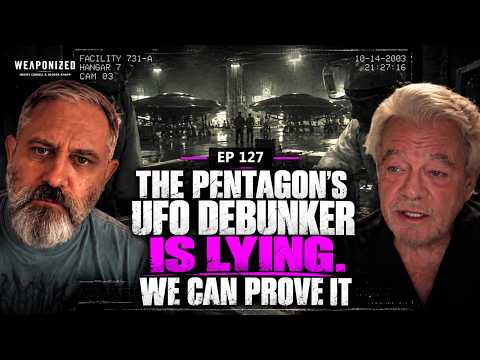
ד״ר גארי נולן, פרופסור לפתולוגיה באוניברסיטת סטנפורד, מספר על הקריירה המדעית שלו ועל המעורבות שלו בחקר תופעות אוויריות בלתי מזוהות. לדבריו, אנשים שהגיעו אליו לבדיקה כללו גם מי שטענו שנחשפו לתופעות חריגות; הוא מתאר כיצד הבחין בין מקרים הקשורים לתסמונת הוואנה לבין אחרים. נולן אומר שהוא מכיר אישית אנשים שטענו שהשתתפו בתוכניות לאיסוף או להנדסה לאחור של כלי טיס, וכן טייסים שראו את תופעות הטיק טק.
נולן מתנגד לטענה שאין ראיות, ומדגיש כי ראיה אינה הוכחה וכי נתונים צריכים להיבדק בידי חוקרים. הוא מדבר על הצורך לאפשר דיון מדעי ללא לעג, על פעילות בנושא בקונגרס ובבית הלבן ועל עבודתו בקרן סול. לצד זאת הוא מציג אפשרויות ספקולטיביות, ובהן גשושיות פון נוימן, ומזהיר מפני הסיכונים האפשריים של טכנולוגיות מתקדמות.
בהמשך הוא מתייחס לדיוויד גרוש ולטענותיו על תוכניות חשאיות, ומספר על תצפית אישית: לדבריו, כשהיה נער שחילק עיתונים בווינדזור שבקונטיקט, ראה עצם שקט עם אורות חולף מעל העצים. נולן אומר שרק שנים לאחר מכן החל לחשוב שההסבר האפשרי הוא עב״ם.
עיקרי הדברים
נולן הוא פרופסור לפתולוגיה באוניברסיטת סטנפורד וחוקר תופעות אוויריות בלתי מזוהות.
לדבריו, הוא מכיר אנשים שטענו שהשתתפו בתוכניות להנדסה לאחור של כלי טיס.
נולן אומר שראיה אינה הוכחה, ונתונים צריכים להיבדק בידי חוקרים.
הוא מספר שראה עצם שקט עם אורות חולף מעל העצים בווינדזור, קונטיקט, כנער.
נולן מעלה את האפשרות של גשושיות פון נוימן ומדגיש שמדובר בהשערה.
0:00I am the Ratchford and Carlotta A. Harris endowed professor in the department of pathology at Stanford University School of Medicine. I've been at Stanford frankly I think as a graduate student since 1983 or so in the department of genetics. Briefly spent my time with Nobel Prize winner David Baltimore at MIT for my postdoc and did a bunch of work there on signaling proteins inside of cells that turn on HIV and lots of other inflammatory processes in the immune system. Uh developed some retrovirus technologies there. Uh so if you hear about CRISPR uh and it's delivered to mammalian cells it's because of a technology that I developed in David's lab.
0:47Um it's grossed about 130 billion dollars worth of clinical trials and grants. Uh so pretty significant uh thing there. I didn't patent it. I gave it away. Silly me. Um [snorts] and um so I came back to Stanford around 1993 as a assistant professor and rose through the ranks and uh full professor now. Um I've developed a number of technologies usually the the term I use I look for what is inevitable in terms of what needs to be done and often it's not capable of being done right now. So being an avid reader of science fiction
1:32I steal from the future. Uh I basically take I you know the the kinds of open-mindedness that you see in writing about science fiction has over the last you know probably 55 years since I've been reading. I'm 65 now. Um has uh sort of uh given me a sense of how to think outside the box. Uh Uh, and even though these are fantastical stories usually, uh, they're fun to read. Um, but I've always been a technologist and developing ideas. And so, that's what my laboratory has done. We've I've started about a dozen companies. Two are on NASDAQ. Uh, I have over 60 or
2:1770 patents now, about 380 published papers. Uh, my students and postdocs are, you know, I have six of my students and postdocs as a professor at Stanford, and all over the place. So, uh, as a scientist and immunologist, people use my technologies for immune system studies and cancer, uh, all over the world. So, I've established myself, if you will, uh, as a credible scientist with, uh, you know, a background of productivity. Um, and so, my interest in, uh, UAP came about because I got a visit from people from the government who needed help studying, uh, some patients of theirs who had been
3:03harmed in some way. Uh, they'd been burned. They had burns inside their bodies. They had burns inside their brains in some cases. Uh, they were hearing the sounds. Uh, and, you know, long story short, cuz part of it's and a lot of it's already in the public domain. Um, most of the patients that they brought to me at that time were and the reason they came to me is because of one of the inventions that I had made or co-invented, uh, called the CyTOF. Uh, it's this it's a way of measuring multiple events in cells from the blood. And because they were doing complete medical workups on these individuals, uh, they wanted blood analysis. And so, they asked around and they said, "Who's the best guy to do blood analysis? You got to go talk to this guy, Garry Nolan,
3:48at Stanford. He just he has this instrument that, you know, just just won Nature's invention of the year award." I don't know if you know Nature magazine, but it's the premier magazine that, uh, biologists publish in. Um, and so, they showed up in my office and asked for help. And so while the majority of those patients ended up being Havana syndrome, which is a serious situation and now acknowledged by the government as a real thing that you know, our political and military adversaries were using energy weapons, basically microwave beams to fry our diplomatic people in Havana uh, and fry their brains. Uh, after we segregated the the patients and figured out which ones were Havana,
4:34what was left on the table is what often happens in science. Uh, once you understand something, it kind of becomes uninteresting if there's nothing more you can do about it. What was interesting was that uh, about half of the remaining 10 people had claimed that they had gotten very close to UFOs. And uh, that they had been uh, unaccountably harmed, burned on your skin, hurt inside. Not in the same way as we saw in the Havana syndrome. That uh, so the something else was happening to these people. Uh, and so in the process of studying them, I came across a lot of other scientists as well as people working in the government. Everybody from people in the CIA to the military, you know, who claimed, alleged that uh,
5:22that they had uh, either been part of programs for reverse engineering craft or had been in one case, uh, military person said he went out and recovered some of these craft and brought them back. Now, these are fantastic stories, right? I mean, they're they're anecdotes and yet they're told by people who are otherwise credible, who had no reason to seek me out. In fact, I'm often the one who went looking for them uh, because somebody else told me about them and they tell me these stories and all the stories are corroborating. So all the people that you've seen on TV, uh, everybody from Lue Elizondo to David Grusch, who are both military people who testified in front of Congress uh under
6:07oath >> [snorts] >> uh as well as uh pilots who actually saw the Tic Tacs and the other things uh that are in those famous videos from the 2017 um release. Um are all, you know, friends of mine or I know them personally and over now as many as 10 years, not a one of them has changed their story. Uh and um you know, so that's and I've been involved and you know, I can't say the some of the things that I've been involved in doing, but let's just say that there's there's nothing I there's nothing I've seen that has convinced me that there's not that it's untrue. Um and that's probably the most I can I can say. Now, part of what has propelled
6:54me as a scientist is uh trying to teach people how it is to talk and think about this idea. How do you talk about something so incredible that many of your friends, colleagues, parents, family would tell you you're insane to even be thinking about this. Uh and so the short answer is the same answer that I gave to uh a scientific colleague of mine back around 2014, 2015. Uh he was one of the co-directors of the National Cancer Institute at the NIH. And we were at a meeting in in the bar, he said, "Gary, you're going to ruin your reputation by looking at this." And my sh- my answer was I was I was sort of offended. I was like, "Well, why? It's just a question. I'm not I'm not stating a
7:40conclusion. I'm stating that there's a question here and that there's interesting data worth studying." And he said back to me the most incredible thing that a scientist I think ever could say. "Wrong." He said, "Well, there's no evidence." I I was like, "What are you talking about?" Evidence is just like in a jury trial. Evidence is not proof. Evidence is something to be judged by a jury. Either in a legal sense the jury as to whether or not the uh the um the person uh in the trial should be acquitted or convicted. Um in a scientific sense, evidence actually is a hypothesis.
8:28Or at least it is support I should say it's supportive of a hypothesis. To say, "Okay, here's data, which is just numbers." The numbers could be about you know, a uh a golf game. Or the numbers could be about quantum computers. But how you ask the question about the data or what questions you ask about the data determines whether it's evidence or not. Uh and then the evidence has to be has to support certain uh steps along the way of that if it is evidence it must be this, it must be this. So what I said to him back, I said, "Look, you don't sound to me like a scientist. You sound like a priest. You're telling me certain questions that
9:13are reasonable to ask based on evidence and the evidence is thousands of years old, hundreds of books, tens of thousands of testimonies from otherwise credible people uh that they saw something. Now, what they saw is still open to question. Um so what I always tell people, even somebody like Neil deGrasse Tyson has said there's no evidence um until recently. Now he's come out and said that he thinks it's it might be real cuz he has a book to sell. So I you know, I think he honestly um I I I I'm I'm so bothered by by his change of stance. I'm happy he changed his mind, but that he had to change the time at the same time that he seems to be
9:58selling a book tells me something about his uh personality. Um and that how how much of a non-scientist he is. And so what drove me to um push this is that look, you're being a bully and I don't like bullies. You're telling me I shouldn't do something that is fair under the rules of how science should be done. Uh and data really that the question about studying something is not if other people agree with your supposed conclusion, it's whether they agree that the data was collected correctly. If I can convince another scientist that the methods I used and the anal and the analytics that I used and the
10:43instruments I used and the settings that I used and the controls that I had available uh were all done correctly, then it's not entirely up to me to answer what the data means. Now, it's a joint problem with another scientist to solve what the data means. So, when people say there's no evidence, they actually think that when people says that there's there's evidence, they actually think that you're you're coming to a conclusion. Now, you can be of two minds as a scientist. As a scientist in my normal day lab, I'm interested in uh let's say I believe that there's something about how the immune system acts to
11:29uh you know, be to overcome cancer. So, I have a belief about an idea. That's not the same as a proof. So, I then I go into the laboratory and do the experiments that prove or disprove the hypothesis. I can believe that UFOs represent something. What they represent, I don't know. But, there's experiments that can be done or materials that can be obtained and this is what you see in the newspapers a lot today uh from representatives, congress people, senators, president came out and said it. Presidents before have said it, Obama, Clinton, etc. Uh have said that there's you know, maybe something going on. They're very cagey about it.
12:14Um and so, you know, but to con- to convince another scientist, I need a certain standard of evidence, standard of proof that needs to be met. And so, publicly it hasn't been met. Privately, I know it's been met. But the whole push is to get that information out, but to also give people permission and create a permission structure. So, there's a perimeter, an area with- within which reasonable people can come and talk about the data, ask questions about it, come up with ideas without fear of ridicule.
12:59And so, you know, I started the Sol Foundation. Uh Sorry, the house cleaners might be here. I started the Sol Foundation. I started um uh you know, I've run big events at Stanford and overseas, hundreds of people, w- which were all filled with scientists and professionals. And the most common feedback I've gotten has been, "Thank you very much for doing this and making this sane and giving us a language by which we can speak about this." Now, the other reason I'm interested is, I mean, now that actually I've won that, I mean, people are now taking it
13:44seriously. We've you know, I've I've visited the Canadian Parliament and given presentations to each of the members of the Congress there. I've worked in Europe on this. I've worked at the Senate. I've been in representatives. I've written reports. All these things all in support of this idea. But I'm not interested. This kind of circles back to my career. I'm not interested in who they are or even what they are. I'm interested in what they can do. What it seems that their craft and technologies are capable of doing. And so, because I think that they're if they're real, allegedly, and I have good reason to believe that they are real.
14:29Um I can't give it to you, unfortunately. So, tough luck. Um but I'm a capitalist, or at least I think that capitalism can be used for social good. I don't think all capitalism is fantastic. There's predatory capitalism and that's not something that I'm interested in. Um and so I think that there's ways that So, if these things can do what they can do, that means that they are probably thousands of technology revolutions ahead of us. Right? Uh I mean, just look at what silicon has done for our civilization. Everything that we're doing right now, our ability to talk to each other is because of silicon and how we make slightly impure silicon or germanium. Right? Uh and that makes transistors.
15:16Transistors make computer chips. That is the basis of our you know, our civilization right now. So, imagine where we are going to be a million years from now. Just think about that. We won't be like this. I mean, just think of how what we were like a million years ago. With AI, assuming we don't use it to walk off a cliff or kill ourselves, or it doesn't kill us. Um you know, we we will be so far advanced, we will not even recognize ourselves. So, if you think about it in those terms, and you think about how old the universe is, 14 billion years old. There were planets and solar systems
16:02capable of supporting life by about 11 billion years ago. That's a lot of time. You know, our planet is only about 4 billion years old, and life seemed to have arose about 3.5 billion years ago. So, there has been plenty of time for other civilizations to rise. They don't need to use warp drive to get here. Have you ever heard of something called the Von Neumann probe? >> I have not, no. >> Okay, you should go look up Von Neumann. So, his idea was very simple. Um his idea was you're a civilization, you make an advanced rocket ship that goes at you know, conventional speeds, let's say 50,000
16:49mph. Um doesn't need to be a warp drive. Um the galaxy is 100,000 light-years across. It would take you maybe Oh, and you'd make this rocket, it goes to one place, it lit sits down, it could even sit in the Oort Cloud, doesn't even need to land on a planet. It could just needs to find materials. It makes 100 copies of itself, sends them off to the nearest stars, and then exponentially makes 100, 100, and 100, and 100. And basically by after about a about 100 to 200 million years, you're everywhere. And then what do you do? Is the same person or thing that got on the craft in the first place is no longer there. Long since dust.
17:35But the idea and the ability to perhaps print more local copies of yourself goes along with your machine. That might be what's here. Just some advanced form of that. Because there's been plenty of time. The time has already happened. That's the funny thing about time. It's already happened. 10 billion years worth of opportunity for something else to develop and get here. And so, the question might be, people say, "Well, why why don't they land on the front White House lawn?" When you move into a house into a new house, why don't you go establish diplomatic relations with the ants in the garden? Because they don't matter. And even if you did, how would you talk to them? How would you talk to an ant about Tik
18:21Tok? What would be lost in translation? And so what would you do? Maybe you would make a little you know, a little thing that looked like an ant but wasn't an ant that would use you would use as an avatar and a translator. Right? But then you'd have to talk via pheromones and feelers and movement. Things like that. So maybe that's what we're dealing with. So anyway, so that's a long lecture but >> Yeah, that's Thank you. That answered a lot of my questions. I appreciate it. And that's I I never heard of that that theory before. That's like a really fascinating way to to look at it. Um so yeah, you that answered a lot of my questions. So thank you so much. Um you you touched on you touched on uh presidents um
19:06both President Trump and and former presidents uh touching on the subject uh specifically with uh what we're dealing with now in this current administration, what do you what do you think of uh how disclosure is happening right now and what might it even look like in uh the next couple of years, in the next 5 10 years um as you said as we continue as our society continues to evolve, what does that look like? >> Well, for for me, I mean, I I know a lot of the players uh who are working either in you know, on the public scene or behind the scenes to move it forward. Uh the um I think part of what's motivating members of Congress is the same sense of it's kind of the same sense of anger that I felt by being told I shouldn't be asking certain questions. Congress is in charge of the nation's
19:52money. It's the power of the purse is the Congress. Um the president proposes what should be spent, but the power of the purse is supposed to at least be with Congress. Um and so when you ask a question about where something is or how certain money is were being spent and then you're told by the you know, the deep state which is real, you know, not in the conspiratorial sense, but in the sense of presidents come and go, but administrators are forever. Um you know, they basically say no. Or they push back, or they hide it. Um, and so, what's what's happening is what I know is is happening is there's a lot of activity both in Congress and at
20:39the White House. Uh, that people have told me about where people are trying to find a way to get this information out. Now, you're seeing some of it come out. Right? I mean, it's not the best evidence at all. Uh, still blurry pictures. We know that there are super high resolution images of some of this stuff. Um, I do at least. And, uh, so, you know, why are they not putting that information out? So, perhaps what you're seeing is an acclimatization process where people are sort of testing the waters, seeing, okay, well, we've put this much information out, people aren't crazy, the markets haven't crashed. You know, because once you let the
21:24actual fact out, what begins to happen? People start to have questions. Why did you hide it so long? How was the money spent? Did you learn anything? Did you talk to them? Did you make any deals with them? On whose authority did you do any of this? Right? What have you learned? Did you give it to Lockheed or McDonnell Douglas, and what have they learned? And what have they kept secret? You know, and maybe there's good reason, for instance, that you don't want certain technology out because maybe it would give everybody Let's say anti-gravity were real, and I could put a backpack, or I could put an object on your car and make it fly into space, as easy as whatever.
22:09Well, what might a terrorist think to do? A terrorist might think to take a big object into space, or go out and get a big asteroid and push it towards Earth. And, you know, basically, we go the way of the dinosaurs. Right? So, you know, there's good reason not to give immense power to people who don't know how to use it. So, maybe that's one of the reasons. Maybe that Pandora's Box is something that doesn't want to get opened. Maybe there's something about what they are that we don't that we can't understand. You know, that there's or that they don't want us to understand. I don't know. Um and so I I really don't. And and there's not a single person that I know
22:55who works on the subject on the inside who does who either does know or when they when I ask them they say, "You don't want to know." That's interesting. So, and these are people I trust. So, you know, maybe there's maybe there's good reason. Who knows? Maybe you don't want to know that you're somebody else's property or you're considered somebody else's property. That somebody else got here 10 million years before we were even a blip on the Savannah. Right? And so, we're basically living on their turf. >> Mhm. Yeah. >> I don't know. [clears throat] >> Yeah, that's that's fascinating. I mean,
23:41especially with with I feel like uh you had mentioned uh that it that it might be something that we can't even comprehend. I feel like uh bringing that forward to uh not even just the United States but to the whole world um brings like what it comes with a follow-up of like you said um all those different questions which can complicate uh the situation. >> Well, I mean, how many lives have been ruined or attempted to be ruined uh because of this? People who have been made fools of who came out. I mean, David Grusch is a close friend of mine. Some of the things that have been done to him and happened to him that are public public record. I mean, people in the CIA literally CIA literally this is on record cuz the reporter stupidly said it
24:26on TV who released his medical records from when he had a drinking problem after a friend of his, cuz he worked cuz he was in Afghanistan, a friend of his committed suicide. And as with many veterans, they can come back from these situations and, you know, we're lucky that we didn't have to live it I did I never had to go to war, you haven't had to. Um you know, that people come back broken. I mean, they have to, you know, they see some horrible things. And so he came back and this guy killed himself and it sort of drove Dave, you know, into a bit of of an issue. Some people in the CIA, this is true, it's on record,
25:12got his medical records, gave it to what I think is or I would think of as an unethical reporter who published it to make him look like he was crazy. To say, "Well, he might be talking about UFOs, but look, he actually had to go into a medical facility because he was he was drinking." I mean, why would you do something like that? I mean, what what I mean, first of all, why would the reporter do something like that? Well, we know why reporters do things, they just want notoriety at one level. Um but reporters do these kinds of things to get access cuz once you're once you're the water boy, the water carrier for one group, people know you're a trusted snitch for other groups. So you can now be trusted to
25:58pass on disinformation or to help hurt people. That's not the worst of it. I mean, some people have, you know, literally been killed over this. So it's um you know, it's it's in a way being public is the best way to um to protect yourself. So um you know, David, all these things happened to him when he was still being quiet. I mean, they tried to they took away his security clearances cuz he had actually been tasked by Congress to go look for these programs. He found the programs, and he found people in the programs who told him what was going on. And he he had the highest
26:44he had security clearances higher than the president. I mean, if you know David, he's he's an autistic savant. He can remember any series of numbers, all the code words, etc. He had access to all the special access programs. So, he knew what was going on. But he But you can't be a whistleblower unless you are whistleblowing about an illegality. David found illegalities. Monies that had been apportioned for one thing, but siphoned off and used for some of these other more secret programs. That's an illegality. And so, you know, people kill over a lot less. But if you've now got an entire research program, or your total net worth is
27:30because of some technology that you leaked into the public realm, uh and it could becomes known that you're the person who, you know, you got access to this through a defense contractor because the government let you have it, and now it, you know, went to your personal benefit, who's going to start suing your company? Who's going to start suing you? And if somebody was murdered on on the basis of this Some of the stories that I hear are just I mean, would make your hair stand on end. You know, I So, I I mean, I've I've been with the military people on um
28:15This is public knowledge. I've been with military people on uh let's say attempts at recoveries. Um and uh these are serious people. I mean, I I mean, I was a I was By the end of the week, I was known as the professor. Oh, go ask the professor what we should be doing here or there. But, these guys were like 6'5 built out of steel. Uh and I'm this little puny, you know, scientist skinny type, very stereotypical. Um and uh but, you know, I got along well with them. So, it's uh you know, I I think, you know, your question was, "Where are we going to be a few years from now?" I think I I honestly can say I don't know because I've seen this turn around
29:01so quickly so many times that, you know, s- if if China suddenly goes to war with Taiwan, this will be off the table for another year. Right? If Russia succeeds in Ukraine or Russia attacks Eastern Europe, you know, again, th- this is not top-of-the-line important stuff. So, there's lots of real distractions, and most people, frankly, in my opinion, most people, uh if this is ever revealed, will look up, say, "Oh, that's interesting. D- Does it take food or put food on my table? Does it affect me?"
29:47No. I mean, I think it affects humanity in a bigger sense to know that we're not alone. That would be great. But, if they're so incommunicado, which they are, you know, you're sort of left with you know that they're there, but they won't talk to you. W- Why? Or if they're talking to somebody, what are they saying? And I want to know. So, you know, it's it's again, it's that Pandora's Box. Once you start asking questions, the list of questions is endless. >> Yeah. Yeah. Thank you so much for that. Um I don't know how we're doing on time. Do we have time for one more last quick question? >> Yeah, let's do one last one. >> Okay. Um so, you you touched on how you have um
30:35uh been with people who have been affected. You have uh done research on it, but have you ever personally witnessed anything that you couldn't explain other something that you saw or something that you might have felt and if so, what was that like? And yeah, what was that experience like? >> So, I was a paperboy around 1972-73. I know this is ancient history. And there was a guy who needed his paper delivered by 5:30 in the morning. Down the street. I had a big paper route. Um and I So, I know what time of the day it was cuz it had to be before 5:30 or he would call the newspaper office and complain about it. Um and to get to the next street, I had to walk through a little area of the woods.
31:21Um which I didn't mind. But it was March. And I'm walking along the path and I saw my shadow in front of me. Um It was brighter than I thought. I saw I didn't remember seeing the moon. Uh and then all the all the branches of the trees cuz the it was March so there was no leaves on the trees. So, it's Connecticut. Windsor, Connecticut. And um And but the the the shadow was moving. Like, okay, how does this Wait. And I looked up and this object was at the basically about 50 ft up at the top of the trees just went silently over me. Um and then with these lights.
32:08And I just stood I mean you know, look, this is 1973. We had three channels on TV. Black and white. That was it. ABC, CBS, NBC. That was it. No such thing as cable. Um and so I didn't even know what a UFO was. I I I saw it. The I saw the thing. I knew it couldn't be things like a blimp or all the rest because we lived in a small valley. If it had been a blimp, it would have crashed. Totally silent. And it really wasn't until many, many years later uh that I sort of look back and said, "Well, the only real explanation for that is a UFO."
32:54You know, if it had even if it had been a blimp, I would have heard a motor. Right? And so, um I mean, I have seen things in the distance. I was at a military exercise where something showed up. Um I can't talk about it, but you know, we have it on we have it on film. Moving at about 5,000 mph. Um so, do you do you call that seeing something? I don't know. But, you know, we we catch we caught glimpses of it on video and we have some radar tracings. Um And so, uh you know, uh that's about it. But, then there's lots of people I talk to who have much better
33:39data and evidence than I do. So, um my role in all of this, frankly, is just to give uh or lend a sense of credibility of somebody who's accomplished a lot in his life, 65 years. Um and I I'm I'm not dead yet. I probably got another good 20 years in me. Um and uh so, I but I've never had more fun than I'm having right now with the subject matter because I've already accom- I I know what I've already accomplished, so I don't care. I can now do what I want to do or maybe make another mark and help with the
34:25subject. And help people like you and maybe people listening to your documentary think a little differently about the problem. And don't let other people tell you what to think. Look at the data. It's the data, not the conclusion. Evidence is not data. Evidence is a contextualized hypothesis around an idea you're trying to prove or disprove. So, there's lots of evidence. Tons of evidence. But, your standard of what that evidence means depends upon how you view what the data is and how you think it fits or doesn't fit um what you think is a