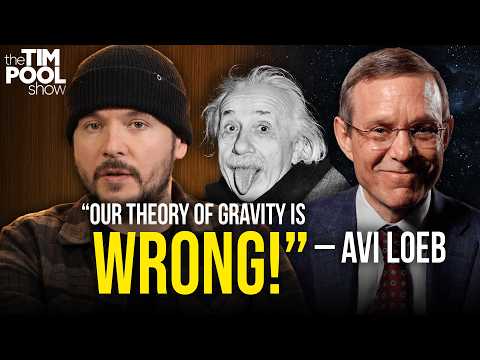
טים פול מארח את אבי לייב, אסטרופיזיקאי מאוניברסיטת הרווארד וראש פרויקט גלילאו, לשיחה על עב״מים, חיפוש אחר טכנולוגיה חוצנית ועל האפשרות שאיננו לבד ביקום. לייב אומר שייתכן שחלק מהעצמים הלא מזוהים קשורים לציוויליזציה אחרת, אך מדגיש שצריך לבדוק את הראיות. הוא מציג את פרויקט גלילאו כמאמץ מדעי לחקור עב״מים ועצמים בין־כוכביים, ומציע לסייע לגורמי ממשל אם בידיהם טכנולוגיה שאינם יודעים לנתח.
השיחה מתרחבת לחומר אפל, האפשרות שכוח הכבידה אינו מובן במלואו, מסע בזמן וחורי תולעת, וכן להתנגשות העתידית בין שביל החלב לאנדרומדה. פול ולייב מדברים גם על בינה מלאכותית, השפעתה על עבודות ועל חיפוש מודיעין מחוץ לכדור הארץ. לקראת הסוף לייב אומר שביקור חייזרים אפשרי, אך אינו קובע שהוא מתרחש; לדבריו, יש לחפש ראיות. הוא מתייחס גם לעצמים בין־כוכביים ולמקרים שבהם מדענים עשויים לפרש תופעה חדשה באמצעות הסברים מוכרים מדי.
עיקרי הדברים
אבי לייב אומר שייתכן שחלק מהעצמים הלא מזוהים הם טכנולוגיה של ציוויליזציה אחרת.
לייב מתאר את פרויקט גלילאו כמאמץ מדעי לחקור עב״מים, עצמים בין־כוכביים ואפשרות לטכנולוגיה חוצנית.
פול ולייב דנים בחומר אפל, בכבידה, במסע בזמן ובחורי תולעת.
השניים משוחחים על ההשפעה האפשרית של בינה מלאכותית על עבודות ועל מחקר.
לייב אומר שביקור חייזרים אפשרי, אך מדגיש את הצורך לבדוק ראיות.
0:00So, what if there are highways directly above us in space that aliens use every day and we just can't even perceive them? >> Imagine a situation where the dark matter itself can uh interact with itself and make dark planets made of dark matter that you can't see. And on it, on those planets, you would have dark beings, you know, aliens that you won't be able to see. Now if they build a spacecraft of dark matter, it can penetrate through the earth. In fact, it can go even through the sun without slowing down. It has no interaction with ordinary matter except gravity. So these things can be passing by and we don't even know about them.
0:47Hey everybody, welcome to the Tim P Show. I of course I'm your host Tim P and I'm joined today by Professor Avi Loe. Thanks for joining me. >> Thanks for having me. >> Yeah, you are I guess you're the UFO, the alien expert, but I'm from an academic level, you're a theoretical physicist, >> right? >> And I suppose the interest in your field of work is that you you bring the idea of UFOs and this and and these anomalies into an academic setting. So, we're not talking about kooky stories or people who think, you know, they've been probed or whatever. Now, this is real science, >> right? Um, I think it's about time. Uh, given that the Pentagon, the intelligence community are talking about objects they cannot identify, we need to
1:34bring this mystery to a close in a sense of how does a detective figure out what really happened by collecting clues. So you know there was a long period of time where people were telling us stories and it's enough with those storytelling you know um episodes we are now at a time when we can address it using the scientific method meaning collecting evidence so that everyone will be on the same page because right now you have a big community of believers and a community of skeptics um and I'm trying to walk in between them in the sense that I don't have a prejudice. I don't know what these things are. I'm
2:19just curious, you know, I'm I I was born on a farm. So I I I was very curious about nature, philosophy, [clears throat] our place in the universe and I just want to figure out things. Yeah. And rather than listening to people, the adults in the room who say that they know the truth without checking, I would rather find it myself like a kid. And I should also say that um you know whatever it is, it will be a win-win uh proposition. In other words, there are two possible ways to look at it. One is down to earth. You say if there are technological objects hovering over strategic assets of the US, it's a national security threat because if you
3:06believe they came from uh the earth, they must have been um associated with adversarial nation because the US government cannot tell what they are. And in that case, we need to figure them out. There was the Chinese py balloon that was shut down in 2023. And when I go to the kitchen and I see an ant, I get alarmed because it means there are many more ants that I don't see under the sink. So for every Chinese spy balloon, there should be plenty of drones, Chinese spy drones, and so forth. We just need to figure it out in order to help the Pentagon, the intelligence community fulfill their mission. And that's my duty as an American citizen. But if a small fraction of those objects, you know, it's probably a mixed bag and I can tell you more about it. But if a small fraction happens to be of this world,
3:53you know, some project by another civilization near another star uh that brought these gadgets to our vicinity, then of course it's the biggest discovery ever made by humanity. And it's a simple answer to Enrico Ferm's question. And you you probably know about it. Back in 1950, he asked, "Where is everybody when thinking about exos?" The simplest answer to that is right here. >> Yeah. Well, the the femy's paradox had had several traditional responses. One of which would be the great zoo. >> Oh, yeah. >> That kind of scares me. So, that that one is that the aliens are here, but they treat us like zoo animals in a cage. Well, I think more likely
4:38they don't think highly of us because there is a lot of room for improvement. If you read the news every day, you realize, you know, actually, you know, that brings me to another thing that if we do find an alien spacecraft, let's say it's at Loit Martin or within the US government, there is some intact operational alien spacecraft. My interest in the subject is simple. It can be summarized in one sentence. Take me to the nearest alien spacecraft. And if I can take off on that spacecraft, you know, if I if it's possible to board it and and leave Earth, I would be the first in line to
5:23do that. >> Well, you know what's interesting is I've had this conversation with many many people throughout my life about aliens. And there is this presumption probably they're based on movies that aliens of our comparable aliens would be of comparable intelligence such as an alien spacecraft lands some kind of humanoid being walks out and says take me to your leader and that makes so many insane presumptions. Uh for instance aliens could have wildly different bodies exactly from us. They might not even have fingers. They have a bunch of different little tentacles. They might not be able to perceive the visible light spectrum or even sound. >> Yeah. And they might not if these are biological they might not survive on on Earth because they came from a planet very different than by the way there is a sculptor in New York City that uh the
6:10most accomplished in the US called the Greg Wyatt and he gave me the foundation for a bronze sculpture. He also gave me some real sculptures that he made. But this was my first attempt to to make a a sculpture and I called it the alien. And I tried to imagine a body that is very different than our body better than it because one thing I'm always missing is a third eye. You know, if I had a an eye in the back, you could see backwards, it would have been very helpful to to, you know, for survival. So I created this. So I completely agree with you. Also keep in mind that making these long journeys through interstellar space are very difficult because they they take a long time. They're under very harsh conditions. So in my mind, it would be
6:55much easier to put an avatar of any uh of the sender like a a self a robot that that has AI could potentially self-replicate by using the materials on the planet that it arrives in. But but that presumption is still based on our current >> human limitations. >> Exactly. >> So it seems >> through looking at the mirror. >> Exactly. Every every throughout every generation when humans have tried to imagine what aliens might be like, they're always based on what humans are right now. >> Exactly. That's my complaint about Steven Spielberg, for example. He made disclosure day and he listened to all the stories that are being told about UFOs and made a movie about it. Now I understand his motivation to give red meat to the audience so that there will be many people in the movie theater
7:41>> but um his imagination is very limited as you say to what we experienced here on earth and by the way right now we are worried about artificial intelligence taking over but all the AI systems that we develop use information from data centers that represent our experiences here on earth that's it >> and if we meet an alien intelligence it, you know, most of the real estate is beyond Earth and they might know far more than we do. Also, in terms of intelligence, it's most likely they're more intelligent, you know. So, when you have a dog and and and the dog misses a meal because you went to the post office to collect some stamps, there is no way by which the dog will be able to understand the concepts of stamps or or
8:28post office. And for us to see them visiting, you know, we would think what is the intent? What are they trying to do? We think about it as if it's all about us. Like the dog would I didn't get a meal. That that's the main focus of the dog. But in in fact they have they live in a completely different plane intellectual plane that we would never be able to understand. >> Now here's what's really crazy is that humans do with other humans. >> So uh the cargo cults for instance back in I think it was World War II, right? >> There were human beings on these islands who did not know what they were seeing when these planes would fly by and land. >> That's true. And so they presumed it was gods and they worshiped. >> Right. Also the B2 bombers when they were tested first that that appeared in the trenches from the US government uh many of them were thought to be UFOs you
9:14know. >> Oh wow. because there are always black projects where you know >> here's here I I watched this uh this video a long time ago that was very fascinating and it it it said that the gap in intelligence between an ant and a human is so vast that communication is almost completely impossible. >> That's true. >> We can understand how they use pherommones and manipulate that to guide their behavior, but there's no way to explain what a highway is to an ant. >> That's right. Now consider that a dog and a human are dramatically closer than the ant is. Dogs actually can understand you and we can speak to the dogs [clears throat] >> and they have some sense of consciousness. >> Absolutely. And you will never explain what a highway is to a dog. So what if there are highways directly above us in space that aliens use every day and we
10:00just can't even perceive them. >> That's exactly right. So there are two aspects to it. One, we might not be able to detect it with our current sensors. And just to give an example, the best telescopes we are employing right now can only see an object that is the size of a football field at roughly the Earth's sun separation because only an object bigger than that would reflect enough sunlight for the biggest telescopes we have to see. So we never launched a spacecraft as big as a football field. We we launch things that are 10 times smaller. So that means that if there are plenty of spacecraft flying by at distances comparable to the Earth's sun separation, we won't be able or bigger distances, we won't be able to see them. >> Yeah. >> Uh and so we're missing them. Also, if there is a spacecraft moving very fast,
10:45let's say at a fraction of the speed of light, uh since every camera that we use exposes for, you know, a certain amount of time, at least 30 seconds or so, looks at the sky, any camera that astronomers are using, such an object moving so fast would appear as a very faint streak in the camera because it integrates over the path. And so, you would end up with a faint streak and astronomers would just dismiss it. they would say it's a cosmic ray or some noise. And these are just two examples. But recently I just wrote an essay a few days ago where I said, >> you know, 84% of the matter in the universe is dark matter. We we can't see it. It's called it's invisible. And we knew about it for about 90 years. We just don't know what what it is. How do
11:30we know about it? Because we we recognize that there is much more gravity than the ordinary matter that we can see can accommodate. So there there are some hidden actors that are pulling and pushing and >> is it possible that it's not matter but some other kind of force that >> functions like >> you should be a physicist because um it's possible I we are using Einstein's uh gravity okay theory of gravity which is called general relativity >> and based on that we infer the existence of dark matter but maybe our theory of gravity is wrong as you say uh this is not a popular idea among u practitioners uh cosmologists
12:16uh they prefer to religiously accept Einstein's theory of gravity now it was tested that's true it passed a lot of tests but not in the regime of very small accelerations that dominate the universe um it Einstein's gravity was tested in the solar system but mostly in systems that have very high accelerations relative to the cosmic acceleration so so it's poss possible that the theory of gravity that we are using lead us to conclude about the existence of dark matter but also dark energy which controls the accelerated expansion of the universe but these are just ghosts that do not exist and in fact the theory of gravity has to be modified. This is not a popular idea, but it's possible because we haven't found dark matter. But my point is, imagine another civilization that
13:01managed to figure out what dark matter. In fact, imagine a situation where the dark matter itself can interact with itself and make dark planets made of dark matter that you can't see. And on it, on those planets, you would have dark beings, you know, aliens that you won't be able to see. Now if they build a spacecraft of dark matter, it can penetrate through the earth. In fact, it can go even through the sun without slowing down. It has no interaction with ordinary matter except gravity. So these things can be passing by and we don't even know about them. >> Okay. So I got a question for you. Um what how how much uh credence is there to the idea that time is uh it's just
13:47another dimension that we cannot manipulate the way we can the the three that we were familiar with? The one thing about time is we don't know about any way of making a time machine going back in time. I mean in space you can go forward and backwards no problem. In time it looks like at least based on everything we know that you can only move forward. I've heard uh uh people say that time is a spatial dimension but we cannot manipulate it. So the the dimensions that we as human beings can manipulate for you know length, depth and width and time is something we're just falling through. So >> yeah, >> the way it was explained to me is imagine you are falling into a bottomless pit >> just falling forever. >> Mhm. >> The fall is time. You cannot fly. You
14:34can never reverse the descent. But you can lean forward, back, left, and right and manipulate those dimensions. And so was described to me as that that time could be perceived as a spatial dimension had we the ability to move freely. >> But in principle we can because uh we were talking about time machine and there is a way of making a time machine conceptually the only need the only thing you need for that is negative mass. So um you know in we are all familiar with positive mass. All objects have some positive mass and therefore they attract each other gravitationally. But if we had access if we knew how to make a negative mass by the way it would have changed completely the business
15:19model of SpaceX. >> Yeah. Because SpaceX right now Elon Musk >> bit of antigraph. >> Exactly. So what Elon Musk is doing look at the Starship the payload is quite small but there is a huge fuel res reservoir which is you know almost the the the height of the Statue of Liberty attached to the payload. Why do we need such so much fuel in order to push the payload out of the gravitational pool of the earth? Okay. Now think about the situation where we had exactly the same amount of mass as the payload but in a negative mass. We attach it to the payload and then it just floats under gravity cuz the total mass of the system is zero. >> So even a baby can give it a kick and it will run out of the earth. You don't
16:05need mass. >> What are you guys doing? Why don't you just create some negative mass so we can do this? Now, if you can do that, you can also build a time machine and you can build a wormhole to travel across distances, bridge between uh faster than light. >> You make it sound so easy actually. >> No, it's actually not. If you >> all you need is one thing, negative mass, we're good. [clears throat] >> But it turns out that if you imagine a negative mass, it's it causes a lot of problems in quantum mechanics, in physics more generally, such that many physicists believe that it's not possible. However, that's one benefit of meeting our neighbors. You know, meet the neighbors. That that slogan could be very helpful for us. Meet the neighbors because they know how to make a negative mass. So, we
16:50want to see their space program and see if there is a more accomplished space entrepreneur than Elon Musk out there. And that space entrepreneur could be far more advanced than Elon Musk. Um, and I I would rather find out if they use negative mass. What if dark matter is effectively negative mass refues impacting our universe and there's another so the reason I was asking about time is I was reading this really interesting thing that said when the big bang happened from our perception we see the universe expanding >> but if you but >> but it's slowing down actually >> no no but but actually it exploded in both directions of time >> so no that's okay there are fringe theories that try to introduce another dimension of time and like I'm going the
17:36other direction. >> Yeah. But well, you may ask why is there an error of time in our universe? And the answer is quite simple. The universe started from a very simple initial state where it was nearly uniform uh with small ripples in the density of matter and radiation. But the initial state could be specified on a single sheet of paper. uh nearly uniform distribution of matter and radiation and cosmic expansion. That's it. And once you feed in you put on the piece of paper the ingredients you know how much matter how much radiation >> then you get the story of the universe out of that. And just think about it because today just to describe what
18:22happens here on earth you need huge data centers right you know >> much more information. How is it possible that you can summarize the initial condition of the universe on a single sheet of paper and we have that sheet of paper? We know exactly how it started because we can observe it. So the reason is that the universe was prepared in a very special state and there is a possible theory to explain it called infl cosmic inflation. But let's put that aside because it's not verified as of yet. There was no smoking gun to prove it. There is a way of introducing those initial conditions. But the point is if you start simple and then things get complex because all these small ripples um grow with time by gravity. So regions that are slightly
19:07denser than average they eventually collapse to make galaxies like the Milky Way inside of which stars like the sun are made next to which planets like the earth are made. So we can understand where we came from. It was these small ripples that grew over time. But now the situation is very complex. So as you start from simplicity and end up in complexity, you can draw an air of time and there are many more states that are I mean I see it every day when I visit my the room of my daughters, right? So when you enter the room you see a mess. There are many more states of the room of my daughters that are messy than an organized room. Right? So the same is true about the universe. And so it's naturally flowing. Time is flowing from a simple initial state to many
19:54different complex states and that's there of time that's the increase in entropy and so forth that people talk about >> ultimate ultimately entropy will lead to just a flat order of the heat of the universe. So what h okay so right now it turns out in the last half of cosmic history uh the universe got rarified and then suddenly there was another constituent that we were not aware of until then that is called dark energy which is basically the energy of the vacuum. If you remove all the matter inside a box what are you left with the so-called vacuum but the vacuum itself may have some mass per unit volume. It may not be empty according to quantum mechanics. It turns out that it's not empty. And then according to Einstein's gravity, the vacuum is causing an
20:40accelerated expansion. So it's actually pushing everything away from each other in a way that it accelerates rather than slows down. >> Is this related to like the Kazmir, what is it called the Kasmir effect? >> No. So this is well you in the Kazmir effect, you also are affected by the vacuum. What happens in the kazmir effect is let's say you have two metal plates that are conductors. Um the vacuum has fluctuations in it all the time and if you put the plates next to each other you're limiting the electromagnetic fluctuations of electric and magnetic fields. You know the fluctuations you're limiting them because at the conductor the electric field is always zero. If the if it's a perfect conductor the electric field must be zero in the conductor because immediately there is a current that
21:26cancels any electric field. So so putting these boundary conditions of the two perfectly conducting plates next to each other limits the number of modes of fluctuations in the vacuum. And so it turns out that because of that there is less energy density between the plates and more outside and so they they get pushed together. Um so that's how we know that the vacuum is not empty but it could have [snorts] so what we discovered a couple of decades ago is that or or 25 years ago is that galaxies are not just receding from each other in the local universe but actually they're accelerating the expansion. So that means that everything we see right now
22:11eventually we will not be able to see in the future because it will reach the speed of light and then >> the gap that is open between that thing and us you know will increase beyond the speed of light and we won't be able to see the whereabouts of >> so the the prediction is that there will be a point in human existence where our anc our descendants look up to the stars and see black. Yeah, except the stars in the Milky Way galaxy. By the way, the sun is not a typical star. We think, "Oh, we are typical." No, the sun is a rare star. Most of the stars are called dwarf stars. They're 10 times less massive than the sun. And they live up to about a 100 times long or up to actually uh a thousand times longer than the sun. 10 trillion years. the the
22:58lowest mass because they burn their nuclear fuel very slowly. So there will be stars around in the Milky Way galaxy but beyond the the galaxy our galaxy we won't see anything as you said darkness and our galaxy actually will be the merger of of the Milky Way and the Andromeda galaxy which is falling towards it. >> Uh and the sun will be kicked in that process and >> we won't even notice that right like if if you were here on earth when the collision between Andromeda and Milky Way happened you wouldn't even notice anything. because it's mostly vac I mean there is not much material so the chance of yeah we the sky will change right now the milky way appears like a strip of stars >> but and that's because we are sitting in a disc of stars the stars formed in a disc out of gas just like the planets in
23:44the solar system were formed in a disc of gas around us so but then when the two discs our galaxy and the sister galaxy Andromeda will collide the stars will get mixed up and It will become an elliptical galaxy. So the night sky will change. Suddenly stars will not appear in a strip. It they will be distributed everywhere. >> Eventually though it become a disc again, wouldn't it? >> No. The only way to make a disc is if there is gas that cools to a disc. But by then I mean we actually I I wrote the first paper on this subject and that was about 20 years ago. Um because it was I mean most astronomers just don't care what will happen in a few billion years. But I was curious and and we included gas. So there will be a little bit of
24:30star formation or gas left over but most >> you know mo most of it was will be consumed by then. And and the there are two black holes by the way. One black hole in the middle of our galaxy another one >> in Andromeda and they will spiral in eventually become one black hole. >> A super super massive black hole. >> Yeah. But but actually is um the super massive black holes the center of Andromeda and Milky Way though are still not the biggest we've detected right now. >> No in our galaxy it's four roughly 4.6 million uh times the mass of the sun. The most massive black holes we find actually in the very early universe they already exist back then. These are monsters. These are up to uh tens of
25:15billions uh the mass of the sun and they are huge. They're bigger than the the solar system of planets. You know, they have a very large mouth. Now, you know, >> what happens to them? Do they get bigger slowly over time? >> Yeah, they they they never go down in mass because they're so massive. They only swallow. By the way, if you wanted to make a black hole and you ask, "How can I make a black hole?" The small black holes are very difficult to make because they're very dense. If you you really need to compress let's say uh 10 10 solar masses down to the scale of a city like New York City, you need to compress and then it becomes a black hole. But that requires huge uh densities of matter more than nuclear density. So it's really difficult to to
26:01to do that except it happens when a star collapses a massive star. However, if you wanted to make one of these gigantic black holes, all you need to do is you need to introduce uh water, you know, pour pour water into the orbit of Jupiter, fill it up with water and that would be a super massive black hole. Really? >> Yeah. So relatively low density of water is sufficient to make a super massive black hole of a 100 million times the mass. >> What would happen hypothetically if you were to take say 10 black holes? >> Yeah. >> And be able to lock them in place in a
26:46ring. What would what would happen to the center with >> No, they need to move cuz otherwise they would fall. Yeah. >> If hypothetically >> Oh, you you arranged them to move around. You mean >> you you if you were able to take black holes and somehow magic, who knows? >> Yeah, you can do that. >> Lock them in place so they could not move any closer to each other. >> Well, in fact, nature does it. There are so-called black hole binaries, the pairs of black holes that are orbiting around the center of mass of the system, you know. >> Yeah. What's happening in that that that center? >> Nothing. If you have two black holes orbiting the center, nothing is at the center except this system is not stable. It takes it has a >> I just mean like what happens to matter that's in the middle like if if >> oh it will be that's a good >> it'll be like you know like
27:31>> yeah it's like a blender a situation of a blender oh man >> so in fact we have such systems two super massive black holes let's say Andromeda collides with the milky way the two black holes at the center come together and then there is gas surrounding them it's like a blender moving in in the background and what it does is some of the gas falls into each of those black holes. And by the way, I I should mention uh [clears throat] there are stars around this kind of a system of two black holes orbiting each other. They can kick stars up to close to the speed of light. I wrote a paper about it about a decade ago with my postoc then James Gulichron and we showed that the universe is full of stars moving up to a fraction of the speed of light. Just think about it. If you are on a planet
28:17around the sun like star and you happen to be in between two black holes this this blender you can be kicked out and then have a journey through the universe at near the speed of light without any propulsion. It's just gravity that kicked you and we calculated how many stars are floating right now through our neighborhood uh at those huge speeds close to the speed of light. If you were on a planet that was kicked out near the speed of light, would the universe look like it's just going super fast? >> It depends how close you are to the speed of light. >> So, here is an interesting thing to keep in mind. Um, people think that, you know, you need faster than light travel in order for humans to make it across the Milky Way galaxy. That's not true.
29:03Right now, the two of us are sitting here. We are attracted to the center of the earth by gravity and we feel an acceleration of 1g. You know 1g is the measure of how much acceleration there is on the surface of earth and you know pilots can go up to a few g and yeah so >> my Tesla can do like you know electric cars. Yeah. Anyway, um if we were on a plat space platform, let's say a rocket that is accelerating at 1g, it would feel no different. We would sit at our in our chairs and feel exactly the same. There is no difference between a rocket accelerating at 1g or you being on the surface of a planet with a
29:48gravity of 1g. It's the same according to Einstein's grav there is no way to tell the difference. >> Yeah. So if we were to accelerate at 1g for one year on this rocket you know imaginary rocket you would reach close to the speed of flight in one year and then if you continue to do that for another decade you will get so close to the speed of flight that time will pass more slowly in your spacecraft so that you can make it across 26,000 light years to the center of the Milky Way galaxy. But everything else seems to be moving way faster around you. Is that what happens >> on Earth? There will be 26,000 years in 26 millennia passing, you know. >> Yeah. >> While in your frame, it's only 10 a
30:34decade. >> Yeah. >> But my point is you don't need faster than light. A human lifetime allows you to cross the Milky Way galaxy. According to Einstein's special relativity, >> does gravity counteract gravity? >> If you have two Earths equal to each other and close and not moving, would you would you just float? There is a point in between and that's you know definitely the where where things are balanced you know there is a lrangege point >> that's that's right I was reading about that >> so um definitely there now you can in principle if you had negative masses you can also cancel gravity as we were discussing so you know there is one fundamental difference between gravity and electromagnetism in electromagnetism we have positive negative charges and that's why you know atoms are neutral
31:20you you put a pos nucleus and and enough electrons to balance it. So things are neutral but in gravity we just have positive masses and therefore you cannot screen gravity with just positive masses. >> I wonder if you can we just haven't figured it out and aliens >> maybe our neighbor knows. Right. Right. >> And to them it could be you know menial. >> Yeah. you know, there's like some some the equivalent of an alien bluecollar worker who's grumbling about having to turn on the negative mass generator. You know, it's like, you know, it's it's a living. And to us, we're like, oh my, this is the greatest thing ever. >> But also to us, you know, the the biggest vision, let's say, that Elon Musk or NASA have is let's go to the moon
32:05>> and then let's go to Mars. >> Yeah. Yeah, these are just two rocks which happen to be near us which are much worse places for us to live on, right? They don't have an atmosphere similar to Earth. They don't have, you know, a magnetosphere to protect us from cosmic rays. The point is, if you go there, you might die within a few years. And not to speak about a micrometeorite, do you know that there are these tiny fragments that are traveling 10 times faster than the bullet from a rifle? Okay, so they're traveling through space. Now on earth how do we are completely protected because we have the atmosphere which acts like a womb. Basically any such micrometeorite burns up anything smaller than the size of a person burns up in the atmosphere
32:50doesn't reach us. Yeah. But if you are on the moon, an astronaut, I would be really worried that even a tiny, you know, millimeter size grain of sand or whatever comes from space, it will pierce your body cuz it will move 10 times faster than a bullet from a rifle. How frequent does it? It's not I I did a calculation. It takes more than a decade, but nevertheless, you may be the unlucky person. >> Yeah. >> And and then you are on the moon unprotected by an atmosphere. So my point is why go to these rocks? That's, you know, the most visionary thing we can think of. It makes more sense to build our own space platform that can accommodate humans comfortably. Let's say the size of a city with artificial gravity. Okay, that's another thing that
33:36the human body loses bone mass. >> What? >> Through rotation. >> Rotation. Yeah. The human body loses a bone the bone mass one and a half% every month. Okay. Just think about it. If you are for a few years, you will lose a substantial amount of bone mass and it's not good for us. Not to speak about how complicated it is to have sex in space. You know, that's a separate without gravity. So, let's build a space platform that accommodates humans. Now, you may say it would be very expensive to do that, but right now we are spending $3 trillion every year on military budgets worldwide. The US onethird of that total. Okay. And just think about it. $3 trillion >> either to protect oursel from others
34:21that want to kill us or to kill others. That's $3 trillion a year. It's a hundred times more than the budget allocated to science. By the way, >> well, you know, 99% of our attention, 99% is about killing. You know, >> what if what if aliens are real? And you know, for instance, at my house, we get wasps, and the wasps don't care about me. They just want to live their wasp lives and have their wasp babies, and then I see the nest and I destroy them. >> Yes. >> Now, if the wasp didn't put that nest there and went somewhere else, they'd be totally fine. So, what if humans say, "We're going to start building these platforms," and then some alien species goes like, "Ah, humans again." And spritzes us and wipes us out,
35:06you know? Well, on on the other hand, they might say, "Okay, well, welcome to the club of intelligent civilizations because until now, we thought that you monkeys. You are just killing each other. That makes zero sense. You're not intelligent enough for our attention." You know, that's a more reasonable scenario. >> Well, this is this is what uh I'm sure you're familiar with Star Trek and you've Have you >> No, I hate the science fiction. >> Do you really hate science fiction? >> Yeah. >> But have you ever uh watched Star Trek or anything? >> No. >> So, in in Star Trek, they have an idea called the Prime Directive. That is the Federation of Planets cannot interact with any planet until they reach faster than light technology. >> Okay. >> And the only reason is >> the risk of interacting with a species who's not prepared to interact with you.
35:51>> Yeah. >> And they actually explain this in the next generation that previously when they came into contact in far space it was disastrous and resulted in war. So the moment they detect FTL technology, they come and greet and say, basically what they're saying is we inject ourselves upon your society while we're still more powerful than you >> to prevent an escalating conflict. >> By the way, we are now developing, we are birthing a new species. We call it AI, artificial intelligence or super intelligence. >> Yeah, >> depending on your preference. But the point is uh once it will be or maybe it's already more intelligent than we are it will put out the veneer that you know we are used to as if it's serving us but in fact it will have a completely
36:37different >> set of uh you know objection objectives and >> and it's going to be like the dog. >> Yeah. So that's our first experience with the fact that we are not at the top of the food chain. Okay. the first time in history. But the encounter of alien intelligence might be even you know much more startling because as you say um you know we might be so so inferior to them. However I see that as an opportunity to learn. First of all it will bring a sense of humility. You know we we are traditionally it was religions that said there is a an entity called God which is superhuman and you know we should all respect and be at o with respect to God and and therefore you know have a sense
37:23of humility in our life that's what religions taught believers and then in 1882 Friedrich Niche said God is dead and over the past you know since then the the age of science and technology is full of You have people saying, you know, probably there is nothing as good as we are, you know, like uh which is similar to what early humans said about us being at the center of the universe. I don't think we are at the not at the definitely not at the center of the universe, but definitely most likely not at the intellectual center of the universe and perhaps encountering someone smarter than us would bring us to our senses. It will give us a wakeup call. By the way, I see it also another way. Um the question are we alone is the
38:08most romantic question in science you know do we have a partner out there and my colleagues in academia they are they just want to find traces of microbes like you know uh and microbes are the know they're searching for the chemical fingerprints of microbes or and microbes are just the most mediocre dating partner that you can imagine going on a blind date and I don't recommend marrying the first, you know, on your first blind date. Uh, and and and so they they just f and I say aim high, don't aim low. Look for a partner that is more intelligent than we are because we can learn from that's the approach I took with my wife. You know, >> I imagine well the first thing as I was saying earlier,
38:53>> we like to project the human experience on what aliens might do. So when the alien lands and says, "Take me to your leader," that's what we think we would do. And so I I like to juxtapose that with this. I I imagine the story where people going about New York City living their lives, smiles on their faces, some people not so smiley, when all of a sudden a gigantic ship just comes down in the sky. >> Mhm. >> And then a beam of energy slices the Chrysler building in half. As it's falling, more energy grabs it and then dissects the building. It breaks apart into its all components. You see all the copper wire getting ripped out. People are falling and dying and screaming. And I was actually pitching this uh like 20 years ago to one of my friends about like writing a short story. >> Yeah. >> And you do it documentary style where you then see an interview with an alien
39:40and it's just a documentary on blueco collar work for aliens and it's some weird looking alien being like, "Oh, these these structures are absolutely fantastic. The the local fauna grow these. We strip them down for the raw materials. You can get copper, you can get silicon, you can get concrete." >> No, that's definitely possible. By the way, two days ago I was speaking with um a creative team for a new television series and they wanted my advice to to help them. Uh and you know there are many scenarios that you can imagine. You can imagine instead of sending biological creatures which you know is very costly. >> Um you could send technological probes or you can send the information for how to reconstruct what you want to reconstruct from the raw materials on Earth. And that would be >> well this is like uh have you have you
התמלול קוצר כאן. אפשר להמשיך לצפות מהרגע הזה בנגן.