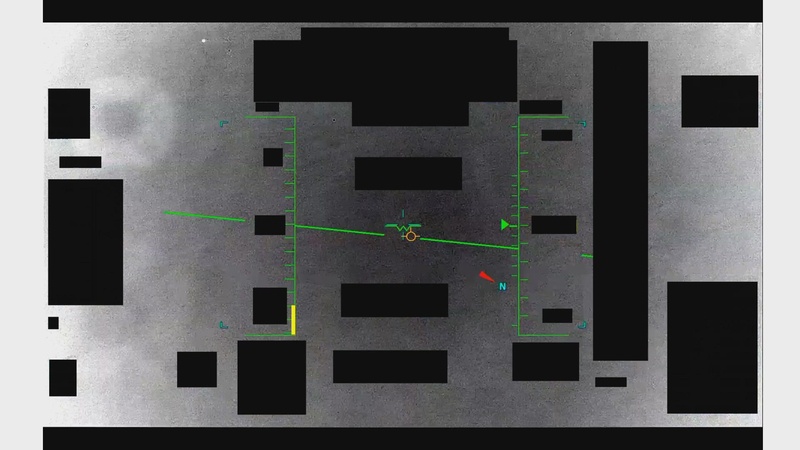
Between 2020 and 2024, U.S. thermal-imaging systems in the Middle East recorded objects that could not be identified as known aircraft. The reports are brief, dry, and unsettling for precisely that reason.
May 9, 2026·3 min read·By The Aliens editors
Share:
About this story
A
The Aliens editors
This story was put together by our editors from the original documents. Every quote, date and figure comes from the source files listed further down the page.
The conversation
Open discussion
No messages yet. Be the first to say what you think you're looking at.
In May 2020, over a U.S. area of operations in the Middle East, a thermal-imaging camera recorded a hot spot moving against a cold background. There was no explosion, no pursuit, and no public statement.
There was only a short recording, followed by a report.
Thirteen similar recordings were released as part of the Department of War’s series on unidentified anomalous phenomena. All concern incidents that remained unresolved at the time. They don’t look like science-fiction footage. Most look like a dot on a screen. But in the language of sensors, even a dot can be a problem.
What the Reports Describe
The reports span several areas of operations: Iraq, Syria, the United Arab Emirates, Greece, and other parts of the Middle East. Some involve thermal-imaging cameras on aircraft. Others appear in mission reports or debriefings of incursions into training areas, meaning incidents in which an unidentified object entered a military operating area.
No positive identification in the released documents
Why Identification Is Difficult
The challenge is not simply spotting an object. It is connecting several layers of information: sensor imagery, location, wind, speed, altitude, radar data, the movements of friendly aircraft and drones, and sometimes the activity of adversaries.
The Middle East has plenty of all of these. Sensors are dense, traffic is heavy, and the operational environment is complex. Some of the reports may ultimately turn out to involve drones, balloons, birds, or sensor artifacts. But that is precisely the point: in these documents, the identification was never completed.
What Didn’t Happen
What stands out in these reports is not only what was observed, but also what was not done. They describe no gunfire, no interception, and no capture of the object. Typically, the incident ends with documentation, a debriefing, and a referral for further review.
There is an operational logic to this. A military won’t fire on an object without positive identification, especially in a crowded, international environment. But the result is that many cases remain unresolved: not dangerous enough to open fire, not clear enough to close the file.
Why It Matters
It’s easy to dismiss short recordings. It’s just as easy to read more into them than they contain. The serious approach lies between those extremes: read the reports as military documents, not as legend or joke.
If an object enters an operating area, is observed by a military sensor, remains unidentified, and prompts no action, that is a fact worth documenting. Even if an explanation comes a year later. Even if it turns out to be entirely terrestrial.
The 2020–2024 reports are a reminder that the question of unidentified anomalous phenomena is no longer just “What did people see?” It is also “How do modern systems deal with what they can’t classify?”
Sources: DVIDS reports on unidentified anomalous phenomena from the Department of War, released May 8, 2026.