Official · Document · Department of State
Turkmenistan’s UFO Enthusiasts Became Trusted U.S. Partners
A U.S. representative described the group’s surprising reputation in a document he sent from Ashgabat.
Released to the public May 8, 20262 min read
A U.S. representative described the group’s surprising reputation in a document he sent from Ashgabat.
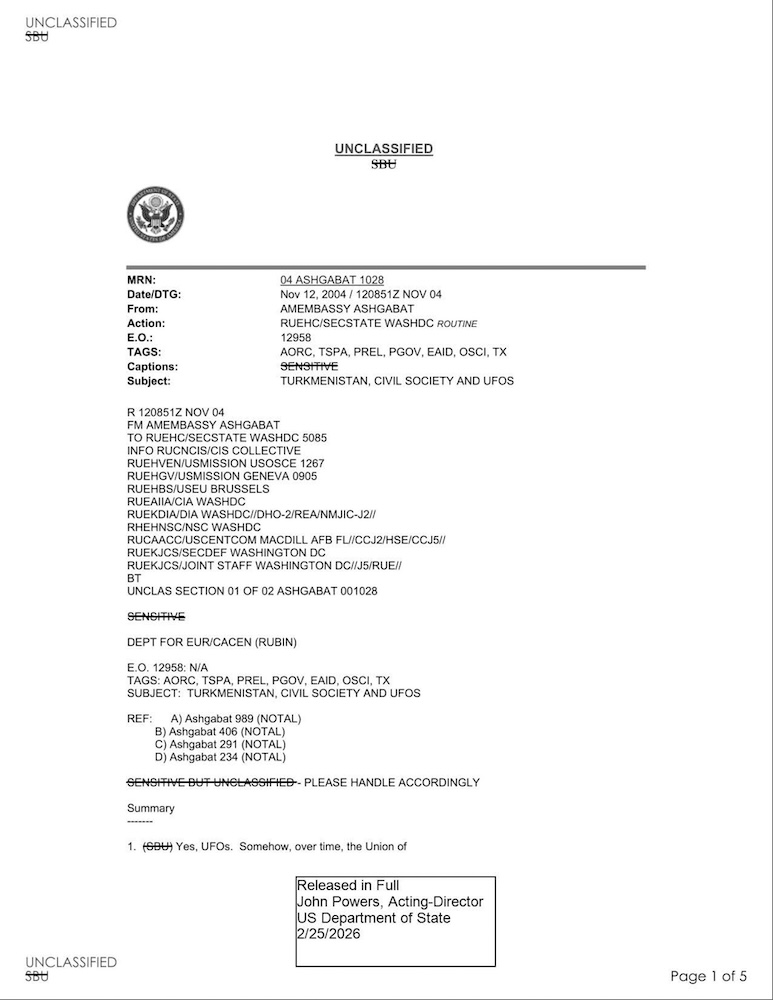
A U.S. representative described a group of UFO enthusiasts in Turkmenistan as trusted partners. He was surprised by the group’s reputation and linked it to widespread interest in UFOs across the country.
Unclassified State Department cable from U.S. Embassy Ashgabat (MRN 04 ASHGABAT 1028, dated 12 November 2004), reporting on a 5 November 2004 meeting between the DCM and USAID Director with the Board of the Union of UFOlogists (UOU) of Turkmenabat, Lebap Welayet, Turkmenistan. The cable describes how the UOU, originally founded to study extraterrestrial life, has evolved into one of the most reliable USG NGO partners in Turkmenistan — assisting with small/medium business registration, humanitarian assistance distribution under the State Department-funded CHAP program (via Counterpart International), and helping other NGOs register under the 2003 NGO law. UOU President Ovezberdy Muradov stated Turkmen military and government had consulted him about mysterious occurrences in Turkmen airspace but that there had been no confirmed UFO sightings in Turkmenistan. The cable discusses pending USAID grants ($8,532; $15,000; and a proposed $30,000 grant for newsletter printing equipment) and concludes the UOU is 'Crazy? Like a fox; and worthy of USG attention and support.' Signed JACOBSON.
DCM and USAID Director met with the Board and interested members of the Union of UFOlogists (UOU) of Turkmenabat to discuss the organization's NGO work, history, and pending USAID grants. UOU President Muradov reported the Turkmen military and government had consulted him about 'mysterious occurrences in Turkmen airspace,' though he stated there were no confirmed UFO sightings in Turkmenistan.
"Yes, UFOs."
Why it matters: Opening line of the summary paragraph; sets the bemused tone of the cable.
Page 1
"everyone is interested in UFOs."
Speaker: UOU members (paraphrased) / Ovezberdy Muradov
Why it matters: Cited as the reason the UOU has rapport with local Turkmen authorities.
Page 2
"the Turkmen military and government authorities had consulted him about mysterious occurrences in Turkmen airspace, but he said there had been no confirmed sightings of UFOs in Turkmenistan."
Speaker: Ovezberdy Muradov (reported)
Why it matters: Only direct UAP-relevant claim in the cable: Turkmen government consulted UOU on unexplained airspace occurrences.
Page 2
"help spread the ideas about the struggle for peace and human coexistence on Earth and in the Universe."
Speaker: UOU mission statement
Why it matters: Stated mission of the UFOlogist NGO.
Page 2
"In the appearances-are-deceiving world of Turkmenistan, it almost seems fitting that one of the USG's most reliable implementers is equally committed to looking for life on another planet."
Why it matters: Embassy framing of the UOU partnership.
Page 1
"Crazy? Like a fox; and worthy of USG attention and support."
Why it matters: Cable's concluding comment endorsing continued engagement with the UOU.
Page 4
Ovezberdy Muradov
President, Union of UFOlogists (UOU) of Turkmenabat · Union of UFOlogists · Page 2
Jacobson
Cable signer (Chief of Mission/Charge, Embassy Ashgabat) · U.S. Department of State · Page 4
Rubin
Department addressee, EUR/CACEN · U.S. Department of State · Page 1
Ashgabat, Turkmenistan
Page 1
Turkmenabat, Turkmenistan
Page 2
Lebap Welayet (province), Turkmenistan
Page 2
Tajikistan
Page 3
Afghanistan
Page 3
RG 59 State Department cable. Cable header: MRN 04 ASHGABAT 1028; Date/DTG Nov 12, 2004 / 1208512 NOV 04; From AMEMBASSY ASHGABAT; Action RUEHC/SECSTATE WASHDC ROUTINE; E.O. 12958 N/A; TAGS AORC, TSPA, PREL, PGOV, EAID, OSCI, TX; Caption 'SENSITIVE'; Subject 'TURKMENISTAN, CIVIL SOCIETY AND UFOS'; signed JACOBSON. Released in Full by John Powers, Acting-Director, US Department of State, 2/25/2026. Information addressees include CIA, DIA (DHO-2/REA/NMJIC-J2), NSC, USCENTCOM (CCJ2/HSE/CCJ5), SECDEF, Joint Staff (J5/RUE), USMISSION USOSCE, USMISSION GENEVA, USEU BRUSSELS, and CIS Collective. The OCR rendering shows minor garbles ('UFOiogists' for 'UFOlogists', 'srnSITl'o'E' for 'SENSITIVE', 'Sitt' as a recurring header artifact); these are OCR artifacts, not document content. Document is 5 pages, fully unclassified, no redactions. Companion to slugs 153 (00011) and 155 (00013). This is the fourth in a series of State Department UAP cables released in this batch.
An unidentified flying object. The term doesn’t mean aliens were involved.
The document doesn’t specify what the group did or how the relationship began.
A U.S. representative in Ashgabat, the capital of Turkmenistan, wrote about a local group of UFO enthusiasts. In a document he sent from the U.S. Department of State, he described them as trusted partners of the United States.
The surprising detail wasn’t a sighting in the sky, but the reputation the group had earned. The writer was struck by it, especially as independent groups were emerging in Turkmen society. Then he offered a brief explanation: Many people in the country were probably interested in UFOs.
The document was written in 2004. Its author, a U.S. State Department representative, was writing about the standing of groups in Turkmenistan and the growth of civil society there. In that context, he mentioned the UFO enthusiasts, who had already, he said, earned a positive reputation as trusted partners of the United States.
UFOs are flying objects that have not been identified. But the document doesn’t describe a mysterious object, a chase, or an encounter with aliens. The story is about a group interested in the subject and the trust the United States placed in it. That combination surprised the writer.
The writer linked the group’s reputation to widespread interest in UFOs in the country. He put it this way: Everyone in Turkmenistan, apparently, was “interested in UFOs.” In the writer’s view, the group’s area of interest was therefore neither unusual nor foreign to the people around them.
The document doesn’t explain how the group came into contact with Americans or what it actually did. Nor does it describe a specific encounter that led to the trust. Instead, it presents the group’s reputation and the writer’s explanation for it: interest in UFOs was widespread in the country.
It is unclear what the group did to earn the trust or how its relationship with the United States began. The document only suggests that its reputation was connected to widespread interest in UFOs in Turkmenistan.
For the U.S. representative, the group’s unusual hobby was what made it known. What else might a diplomatic document reveal?